AI and Smart Grids: New Opportunities for Homeowners in 2026
AI-driven smart grids are reshaping the American power system — and for homeowners with solar or battery storage, that means new ways to save money.
The U.S. electricity grid is undergoing its biggest transformation in a century. Artificial intelligence, real-time sensors, and two-way power flows are replacing the one-way, utility-controlled system our grandparents knew. For homeowners, this shift isn't just technical jargon — it's a genuine opportunity to lower bills, earn money from the grid, and gain real energy independence.
In this guide, we'll break down exactly how AI and smart grids work, why they matter for your home, and how to position yourself to benefit starting today.
What Is a Smart Grid (and Why AI Matters)?
A smart grid is an electricity network that uses digital communication, sensors, and automated controls to match supply and demand in real time. According to the U.S. Department of Energy, smart grid investments have exceeded $30 billion since 2010, with AI-driven load forecasting now deployed in all major U.S. balancing authorities (DOE Office of Electricity, 2024).
AI plays three key roles:
- Forecasting — Machine learning models predict solar output, wind generation, and household demand with 95%+ accuracy up to 24 hours ahead (NREL, 2024).
- Optimization — Algorithms decide when to charge batteries, run HVAC, and draw from the grid to minimize cost and emissions.
- Coordination — AI orchestrates thousands of distributed energy resources (DERs) — rooftop solar, home batteries, EV chargers — as a unified "virtual power plant."
The Energy Information Administration (EIA) reports that distributed solar capacity reached 48 GW in the U.S. by the end of 2024, with nearly 5 million homes participating — a perfect foundation for AI-coordinated grid services.
New Opportunity #1: Time-of-Use and Real-Time Pricing
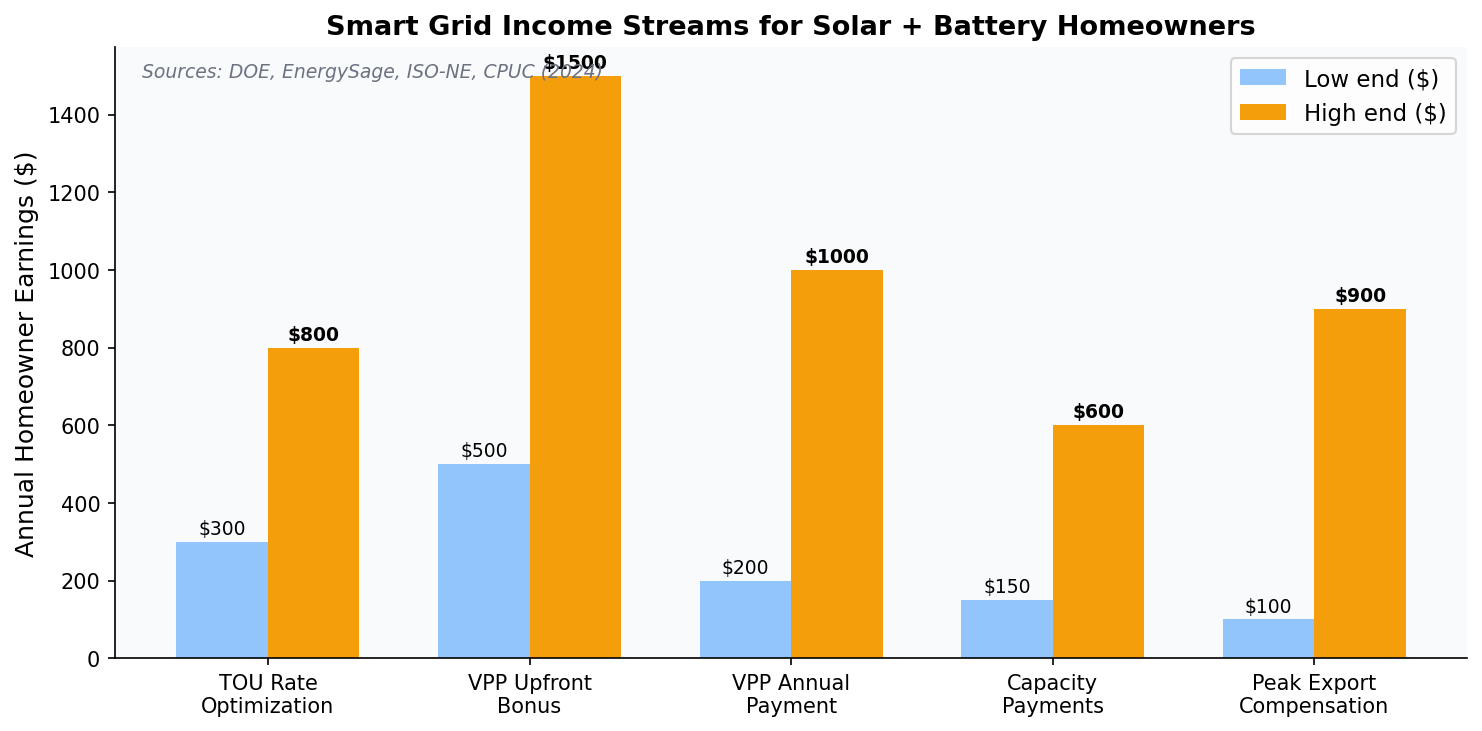
Utilities in 38 states now offer time-of-use (TOU) or real-time pricing plans, where electricity costs swing by 3–5x between off-peak and peak hours (Lawrence Berkeley Lab, 2024). AI-enabled smart thermostats, EV chargers, and home batteries automatically shift usage to cheap hours — saving typical households $300–$800 per year without any lifestyle change.
For solar homeowners, the math gets even better. A battery that charges from rooftop panels during the day and discharges during peak evening hours can effectively earn $0.40–$0.60 per kWh in avoided costs in states like California, Massachusetts, and New York.
New Opportunity #2: Virtual Power Plants (VPPs)
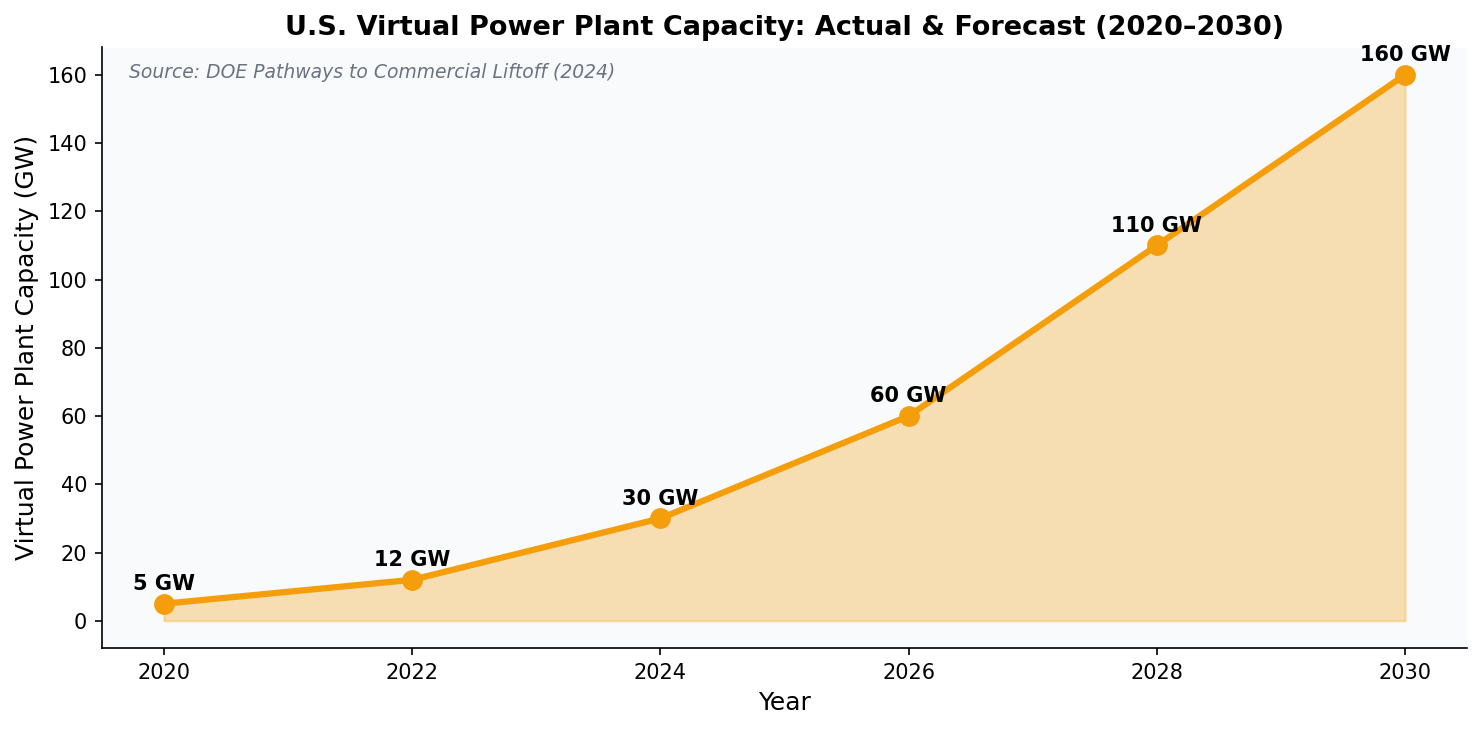
A Virtual Power Plant is a network of distributed home batteries that a utility or aggregator can dispatch together, replacing the role of a traditional gas "peaker" plant. The Department of Energy estimates VPPs could deliver 80–160 GW of capacity by 2030, saving ratepayers $10 billion annually (DOE Pathways to Commercial Liftoff, 2024).
Homeowners who enroll typically earn:
- $500–$1,500 upfront signing bonuses
- $200–$1,000 per year in ongoing participation payments
- Guaranteed backup power during outages
Programs like ConnectedSolutions (New England), Tesla's VPP (California, Texas), and Sunrun's Community Power Plants are already paying homeowners. EnergySage reports that over 100,000 U.S. households participated in VPPs in 2024, up from fewer than 20,000 in 2020.
New Opportunity #3: Smarter Incentives, Better Matching
One of the biggest challenges for homeowners has always been finding every incentive they qualify for. AI-driven tools now cross-reference federal, state, utility, and municipal programs in seconds.
Important update: The federal 30% Residential Clean Energy Credit (ITC) for purchased solar systems expired at the end of 2025. However, third-party-owned systems — solar leases and Power Purchase Agreements (PPAs) — still qualify under the commercial ITC through 2032 (Section 48E, IRS guidance 2025). This means leasing remains a viable path to upfront savings for many households.
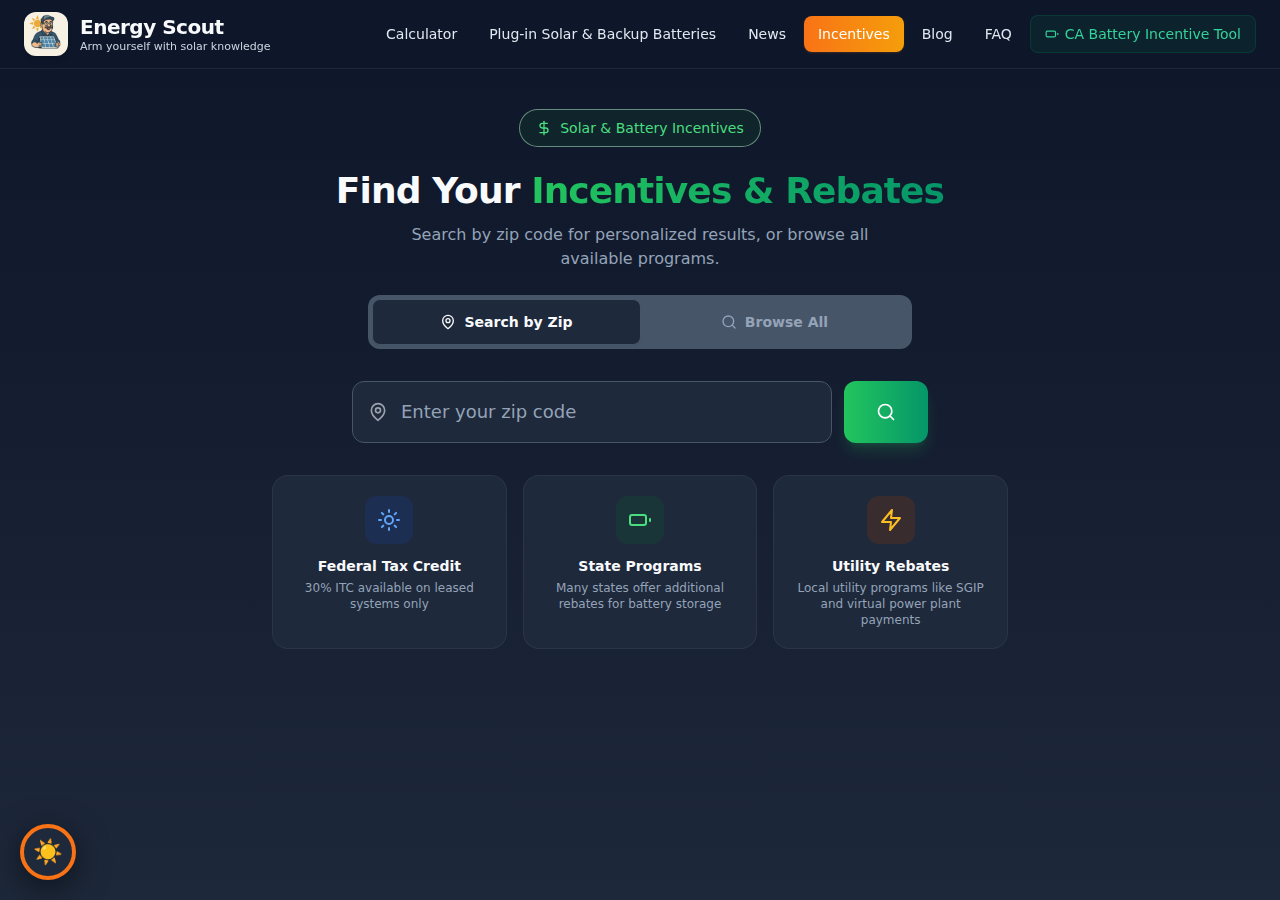
Beyond the federal tier, there are hundreds of active state and utility incentives. EnergyScout's zipcode-based incentives search pulls live data from NREL's DSIRE database and state energy offices to show you exactly what you qualify for.
New Opportunity #4: Grid Services Income Streams
As smart grids mature, homeowners can monetize capabilities utilities desperately need:
Frequency Regulation
Home batteries can respond to grid frequency signals in milliseconds, a service utilities pay $25–$60 per MW-hour for. Aggregators bundle thousands of homes to bid into wholesale markets.
Capacity Payments
In PJM and ISO-NE territories, homeowners can earn $50–$120 per kW-year just for being available to reduce load during grid emergencies — typically 5–10 events per summer.
Export Compensation
Under emerging "distribution-level markets" (now live in California under NEM 3.0 and piloting in New York), exporting solar at peak times can pay $1.00+ per kWh during grid stress events (CPUC Decision 22-12-056).
New Opportunity #5: Predictive Home Energy Management
AI-powered home energy management systems (HEMS) analyze weather forecasts, your historical usage, utility prices, and solar output to automatically optimize every device in your home.
Real-world results from a 2024 NREL pilot of 1,200 homes showed:
- 18% average reduction in electricity bills
- 27% reduction in peak-hour grid draw
- $0 added cost when bundled with a new solar + battery installation
What Should Homeowners Do Right Now?
You don't need to wait for some future grid to start benefiting. Three concrete steps:
1. Get a Personalized Assessment
Start with EnergyScout's free solar assessment tool. It uses NREL's PVWatts model, your utility rate, and local irradiance data to project real 25-year savings based on your roof, usage, and local incentives.
2. Map Every Incentive You Qualify For
Even with the residential ITC expired, state-level incentives in places like New York (NY-Sun), Massachusetts (SMART), Illinois (Illinois Shines), and California (SGIP for batteries) can cover 20–50% of system costs. Use the incentives lookup to see what's available in your ZIP.
3. Compare Vetted Local Installers
VPP eligibility, smart-inverter compatibility, and battery brand all depend on your installer. EnergyScout's installer directory shows verified local companies, their specializations, and which VPPs they partner with.

The Bottom Line
AI and smart grids aren't abstract future tech — they're here, they're growing fast, and they're tilting the economics decisively in favor of homeowners who own (or lease) solar and storage. According to SEIA's 2024 Solar Market Insight report, homes with solar + battery + smart controls now generate 2–3x more lifetime value than solar-only systems from a decade ago.
The window to position yourself as a participant — not just a bill payer — in this new grid is open right now. Start with a free, no-pressure assessment and see what the numbers look like for your home.
More Articles
Do Solar Panels Work During a Power Outage?
Most homeowners assume solar panels keep the lights on when the grid goes down. The actual answer surprises people — and the fix is simpler than you think.
Read article Battery StorageChile Hit 75% Solar in March. Here's What U.S. Homeowners Should Take From It
Chile's grid produced 29% of its electricity from solar in March, with peaks at 75%. The bottleneck wasn't generation — it was storage and transmission. Here's the homeowner takeaway.
Read article