Chile Hit 75% Solar in March. Here's What U.S. Homeowners Should Take From It
Chile's grid produced 29% of its electricity from solar in March, with peaks at 75%. The bottleneck wasn't generation — it was storage and transmission. Here's the homeowner takeaway.
In March 2026, solar PV produced 29% of Chile's electricity, with instantaneous peaks reaching 75% of national demand, according to the latest bulletin from Generadoras de Chile (the country's power generators association). At the same time, more than 2.5 GW of battery storage is now operating alongside Chilean solar plants, with another 6.3 GW under construction. (PV Magazine, May 2026)
That's a remarkable number. But the more interesting part of the bulletin isn't the 75% peak — it's the fact that Chile is also dealing with rising solar curtailment (electricity that gets generated but never delivered) because the transmission grid in the south can't move all that power to where it's needed.
If that sounds abstract, it shouldn't. The same physics is shaping decisions for homeowners in California, Arizona, Texas, and Hawaii right now. Let's walk through what's happening in Chile, why it matters, and what U.S. homeowners can take from it when sizing their own solar and battery systems.
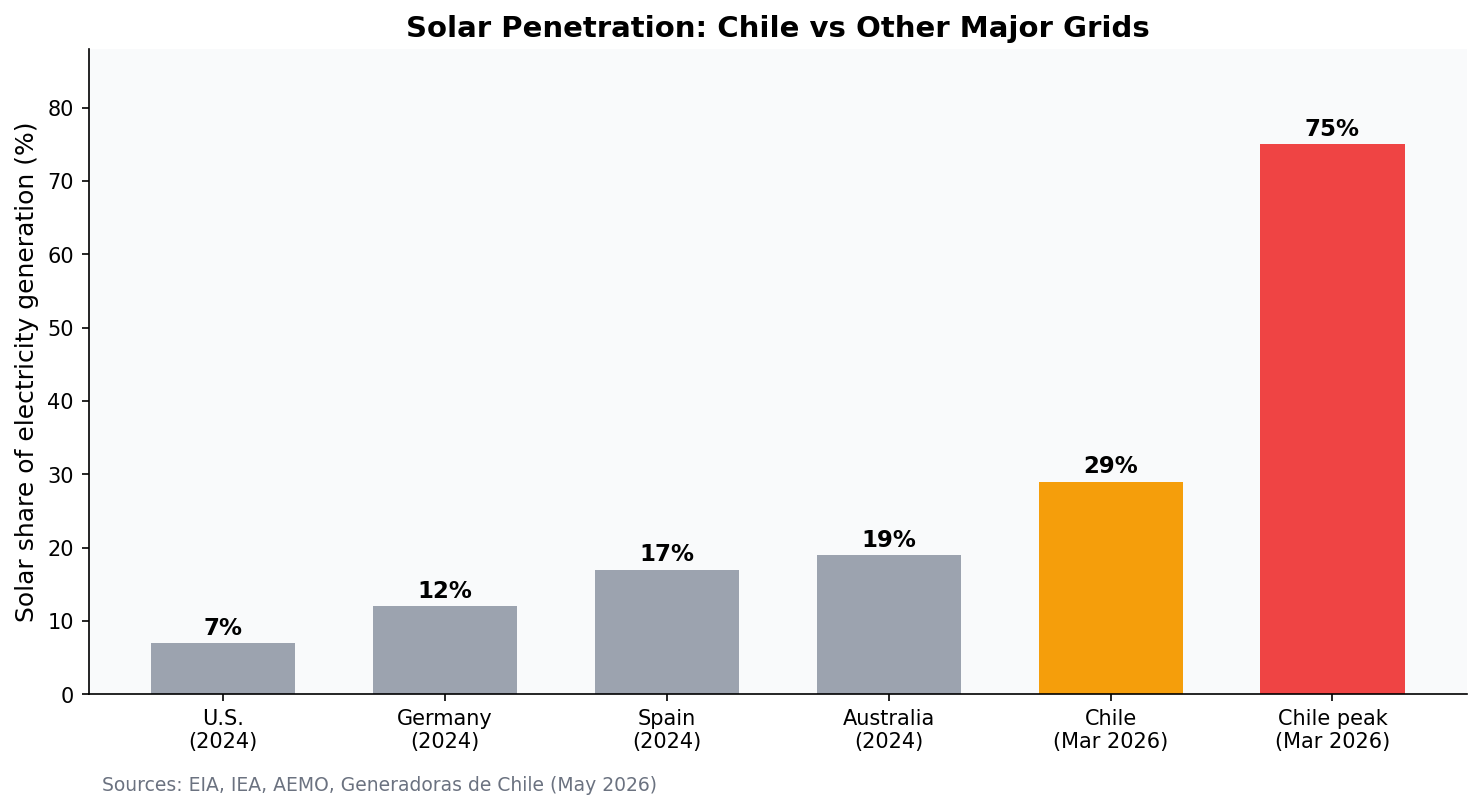
What 29% solar penetration actually looks like
Chile's electricity mix has shifted faster than almost any other country's. In 2015, solar was a rounding error. By March 2026, it's nearly a third of the entire grid's output for the month, and during sunny midday hours it briefly carried three-quarters of national load.
For comparison, the U.S. Energy Information Administration reported that solar (utility + small-scale combined) supplied roughly 7% of U.S. electricity in 2024 and is projected to climb past 9% in 2025. California, the leader, regularly hits 50–70% solar share on spring afternoons, per California ISO data.
So Chile isn't an alien outlier. It's a preview of where high-solar U.S. regions are headed — and the problems Chile is solving are the same ones already showing up in U.S. utility tariffs.
The curtailment problem in plain English
When a grid generates more solar than it can use or move, operators have to throw some of it away. That's curtailment. In Chile's southern regions, the high-voltage transmission lines that connect solar farms to demand centers are full during the middle of the day. Generators get told to dial down output even though the sun is free.
The fix is two-pronged:
- Build batteries at or near the solar plants to soak up midday energy and discharge it in the evening peak.
- Build more transmission, which takes years and faces the usual permitting fights.
Chile is moving fast on the first one — that 6.3 GW of battery storage under construction is one of the largest pipelines in the world relative to grid size. The U.S. is moving on both, but unevenly. Lawrence Berkeley National Lab's 2024 Queued Up report tracked over 1,500 GW of generation and storage waiting in U.S. interconnection queues, with batteries now the single largest category. (Berkeley Lab, 2024)
Why this matters for your roof
Here's the connection back to your home: when grids hit high solar penetration, the value of exporting midday solar to the grid drops. Utilities respond by changing the rules. California's NEM 3.0 (now "Net Billing Tariff") cut export compensation for new solar customers by roughly 75% compared to the old NEM 2.0 program, according to the California Public Utilities Commission. (CPUC)
That single rule change moved solar economics in California from "sell-everything-back" to "store-and-self-consume." The math now favors a battery in almost every NEM 3.0 install. EnergySage's 2024 marketplace data shows the share of California solar quotes that include a battery jumped from under 25% in 2022 to over 70% in 2024. (EnergySage Marketplace Report)
If you live in a high-solar state — California, Arizona, Hawaii, parts of Texas — assume your utility's export rate will get less generous over time, not more. Sizing for self-consumption (with a battery) is the more durable bet.

Run the math on a typical U.S. system
Let's put numbers to it. Take a 7 kW rooftop system in a sunny U.S. metro:
- Annual production: ~10,500 kWh (NREL PVWatts, average siting)
- Daytime self-consumption (no battery): typically 30–40%
- Excess exported to grid: ~6,300 kWh/year
Under a generous net-metering tariff at $0.30/kWh retail rate, those exports are worth ~$1,890/year. Under a low export rate of $0.05/kWh — closer to where new California solar customers land — the same exports are worth only ~$315/year. That's a $1,575/year swing tied entirely to one policy variable.
Add a 10 kWh battery and the picture changes. You can shift another ~3,000–4,000 kWh/year from low-value export to high-value self-consumption (or peak-rate offset). At a $0.40/kWh peak rate, that's roughly $1,200–$1,600/year in additional value the battery captures — value that just disappears without one.
The National Renewable Energy Laboratory's 2024 cost benchmark puts an installed residential solar + battery system at roughly $3.50–$4.50/W for solar plus $1,000–$1,300/kWh for storage, before any state or utility incentives.
What about the federal tax credit?
This is where the news has shifted in 2026. The federal 30% Investment Tax Credit (ITC) for purchased residential systems expired in 2026. If you buy a system outright today, you can no longer claim the 30% federal credit on your taxes.
Two things still apply:
- Leases and PPAs can still capture the commercial ITC at the project-owner level, which gets passed through as lower monthly payments. If a lease quote looks priced as if the credit is still in play, that's why.
- State and utility incentives — California's SGIP battery rebate, New York's NY-Sun, Massachusetts SMART, Illinois Shines, and dozens of utility rebates — are unaffected by the federal sunset. Many are in the $200–$1,000/kWh range for batteries, often the most valuable part of the project economics now.
You can check what's available in your ZIP code with our incentive search tool.

The Chile lesson, distilled
Three takeaways for U.S. homeowners thinking about solar in 2026:
1. The grid is changing under your feet.
Solar is cheap and getting cheaper. Lazard's 2024 LCOE study put unsubsidized utility solar at $29–$92/MWh versus $69–$168/MWh for new gas. (Lazard LCOE+ 2024) That price gap drives more solar onto the grid, which drives more curtailment, which drives utilities to reprice exports lower. Plan accordingly.
2. Storage is no longer optional in high-solar states.
If your utility has already moved to a low export rate or a time-of-use peak, a battery isn't a luxury — it's how you capture the value the export rate no longer pays you for.
3. The right size depends on your numbers, not averages.
Your roof, your usage, your local rates, and your local incentives drive the answer. A 5 kW + 10 kWh system might pay back in 7 years for one homeowner and 14 for another a few miles away on a different rate plan.
Check your own numbers
If you want to see what a system would actually look like on your house — production, payback, local incentives, and what installers in your area charge — our free assessment tool uses NREL production data and your utility's current rate to run the math. You can also browse vetted local installers on our providers page.
Chile's grid is showing the rest of the world what high-solar penetration looks like in practice — and it's a useful reminder that the most valuable thing you can do as a homeowner isn't to chase headlines. It's to know your own numbers before anyone tries to sell you a system.
More Articles
Do Solar Panels Work During a Power Outage?
Most homeowners assume solar panels keep the lights on when the grid goes down. The actual answer surprises people — and the fix is simpler than you think.
Read article Solar IncentivesBolivia's New Renewables Law: What It Means for Homeowners
Bolivia's Ministry of Hydrocarbons and Energy unveiled a new draft law to open electricity and renewables markets to private investment. We unpack what's in the bill, why global markets are watching, and what US homeowners can learn from the policy shift.
Read article