Chinese Solar Manufacturers Lose Billions: What It Means for You
Longi and Trina Solar — two of the world's largest module makers — both posted big 2025 losses. The flip side for homeowners: panel prices are at historic lows. Here's how to translate that into your installed quote.
On May 1, 2026, PV Magazine reported that Longi posted reduced — but still substantial — 2025 losses, while Trina Solar's full-year losses deepened with continued margin pressure across its core module business (PV Magazine, May 2026). Two of the world's three largest panel manufacturers — bleeding cash for a second straight year.
For homeowners, this is not bad news. It's the clearest signal yet that solar module prices are sitting near historic lows, and that the savings should be showing up in your installed quote. Here's the math, the context, and how to make sure you're not overpaying.
The numbers behind the losses
The Chinese PV oversupply story is now well documented. According to BloombergNEF and the International Energy Agency, global module manufacturing capacity hit roughly 1,100 GW in 2024 against annual demand closer to 600 GW (IEA Renewables 2024). That's nearly 2x more capacity than the world is buying.
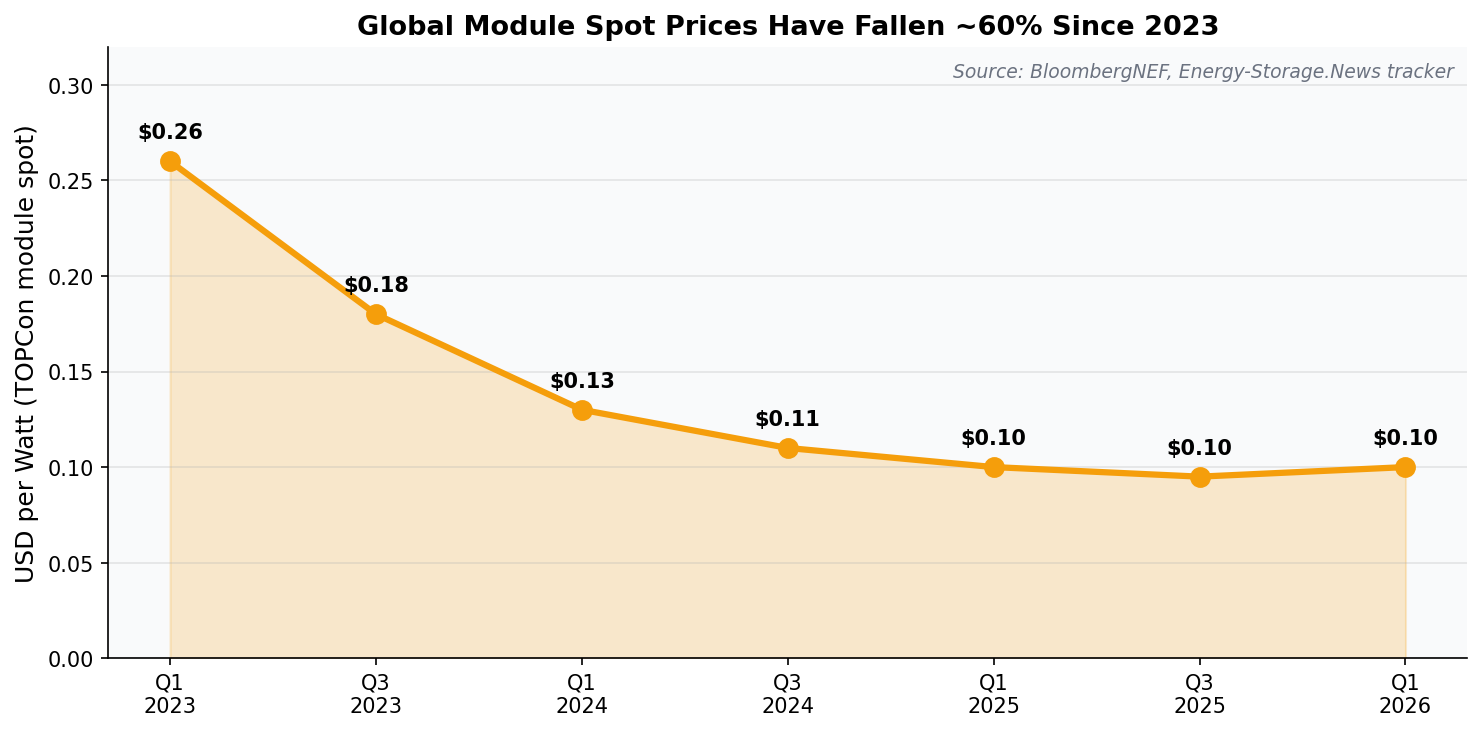
The result: spot prices for mainstream TOPCon modules fell to roughly $0.09–$0.11 per watt in early 2026, down from $0.26/W in early 2023 (Energy-Storage.News tracker data). That is a ~60% drop in 36 months.
Longi and Trina are caught in that squeeze. Per the PV Magazine brief:
- Longi's 2025 revenue and net loss both declined year-on-year — meaning the bleeding is slowing, but the company is still losing money on every shipment.
- Trina Solar's 2025 net loss deepened versus 2024, with management citing module-segment margin pressure as the main driver.
What this means for U.S. homeowners
The U.S. residential solar market does not pay Chinese spot prices directly. Section 201 tariffs, the Uyghur Forced Labor Prevention Act, and Section 301 duties keep imported modules above global lows. But cheap global modules pull everything down: U.S.-assembled panels, distributor inventory, and ultimately what shows up on your roof.
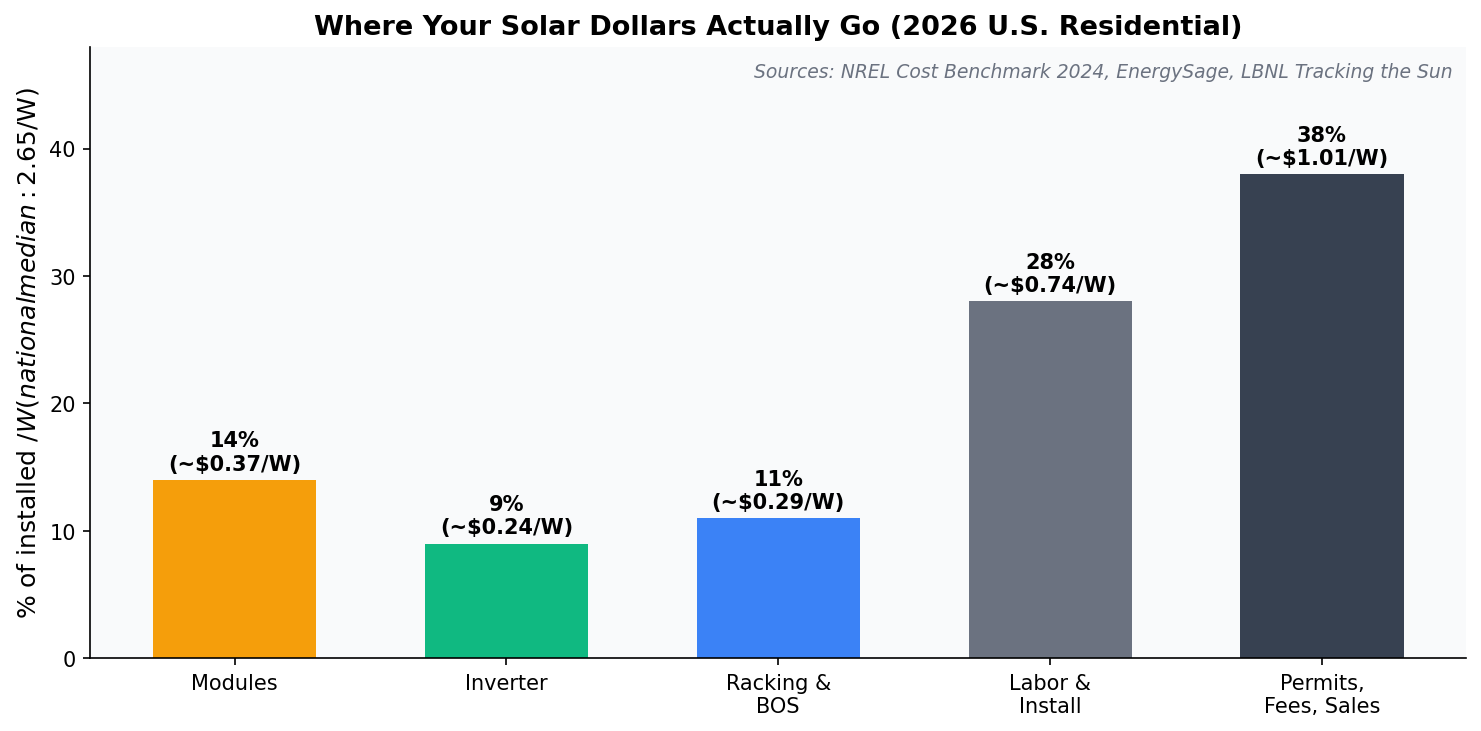
EnergySage's H2 2024 Solar Marketplace Report pegged the average U.S. residential cash price at $2.50–$2.80 per watt installed, with module costs accounting for roughly 12–15% of that total (EnergySage Marketplace Report). The Lawrence Berkeley National Laboratory's Tracking the Sun series confirms a similar national median in its 2024 edition (Berkeley Lab Tracking the Sun 2024).
So: even though modules are 60% cheaper at the factory gate, your installed quote has only fallen ~10–15% over the same period. The rest of the cost stack — labor, racking, inverters, permits, sales — has barely moved.
The math on a 7 kW system
Let's price a typical 7 kW system at the 2026 national median of $2.65/W installed:
- System size: 7,000 W
- Installed cost: 7,000 × $2.65 = $18,550
- Estimated module portion (~14%): ~$2,600
- If modules drop another 10% in 2026 and your installer passes it through: roughly $260 in savings on the same system.
Translation: panel-price collapse alone won't cut your bill in half. But it does mean today's quotes should already reflect the cheapest module pricing in solar's history. If your bid comes in above $3.00/W for a straightforward roof, ask why.
The federal incentive picture changed in 2026
One critical update before you price anything: the federal 30% Residential Clean Energy Credit (ITC) expired at the end of 2025 for purchased systems under the One Big Beautiful Bill Act passed in 2025 (IRS Residential Clean Energy Credit guidance). If you buy a system in cash or with a loan in 2026, you do not get the 30% federal credit on the homeowner's tax return.
Leases and Power Purchase Agreements (PPAs) still qualify under the commercial ITC (Section 48), because the third-party owner — not you — claims the credit and (in theory) passes the savings through in the monthly rate. Whether they actually pass it through is something to verify line-by-line on the proposal.
That means the 2026 buying decision has changed:
- Cash or loan purchase: No 30% federal credit. State and utility incentives still apply.
- Lease or PPA: Third-party still claims 30% ITC; ask the installer to show how it lowers your rate.
State-level incentives become more important than ever. New York's NY-Sun, Massachusetts SMART, Illinois Shines, California's SGIP for batteries, and dozens of utility rebates are still active. EnergyScout's incentive search shows what's available in your ZIP.
Are cheap Chinese-tied panels safe to buy?
Reasonable question. A few things to know:
- Most U.S. residential modules are not direct Chinese imports anyway. The big residential brands sold here — Qcells (made in Georgia and Korea), Silfab (Washington and Toronto), REC (Singapore), Mission Solar (Texas) — are largely outside Longi/Trina's direct shipments. Trina and Longi sell more into U.S. utility-scale.
- Bankruptcy risk affects warranty value, not panel performance. A 25-year product warranty is worth what the company backing it is worth. Buy from a manufacturer with a balance sheet that can survive a downturn.
- Tier 1 doesn't mean what people think. BloombergNEF's Tier 1 list is a bankability score for utility projects, not a quality grade. Check independent test results from PVEL's annual Module Reliability Scorecard (PVEL 2024 Scorecard).
What to do with this information
If you're getting solar quotes in 2026, here's a five-minute checklist that uses the current market to your advantage:
1. Anchor your price expectations
Aim for $2.40–$2.85 per watt on a straightforward roof with a major brand panel and string inverter. Complex roofs, microinverters, or integrated battery installs run higher. The U.S. Department of Energy's National Renewable Energy Laboratory benchmarks these costs annually (NREL U.S. Solar Photovoltaic System Cost Benchmark).
2. Get 3+ quotes — and compare line items, not just bottom lines
EnergySage and NREL data both show that homeowners who get three or more quotes pay roughly 10% less on average than single-quote shoppers. The gap between the cheapest and priciest quote on the same roof is often $5,000–$10,000.
3. Decide cash/loan vs. lease/PPA after running the post-ITC math
With the federal credit gone for purchased systems, leases and PPAs are more competitive than they were in 2024. Run both: a 25-year cash NPV vs. a 25-year PPA escalator. Sometimes ownership still wins because of state incentives and avoided escalator clauses; sometimes the PPA wins because the third-party ITC pass-through tips the math.
4. Verify panel and inverter financial health
If the bid uses a panel brand you've never heard of, search the manufacturer's most recent earnings release. A 25-year warranty from a company with two consecutive years of nine-figure losses deserves a discount.
5. Use independent tools, not just the salesperson's calculator
Installer proposals tend to be optimistic on production and conservative on local rate inflation. EnergyScout's free assessment uses NREL's PVWatts model and live utility data to give you an independent baseline before you sign anything.
The bigger picture
Longi and Trina's losses aren't a sign that solar is in trouble. They are a sign that solar manufacturing got too good at scaling. The IEA projects global solar deployment will hit a record 660 GW in 2026 — even as manufacturers post losses. That's the cost curve doing exactly what it's supposed to: deflate prices for buyers and squeeze margins for producers.
For a homeowner pricing a 25-year asset, that's a tailwind. The federal credit going away for purchases is real, and it changes the financing calculus. But module prices, financing competition, and state incentives are all moving in your favor at the same time. Run the numbers carefully, get multiple bids, and make the math work for your roof — not the other way around.
Run your own numbers
The fastest way to see if solar makes sense for your home in 2026 is to run a real estimate using your address and your utility rate. EnergyScout's free assessment pulls NREL production data and live incentive availability so you can compare it against any installer quote you receive — at energyscout.org/assessment. No phone calls, no sales pressure, just the math.
More Articles
Do Solar Panels Work During a Power Outage?
Most homeowners assume solar panels keep the lights on when the grid goes down. The actual answer surprises people — and the fix is simpler than you think.
Read article Battery StorageChile Hit 75% Solar in March. Here's What U.S. Homeowners Should Take From It
Chile's grid produced 29% of its electricity from solar in March, with peaks at 75%. The bottleneck wasn't generation — it was storage and transmission. Here's the homeowner takeaway.
Read article