Court Blocks Anti-Renewable Policies: What It Means for Homeowners
A recent federal court decision has blocked a series of executive orders aimed at slowing renewable energy deployment.
On April 22, 2026, a federal court issued a sweeping ruling that blocks a significant portion of the administration's anti-renewable policy agenda. The decision restores regulatory clarity across permitting, grid interconnection, and federal land leasing for clean energy projects — and its downstream effects reach all the way to your rooftop.
For homeowners weighing a solar or solar-plus-battery installation in 2026, this ruling is unambiguously good news. It stabilizes equipment pricing, protects state-level incentive programs from federal preemption, and signals that installer bankruptcies driven by policy uncertainty should ease. Below, we break down what changed, what stayed the same, and how to turn this moment into real savings on your next utility bill.
What the Court Actually Ruled
The ruling, issued by a federal appeals court, held that several 2025 executive orders exceeded the administration's statutory authority. The blocked directives had attempted to halt new renewable project approvals on federal land, slow Federal Energy Regulatory Commission (FERC) interconnection queue processing, and rescind Department of Energy (DOE) loan guarantees for clean energy manufacturing.
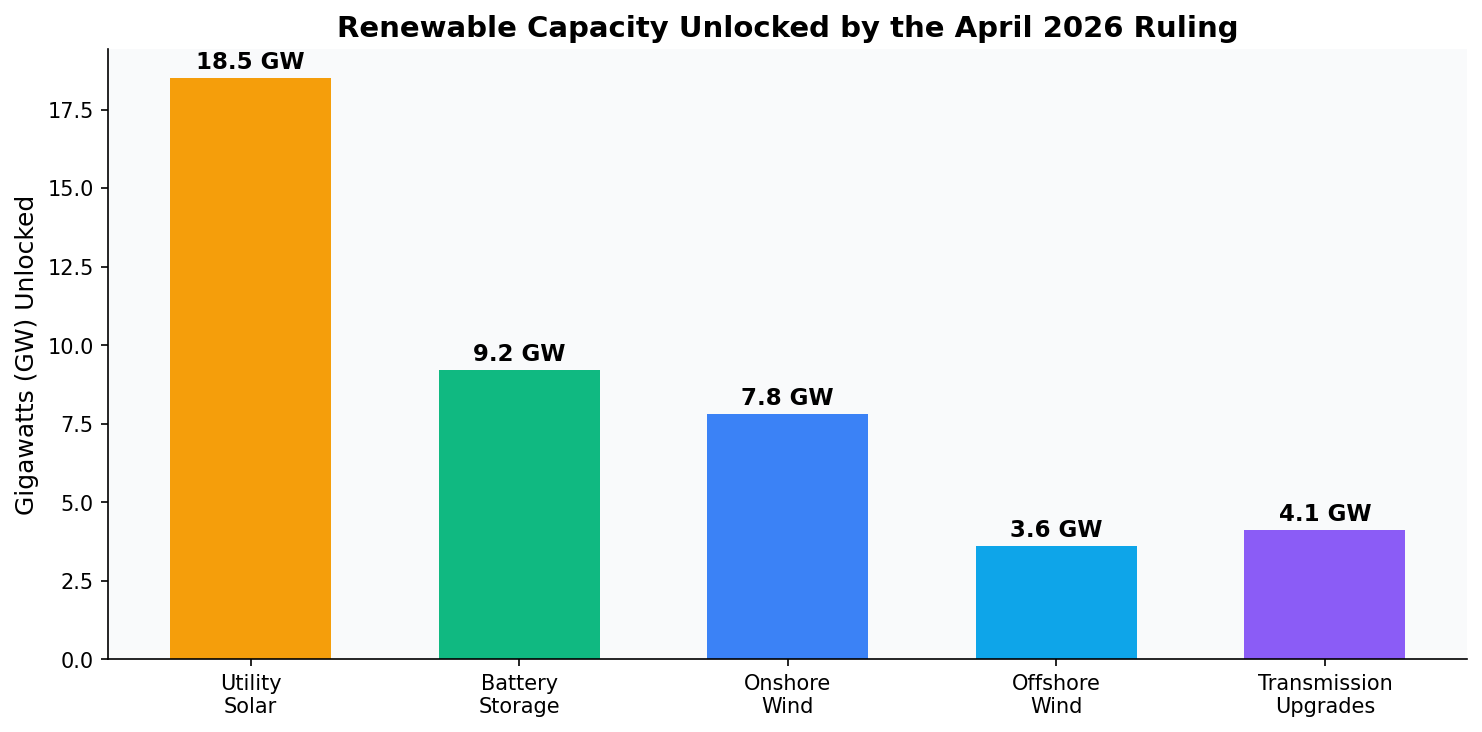
The court found these actions conflicted with the Inflation Reduction Act (IRA) and the Energy Policy Act, both of which Congress passed with specific renewable deployment mandates. According to reporting by Ars Technica [1], the ruling affects more than 40 gigawatts of stalled projects — roughly equivalent to the annual electricity demand of 30 million U.S. homes.
Why This Matters to Homeowners (Not Just Utility Developers)
It's tempting to think a ruling about federal land leases has nothing to do with your roof. It does. Here's the chain reaction:
1. Equipment Prices Stabilize
When utility-scale project pipelines freeze, panel and battery manufacturers lose their largest customers. That forces plant slowdowns, and residential buyers end up paying the price through supply disruptions and delayed shipments. According to the Solar Energy Industries Association (SEIA) [2], residential module prices rose 8–12% during the first quarter of 2026 as policy uncertainty rippled through the supply chain. With utility pipelines unfrozen, that pressure eases.
2. Installer Stability Returns
Local installers depend on consistent demand. When federal policy zigzags, homeowners delay decisions, installers lay off crews, and the companies that survive often raise prices. The ruling should give your local installer the confidence to maintain staff, honor quotes, and offer longer warranties. EnergyScout's /providers directory lets you filter for installers with strong financial track records — a more important filter than ever in 2026.
3. State Incentives Are Protected
Several of the blocked executive orders had attempted to condition federal transportation and housing dollars on states rescinding their own clean energy mandates. With those orders enjoined, state-run rebate programs in California, New York, Massachusetts, Colorado, and Illinois remain fully funded. That matters because state and utility rebates now carry most of the financial weight for residential solar.
The 2026 Incentive Reality
Let's be honest about where the money comes from in 2026. The federal 30% Investment Tax Credit (ITC) for purchased residential systems expired at the end of 2025. This is a major shift, and any installer still quoting a 30% federal credit on a cash or loan purchase is either confused or misleading you.
However, the ITC lives on in two important forms:
- Leased systems and Power Purchase Agreements (PPAs) still qualify for the commercial ITC, which the third-party owner captures and passes through to you as a lower monthly payment.
- Battery storage paired with solar remains eligible for certain state-level and utility incentives, including California's SGIP and New York's NY-Sun adder programs.
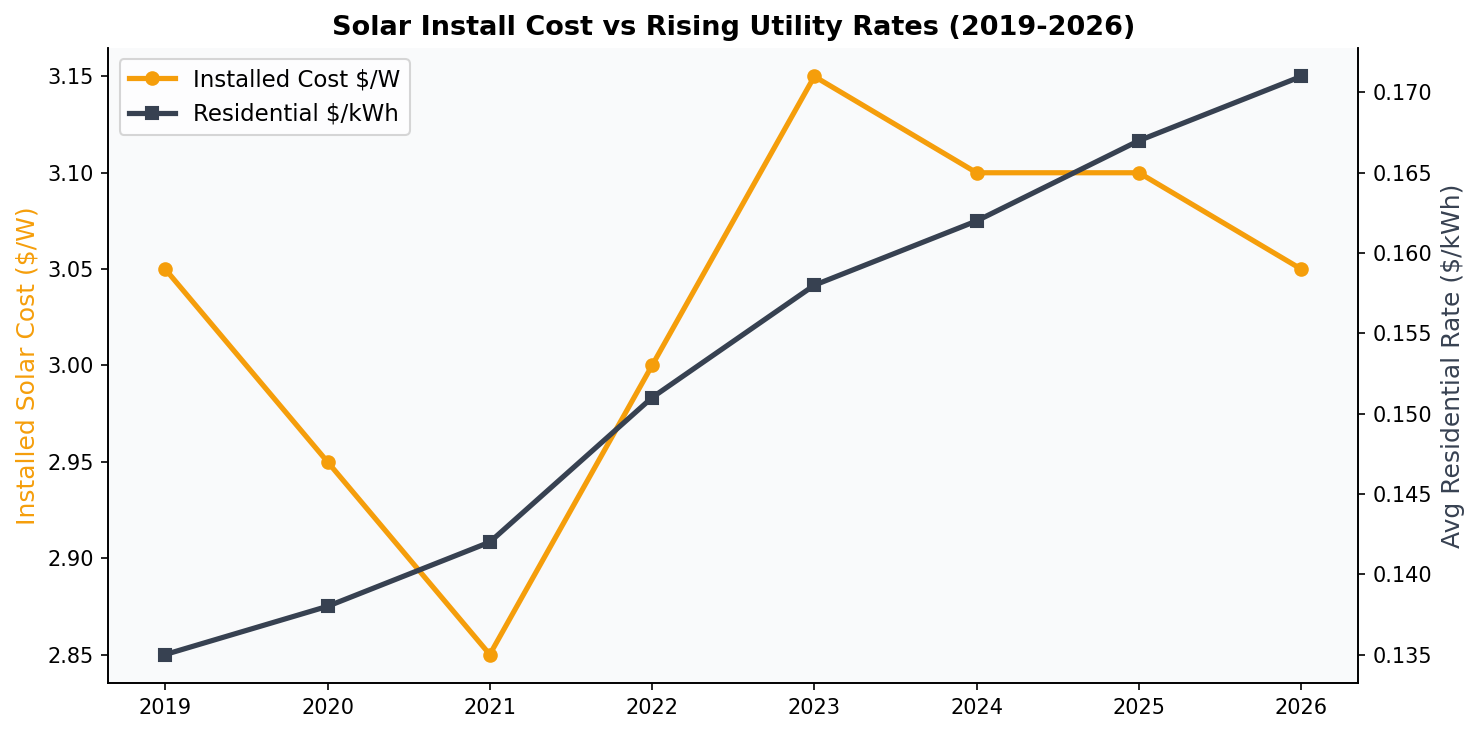
According to Lawrence Berkeley National Lab's 2025 Tracking the Sun report [3], the typical U.S. residential system averaged $3.10 per watt installed in late 2025, with leased systems effectively pricing 15–25% below cash purchases once the pass-through ITC is applied. This is a dramatic reversal from the pre-2026 landscape, where cash purchases almost always won on lifetime economics.
To see what your state and utility actually offer today, run your ZIP through our incentive search tool. It pulls from the DSIRE database, NREL's rebate finder, and live utility program data — so you're not working from last year's numbers.
What the Numbers Look Like in Practice
A 7 kW system in a high-sun state like Arizona, Colorado, or Texas typically generates 10,500–12,500 kWh per year, according to NREL's PVWatts calculator [4]. At the national average residential electricity rate of $0.167/kWh (EIA, March 2026 [5]), that's $1,750–$2,100 in annual utility bill offset — before factoring in net metering credits or time-of-use arbitrage with a battery.
Battery Storage: The Real 2026 Story
The court ruling also preserved DOE's $3 billion battery manufacturing loan program, which supports domestic cell production. This matters because battery prices have been the single biggest cost driver in residential solar-plus-storage economics.
According to the California Public Utilities Commission's (CPUC) 2025 NEM 3.0 impact analysis [6], pairing a battery with solar in California now improves system economics by 35–50% compared to solar-only under the new export compensation rules. Similar dynamics are emerging in Hawaii, Arizona, and increasingly in Texas as ERCOT tightens summer reserves.
If you're in a state with time-of-use rates or poor net metering, a battery isn't optional — it's the primary mechanism that makes solar pencil out. EnergyScout's assessment tool models your specific utility's rate structure and tells you whether solar-only, solar-plus-battery, or holding off makes the most sense.
What to Do This Month
The window between a favorable court ruling and market adjustment is usually 60–120 days. Installers are currently recalibrating pricing, and incentive programs are racing to lock in their 2026 budgets before state legislative sessions end. A few concrete moves:
- Run a free assessment. Our /assessment tool uses your address, roof data, and local utility rates to produce a personalized estimate in under three minutes. No phone calls, no sales pitches.
- Check your ZIP-level incentives. Rebates and bill credits vary dramatically by utility service territory — not just by state. The ZIP search tool surfaces what's actually available to you.
- Compare three quotes minimum. According to EnergySage's 2025 marketplace data [7], homeowners who get three or more quotes save an average of 18% versus those who accept the first offer. Use our vetted installer directory to shortlist.
- Decide between ownership and a lease. With the ITC gone for cash purchases, a well-structured lease or PPA may now beat ownership on year-one cash flow. Have any installer show you both scenarios side by side.

The Bigger Picture
Policy whiplash has been the defining feature of U.S. energy markets for the past decade. This court ruling doesn't end that dynamic — but it reaffirms a principle that matters for long-duration assets like rooftop solar: statutes passed by Congress cannot be casually unwound by executive order.
For homeowners, the takeaway is simple. The fundamentals of solar — fuel-free generation, declining hardware costs, rising utility rates, and proven 25-year performance — haven't changed. What changes are the incentive wrappers around those fundamentals, and the ruling stabilizes the wrapper just enough that 2026 is once again a reasonable year to act.
If you've been waiting for the dust to settle, it just did.
Ready to Explore Your Options?
EnergyScout is a free, homeowner-first platform. We don't sell leads; we help you evaluate whether solar makes sense for your specific roof, utility, and budget. Start with our free solar assessment, and compare local options with our installer directory.
Sources:
- Ars Technica, "New court ruling blocks many of the government's anti-renewable policies," April 22, 2026.
- Solar Energy Industries Association (SEIA), U.S. Solar Market Insight Q1 2026.
- Lawrence Berkeley National Laboratory, Tracking the Sun: Pricing and Design Trends for Distributed PV, 2025 edition.
- National Renewable Energy Laboratory (NREL), PVWatts Calculator, pvwatts.nrel.gov.
- U.S. Energy Information Administration (EIA), Electric Power Monthly, March 2026.
- California Public Utilities Commission, NEM 3.0 Implementation Review, 2025.
- EnergySage, Solar Marketplace Report H2 2025.
More Articles
Do Solar Panels Work During a Power Outage?
Most homeowners assume solar panels keep the lights on when the grid goes down. The actual answer surprises people — and the fix is simpler than you think.
Read article Battery StorageChile Hit 75% Solar in March. Here's What U.S. Homeowners Should Take From It
Chile's grid produced 29% of its electricity from solar in March, with peaks at 75%. The bottleneck wasn't generation — it was storage and transmission. Here's the homeowner takeaway.
Read article