Why a Dutch Polysilicon Factory Matters for US Homeowners
The Dutch government just granted priority status to a planned polysilicon factory under the Net Zero Industry Act. Here is what diversifying solar supply chains means for US homeowners shopping for panels and battery storage in 2026.
On April 24, 2026, the Netherlands' Ministry of Economic Affairs and Climate designated a planned polysilicon factory as a project of strategic importance under the European Union's Net Zero Industry Act (NZIA). It might sound like a distant European headline, but for US homeowners weighing whether to install solar panels or add battery storage this year, this decision is part of a much larger story about price stability, supply diversification, and where the modules on your roof actually come from.
Let's unpack why a single factory announcement in Europe matters for the quote you'll get from your local installer — and how to use EnergyScout's free tools to lock in savings while the global market reshapes itself.
The News, in Plain English
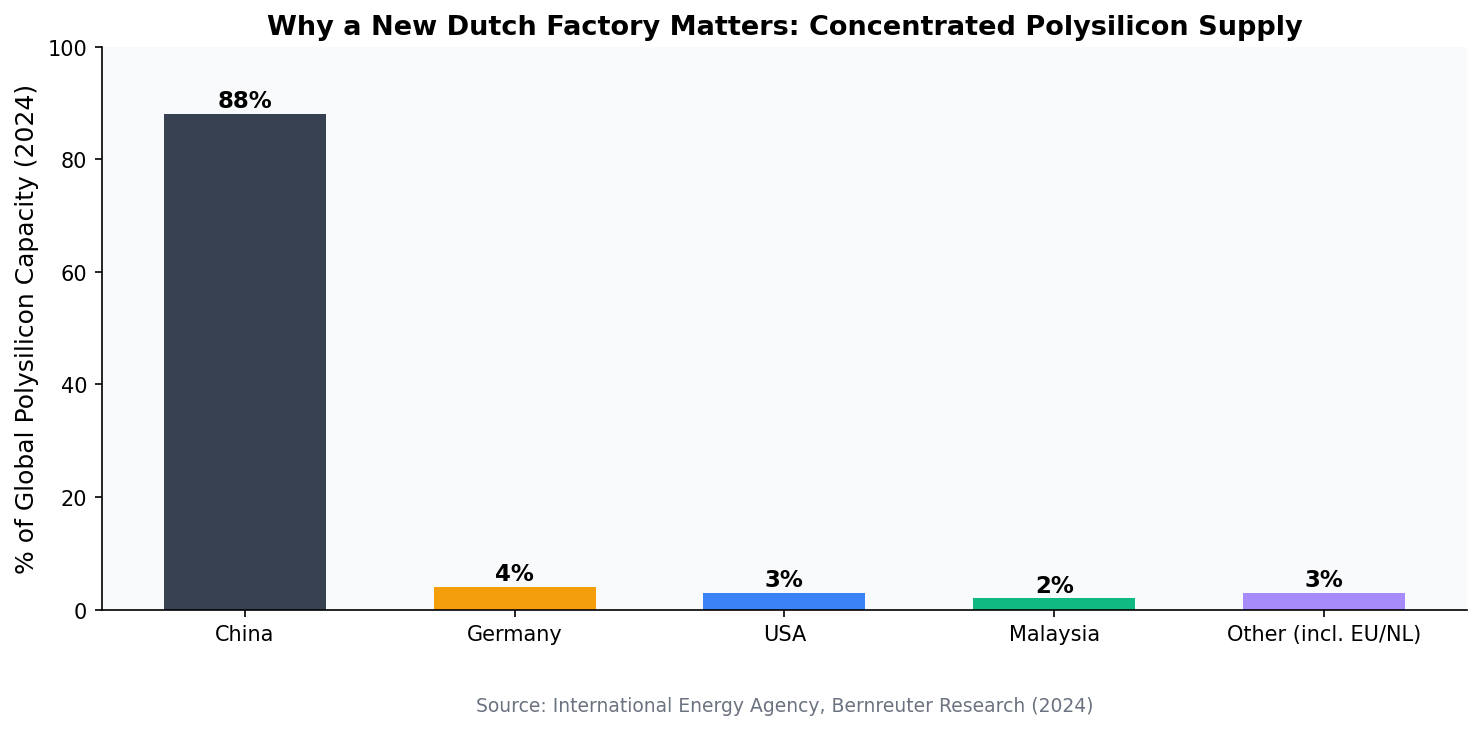
Polysilicon is the ultra-pure silicon feedstock that becomes the wafers, cells, and ultimately the solar panels installed on millions of homes worldwide. Today, roughly 93% of global polysilicon capacity is concentrated in just a few countries, with the vast majority in China (International Energy Agency, Special Report on Solar PV Global Supply Chains, 2022). That concentration has been a pressure point for trade policy, pricing volatility, and energy security.
The Dutch designation under the NZIA — the EU's answer to the US Inflation Reduction Act — fast-tracks permitting and grid connection for clean-tech manufacturing deemed strategically critical. Polysilicon was singled out because without a domestic feedstock, the EU's broader plan to manufacture 40% of its solar deployment needs locally by 2030 simply isn't achievable (European Commission, NZIA framework, 2024).
Why a European Factory Affects American Roofs
Solar is a global commodity market. When new polysilicon capacity comes online anywhere outside of the dominant region, three things tend to happen:
- Spot prices stabilize. Polysilicon prices swung from under $10/kg in 2020 to over $35/kg in 2022 before settling near $5/kg in 2024 (Bernreuter Research, 2024). New diversified capacity smooths future spikes.
- Tariff exposure declines. US Section 201 and antidumping duties have repeatedly reshaped what panels are available to installers. A more geographically diverse supply chain means fewer single-country shocks.
- Module quality competition intensifies. European-manufactured cells using European polysilicon will compete on efficiency, warranty, and traceability — the same forces that have pushed US homeowners from 18% efficient panels in 2018 to 22%+ efficient panels today (NREL, Best Research-Cell Efficiencies chart, 2024).
Translation: even if you never buy a Dutch-made panel, the announcement contributes to a more resilient global pipeline that should keep your installer's bid sheets competitive.
The 2026 US Picture: What Changed for Homeowners
Here's the part that matters most for your wallet right now. The federal 30% Residential Clean Energy Credit (the ITC) expired at the end of 2025 for purchased systems. That means if you buy a solar system outright or finance it with a loan in 2026, the 30% federal tax credit is no longer available to you.
However — and this is critical — third-party-owned systems (leases and Power Purchase Agreements, or PPAs) still qualify for the commercial version of the ITC, which the leasing company can pass through to you in the form of a lower monthly rate or better PPA price (Internal Revenue Code §48; Solar Energy Industries Association guidance, 2026).
This shift has practical consequences:
- Cash and loan buyers should focus harder on state, utility, and local incentives to fill the gap. Many states, including New York, Massachusetts, California, Maryland, and Illinois, still offer rebates, performance payments, or property tax exemptions worth thousands.
- Lease and PPA shoppers should compare escalator rates carefully — a 0% escalator with a fair starting price often beats a slightly lower starting price with a 2.9% annual increase.
- Battery storage continues to be eligible under separate state programs (such as California SGIP and Massachusetts ConnectedSolutions), and pairing storage with solar usually unlocks better economics either way.
How Supply Chain Diversification Shows Up in Your Quote
According to Lawrence Berkeley National Laboratory's Tracking the Sun 2024 report, the median installed price for residential solar in the US was $3.30/W before incentives, with the lowest 20th percentile coming in near $2.60/W. Module costs represent roughly 12–18% of that total — meaning even a 10% drop in panel pricing translates to roughly $0.04/W of homeowner savings, or about $400 on an 8 kW system.
That's not life-changing on its own. But layered with:
- Better warranties from established polysilicon-to-panel supply chains
- More installer choice as importers diversify suppliers
- Improved price stability for batteries (which share lithium and processing supply chains with solar)
…the cumulative effect over a 25-year system life can add up to thousands of dollars in avoided risk. The Department of Energy's Solar Futures Study projects that diversified manufacturing reduces homeowner lifetime cost-of-energy by 6–9% versus a single-source scenario (DOE, 2021).
The Storage Angle Most Homeowners Miss
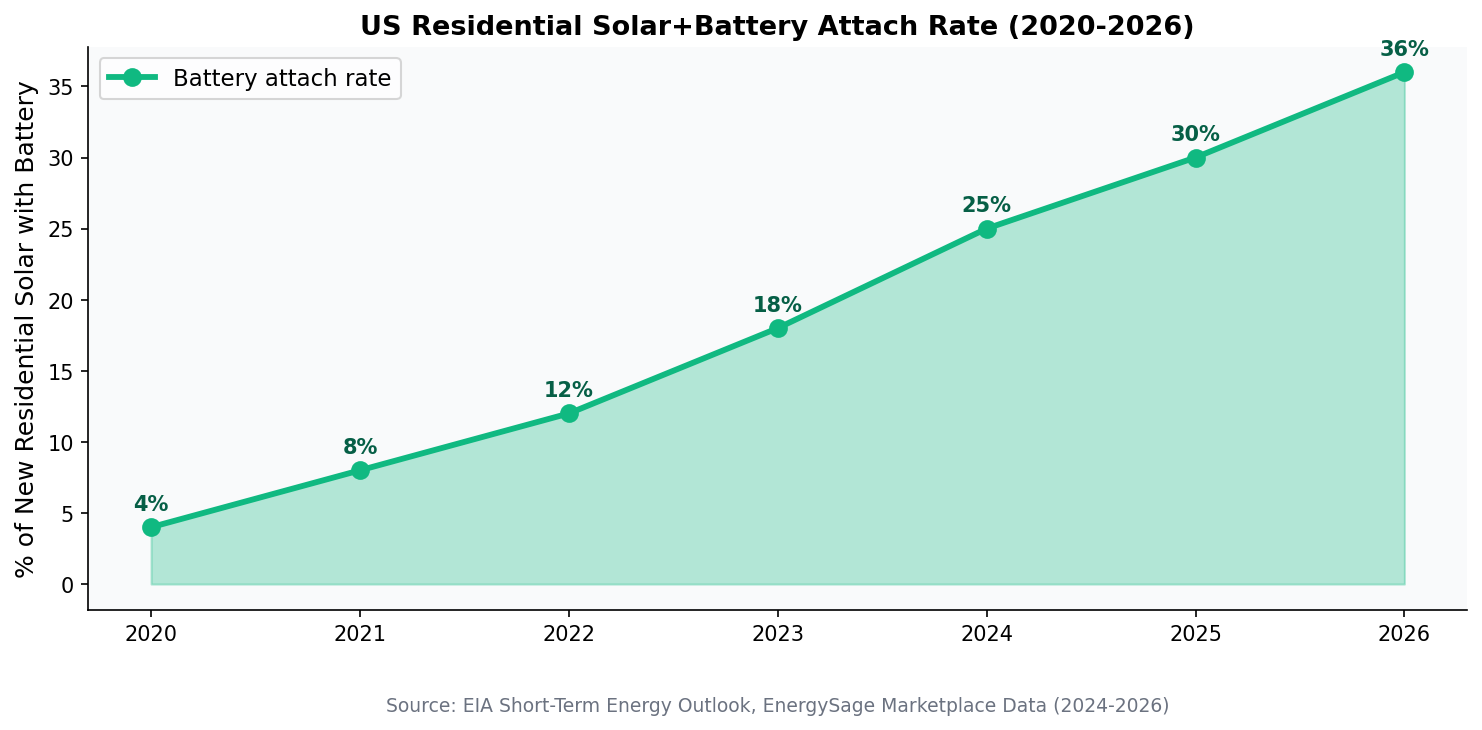
Polysilicon news isn't just about panels. The same NZIA framework that prioritized this Dutch factory also targets battery cell manufacturing. The US Energy Information Administration projects that residential battery storage attached to new solar installations will exceed 35% of all new systems by the end of 2026, up from under 12% in 2022 (EIA, Short-Term Energy Outlook, 2026).
For homeowners on time-of-use rates — increasingly the default in California, Hawaii, parts of New York, and Arizona — pairing storage with solar typically reduces grid imports during peak pricing windows. EnergySage's 2024 marketplace data found that homeowners who added a battery alongside solar reported a median 18% higher first-year bill savings than solar-only customers, even after accounting for the higher upfront cost.
What to Do This Month, Not This Year
Solar shopping in 2026 is a different exercise than it was in 2024. Here's a practical playbook:
1. Run your numbers before talking to any salesperson
EnergyScout's free Solar Assessment tool uses NREL's PVWatts production data and your local utility rates to give you an unbiased estimate of system size, expected savings, and payback. No phone number required, no installer hand-off until you say so.
2. Map every incentive available at your address
State and utility incentives shift quarterly. Use the Solar & Battery Incentives Zipcode Search to pull every active rebate, performance payment, net metering tier, and storage incentive in your zip code in one view.
3. Compare three installers — and ask about supply chains
With supply diversification underway, asking installers which manufacturer they're sourcing from this quarter, what the panel's country of origin is, and whether they offer Tier 1 modules with 25-year product warranties separates serious operators from order-takers. Browse vetted local installers via EnergyScout's Providers directory.
4. If you don't qualify for the ITC, don't panic — pivot
The expiration of the residential ITC for purchased systems doesn't kill solar economics; it changes the optimal financing path. For many 2026 homeowners, a well-structured PPA with a 0% escalator and the commercial ITC built into the price can outperform a cash purchase on a net-present-value basis. Get quotes both ways and compare.
The Bigger Picture
The Dutch government isn't acting in isolation. The US has its own manufacturing renaissance underway, with First Solar, Qcells, and Silfab announcing or expanding domestic facilities under IRA Section 45X production credits. According to SEIA's US Solar Market Insight Q1 2026, US module manufacturing capacity is on track to exceed 50 GW annually by year-end 2026 — enough to meet roughly 90% of projected domestic demand.
For homeowners, this convergence of European and American industrial policy means one thing: the next decade of solar will be defined less by single-source price shocks and more by a competitive, multi-region supply ecosystem. That's good for prices, good for warranties, and good for resilience.

Take the Next Step
Whether or not the Dutch factory ever ships a single kilogram of polysilicon to a US module manufacturer, the broader trend it represents is already showing up in installer bids: stable pricing, better warranties, and more options for battery-paired systems.
Don't wait for the perfect macroeconomic moment — there isn't one. Instead, run your numbers today, line up your incentives, and get competitive quotes from vetted local installers. Start your free solar assessment at energyscout.org and see exactly what your roof, your utility rate, and your zip code can deliver in 2026.
More Articles
Do Solar Panels Work During a Power Outage?
Most homeowners assume solar panels keep the lights on when the grid goes down. The actual answer surprises people — and the fix is simpler than you think.
Read article Battery StorageChile Hit 75% Solar in March. Here's What U.S. Homeowners Should Take From It
Chile's grid produced 29% of its electricity from solar in March, with peaks at 75%. The bottleneck wasn't generation — it was storage and transmission. Here's the homeowner takeaway.
Read article