EPA Eases Utah Ozone Rules: How Homeowners Can Push Back
The EPA proposed rolling back Utah's Wasatch Front ozone nonattainment status, easing pressure on polluters.
When the EPA proposed on Tuesday to rescind a Biden-era reclassification of Utah's Wasatch Front — downgrading the region from "serious" to "moderate" nonattainment of the 2015 ozone standards — it sent a clear message: federal air quality enforcement is loosening. The proposal, which would significantly reduce required pollution cuts in one of America's most ozone-challenged airsheds, leans on the argument that local emissions matter less than long-range transport from outside the region. CleanTechnica reported the move as part of a broader pattern of federal rollbacks under the Trump EPA.
For Utah homeowners — and homeowners anywhere downwind of power plants, freeways, and refineries — the takeaway is simple: if Washington won't insist on cleaner air, your house can become its own clean-energy island. Solar panels paired with battery storage are now the most direct way for a family to cut their personal emissions footprint, lock in electric rates, and stop subsidizing the same fossil generation the EPA is letting off the hook.
What the EPA proposal actually does
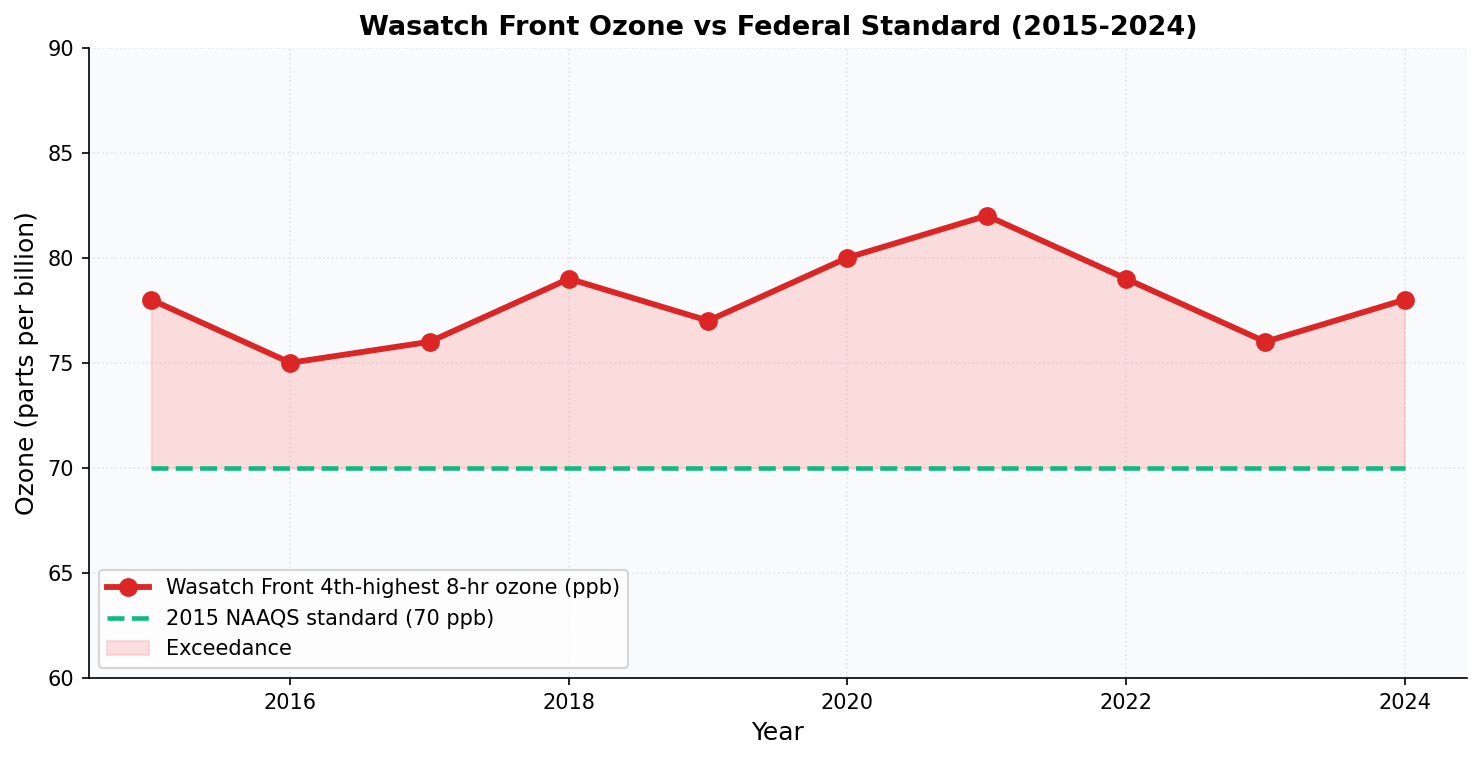
Under the Clean Air Act, when an area fails to meet the National Ambient Air Quality Standards (NAAQS), it gets classified by severity — marginal, moderate, serious, severe, or extreme. Each step up triggers tougher control requirements: reasonably available control technology (RACT), lower offset ratios for new sources, and stricter permitting. The Wasatch Front (covering Salt Lake, Davis, Weber, and parts of Utah and Tooele counties) was bumped to "serious" nonattainment in 2024 after years of missing the 70 parts-per-billion ozone standard.
The new EPA proposal would reverse that. According to EPA's own ground-level ozone documentation, ozone forms when nitrogen oxides (NOx) and volatile organic compounds (VOCs) cook in sunlight — and Utah's geography traps both. The agency now argues that much of the Wasatch ozone is "transported" from outside, so demanding local cuts is unfair. Critics, including state air quality scientists, point out that local sources still contribute the bulk of summertime peak ozone.
Why this matters for your electric bill
Loosening nonattainment status doesn't just affect refineries and industrial boilers. It also softens pressure on coal- and gas-fired power plants whose NOx emissions feed regional ozone. Less pressure means slower retirements, longer lifetimes for the dirtiest plants, and — eventually — higher costs passed to ratepayers as those aging assets need expensive maintenance. The U.S. Energy Information Administration's Annual Energy Outlook already shows that operating-and-maintenance costs for coal plants over 40 years old are climbing fast, even as new solar comes in cheaper than nearly every other resource.
The homeowner's leverage point: rooftop solar + storage
Here's the empowering part. While federal policy zigzags, the economics of distributed solar have only improved. According to NREL's 2024 U.S. Solar Photovoltaic System Cost Benchmark, the modeled cost of a residential rooftop system fell to roughly $2.50–$2.80 per watt installed before incentives. Lawrence Berkeley National Lab's Tracking the Sun report shows median installed prices in the West holding steady or declining year-over-year.
Battery storage has followed a similar curve. SEIA and Wood Mackenzie's most recent U.S. Solar Market Insight documents record residential storage attachment rates — well over 25% of new residential PV nationally, and far higher in states with time-of-use rates or grid reliability concerns.
Important: federal incentive landscape in 2026
This year brought a major change. The federal 30% Investment Tax Credit (ITC) for purchased residential solar systems expired at the end of 2025. Homeowners who buy a system outright in 2026 generally cannot claim the 30% Section 25D credit. However, third-party-owned systems — leases and power purchase agreements (PPAs) — still qualify for commercial-side incentives, which providers typically pass through as lower lease payments or PPA rates.
That makes shopping carefully more important than ever. State and utility incentives, net metering rules, and storage rebates vary enormously by ZIP code. EnergyScout's ZIP code incentive search pulls live data so you can see exactly what's available in your area before you talk to an installer.

Utah's specific picture — and why it generalizes
Utah has some of the country's best solar resource (5.5–6.0 peak sun hours per day in the Salt Lake basin, per NREL's solar resource maps) and rising electric rates from Rocky Mountain Power. The combination means typical paybacks for a properly sized residential system — even without the federal ITC — still land in the 9–12 year range when paired with state incentives and net billing credits.
Layer in a battery, and you get something the EPA repeal can't take away: resilience. When a wildfire smoke event pushes ozone over standards and the utility issues a "flex alert," your battery can carry your home through peak hours without pulling from gas peaker plants. That's local emissions reduction you control directly.
What "your own clean air" looks like in numbers
A 7 kW rooftop system in Salt Lake County generates roughly 11,000–12,000 kWh per year. The EPA's Greenhouse Gas Equivalencies Calculator puts that at about 7.5 metric tons of CO2 avoided annually based on the regional grid mix — equivalent to taking nearly two gas-powered cars off the road. Multiply that by the millions of suitable rooftops in ozone nonattainment areas nationwide and you have a meaningful, voluntary alternative to the regulatory rollback.
How to act — without getting ripped off
The hardest part of going solar isn't the technology; it's finding an installer who quotes a fair price and sizes the system correctly. Door-to-door sales pitches and high-pressure leases have given the industry a black eye. EnergySage's marketplace data consistently shows that homeowners who collect three or more competing quotes save 10–20% versus those who sign with the first salesperson at the door.
EnergyScout was built around that exact problem. Three steps:
- Run a free assessment. Our solar assessment tool uses NREL's PVWatts modeling and your address to produce an honest estimate of system size, annual production, and realistic savings — no sales call required.
- Check your local incentives. The incentive search pulls state, utility, and storage rebates for your ZIP.
- Get matched with vetted installers. Browse local providers who agree to transparent pricing and no high-pressure tactics.

The bigger pattern: federal rollback, local resilience
The Wasatch Front proposal is one of several recent EPA actions softening Clean Air Act enforcement. The Department of Energy's Solar Futures Study projected that distributed solar could supply 20% or more of U.S. electricity by mid-century — but only if homeowners and small businesses keep adopting. Each rooftop installation reduces demand on the marginal generator, which in ozone nonattainment areas is often a NOx-emitting gas plant.
In other words, every home that goes solar this year shifts the ozone math in the right direction, regardless of how the EPA classifies the airshed on paper. That's the leverage homeowners have — and it's why the response to a federal rollback isn't despair, it's installation.
Bottom line
The EPA's proposed Wasatch Front reclassification reduces federal pressure to clean up local emissions, but it doesn't change the math for your house. Solar prices are at historic lows. Battery storage is increasingly affordable. State and utility incentives still exist. And — critically for 2026 — leases and PPAs still benefit from federal credits passed through by providers, even though the homeowner-side 30% ITC has expired.
If you've been thinking about going solar, the policy environment isn't going to get more generous than it is right now. Get a free, no-obligation assessment at energyscout.org and see what your roof can do.
More Articles
Do Solar Panels Work During a Power Outage?
Most homeowners assume solar panels keep the lights on when the grid goes down. The actual answer surprises people — and the fix is simpler than you think.
Read article Battery StorageChile Hit 75% Solar in March. Here's What U.S. Homeowners Should Take From It
Chile's grid produced 29% of its electricity from solar in March, with peaks at 75%. The bottleneck wasn't generation — it was storage and transmission. Here's the homeowner takeaway.
Read article