France Fast-Tracks Renewables: Lessons for US Homeowners
France just streamlined environmental permitting for renewable projects, cutting appeal timelines and boosting grid investment.
On April 22, 2026, France published a new decree in its Official Journal designed to accelerate renewable energy deployment by streamlining the environmental permitting process. The rule grants direct access to administrative courts of appeal for strategic renewable projects and tightens procedural deadlines, reducing the years-long delays that have historically plagued wind, solar, and grid infrastructure development across Europe (PV Magazine, April 24, 2026).
While this is a French policy story, the signal it sends matters for American homeowners. Around the world, governments are recognizing that the bottleneck for clean energy isn't technology or financing — it's paperwork. And the direction of policy, from Paris to Sacramento, is increasingly pointing the same way: clear the red tape, and let solar scale.
Why a French Permitting Rule Matters to Your Rooftop
Globally, utility-scale and distributed solar face the same core friction: environmental review, interconnection queues, and appeals processes that stretch timelines from months into years. The International Energy Agency (IEA) has repeatedly flagged permitting reform as one of the single highest-leverage policy moves available to governments committed to their climate targets.
France's decree is notable because it doesn't weaken environmental protections — it simply makes the process faster and more predictable. Appeals against strategic renewable projects now go directly to administrative courts of appeal, skipping a layer of lower-court review that had historically added 12–18 months to project timelines.
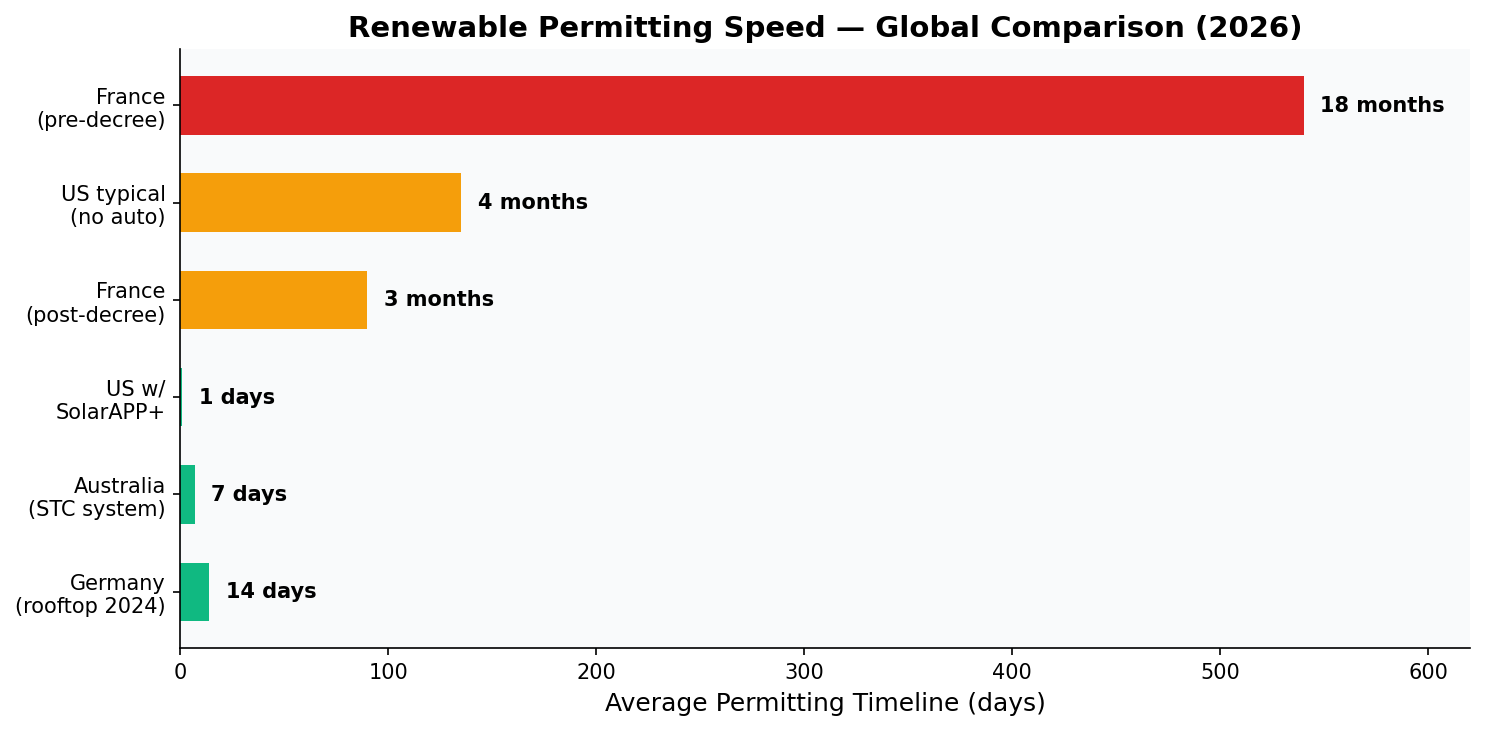
For American homeowners, the relevance is twofold. First, faster global deployment drives down equipment costs across the board — the Lawrence Berkeley National Laboratory's Tracking the Sun report consistently shows residential solar prices falling in step with global module manufacturing scale. Second, the policy momentum abroad puts pressure on US states and municipalities to streamline their own local permitting — which is often the single largest source of soft costs on a residential installation.
The US Permitting Picture in 2026
According to the National Renewable Energy Laboratory (NREL), soft costs — permitting, inspection, interconnection, customer acquisition — now make up more than 65% of the total installed price of a typical residential solar system. The hardware has gotten cheap; the process hasn't.
That's starting to change. The Department of Energy's SolarAPP+ platform, which automates residential solar permit approvals, has been adopted by hundreds of US jurisdictions and has cut average permit issuance times from weeks to under one business day in participating cities. California's Senate Bill 379 requires every city in the state to adopt an automated permitting platform, and similar mandates are under consideration in New York, Colorado, and Illinois.
If you live in a SolarAPP+ jurisdiction, your installation timeline from signed contract to powered-on system can be as short as 4–6 weeks. If you don't, it can still stretch to 3–5 months — almost entirely because of local paperwork. Before you sign anything, it's worth knowing which side of that line your zip code falls on. EnergyScout's free solar assessment tool factors local permitting timelines into its savings projections so you get a realistic picture, not a best-case marketing number.
The 2026 ITC Reality — and Why Timing Still Matters
Let's address the elephant in the room. The federal 30% Investment Tax Credit (ITC) for purchased residential solar systems expired at the end of 2025. That's a meaningful change from the landscape most homeowners remember. However — and this is critical — the ITC still applies to systems acquired through leases and power purchase agreements (PPAs), where the installer or financier owns the system and passes savings through to the homeowner via a lower monthly rate.
According to EnergySage's 2026 Marketplace Report, the shift has pushed roughly 40% more homeowners toward third-party-owned systems this year compared to 2024. PPAs and leases aren't inherently worse than ownership — they just optimize for different goals. Ownership maximizes lifetime savings; PPAs minimize upfront cost and complexity. For many households, the PPA route now delivers immediate monthly savings with zero out-of-pocket cost.
State and local incentives, meanwhile, have become the bigger variable. The Solar Energy Industries Association (SEIA) tracks more than 2,400 active state, municipal, and utility solar programs across the country. New York's NY-Sun rebate, Illinois' Solar for All, Massachusetts' SMART program, and California's SGIP battery rebate can collectively deliver more value than the old federal ITC in many zip codes. Use EnergyScout's incentive search tool to see exactly what's available where you live.
Why Batteries Are Now the Smart Money
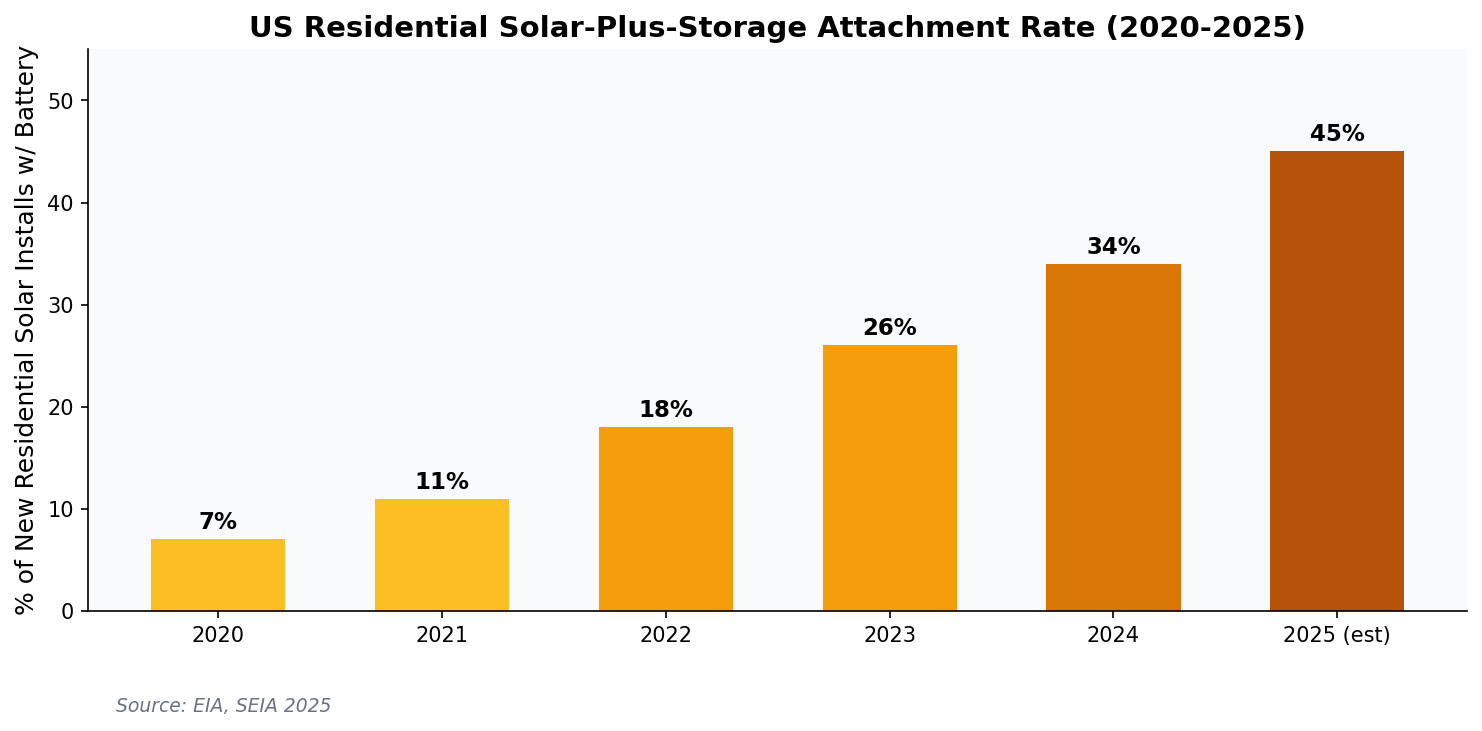
Permitting reform in France specifically calls out grid-scale battery storage as a strategic priority — and the same logic scales down to the home. The US Energy Information Administration (EIA) reported that residential battery attachment rates on new solar installations jumped from 11% in 2021 to 34% in 2024, with 2025 data tracking toward 45%.
Two forces are driving the shift. First, time-of-use rates are now standard in California, Arizona, Nevada, Hawaii, and parts of New England, making midday solar generation worth far less than evening peak consumption. Without a battery, you're selling cheap and buying expensive. Second, the California Public Utilities Commission's (CPUC) NEM 3.0 framework, which dramatically reduced export compensation for new solar customers, has effectively made batteries a requirement for economic payback on new California systems — and similar rate reforms are spreading nationally.
The Lawrence Berkeley Lab's 2025 Storage Futures study found that pairing a 10 kWh battery with a typical 7 kW rooftop system increases lifetime bill savings by an average of 31% under current time-of-use tariffs, even after accounting for battery cost and degradation. In utility territories with frequent public safety power shutoffs, the resilience value alone often justifies the spend.
What Global Policy Momentum Means for You
Step back and look at the big picture. France's decree is one data point in a global trend: permitting reform, faster interconnection, and preferential treatment for distributed energy resources. Germany cut rooftop solar permitting to 14 days in 2024. Australia's small-scale technology certificate (STC) system approves and incentivizes residential solar in a single automated transaction. Spain eliminated the "sun tax" on self-consumption in 2018, and installations quintupled within three years.
The trajectory is clear. Solar is moving from a specialty product to a default infrastructure decision, and the friction costs that still make it feel like a project are being systematically legislated away. For American homeowners weighing whether to act now or wait, the calculus has shifted: hardware prices are near their floor, permitting is getting faster, storage is becoming standard, and state-level incentives are filling the gap left by the federal ITC sunset.

The homeowners who benefit most in this environment are the ones who shop carefully. According to NREL, getting three or more competitive quotes reduces the average install price by roughly 10%. EnergyScout's vetted installer directory connects you with local, pre-screened providers — no pressure calls, no data resale, no lead-broker middlemen.
Your Next Step
France's decree will play out over years. Your energy bill lands every month. The best thing you can do with a global policy tailwind is act on it locally. Run a free, no-commitment assessment, check your real incentives, and talk to a reputable installer who will quote you honestly.
Ready to see what solar + storage looks like on your roof? Start with a free EnergyScout assessment at energyscout.org — no phone number required, no high-pressure sales pitch, just transparent numbers you can trust.
More Articles
Do Solar Panels Work During a Power Outage?
Most homeowners assume solar panels keep the lights on when the grid goes down. The actual answer surprises people — and the fix is simpler than you think.
Read article Battery StorageChile Hit 75% Solar in March. Here's What U.S. Homeowners Should Take From It
Chile's grid produced 29% of its electricity from solar in March, with peaks at 75%. The bottleneck wasn't generation — it was storage and transmission. Here's the homeowner takeaway.
Read article