FranklinWH CEO on Home Batteries: What Homeowners Need to Know
FranklinWH co-founder Gary Lam recently sat down with Electrek to explain why home batteries are becoming essential — with or without solar panels.
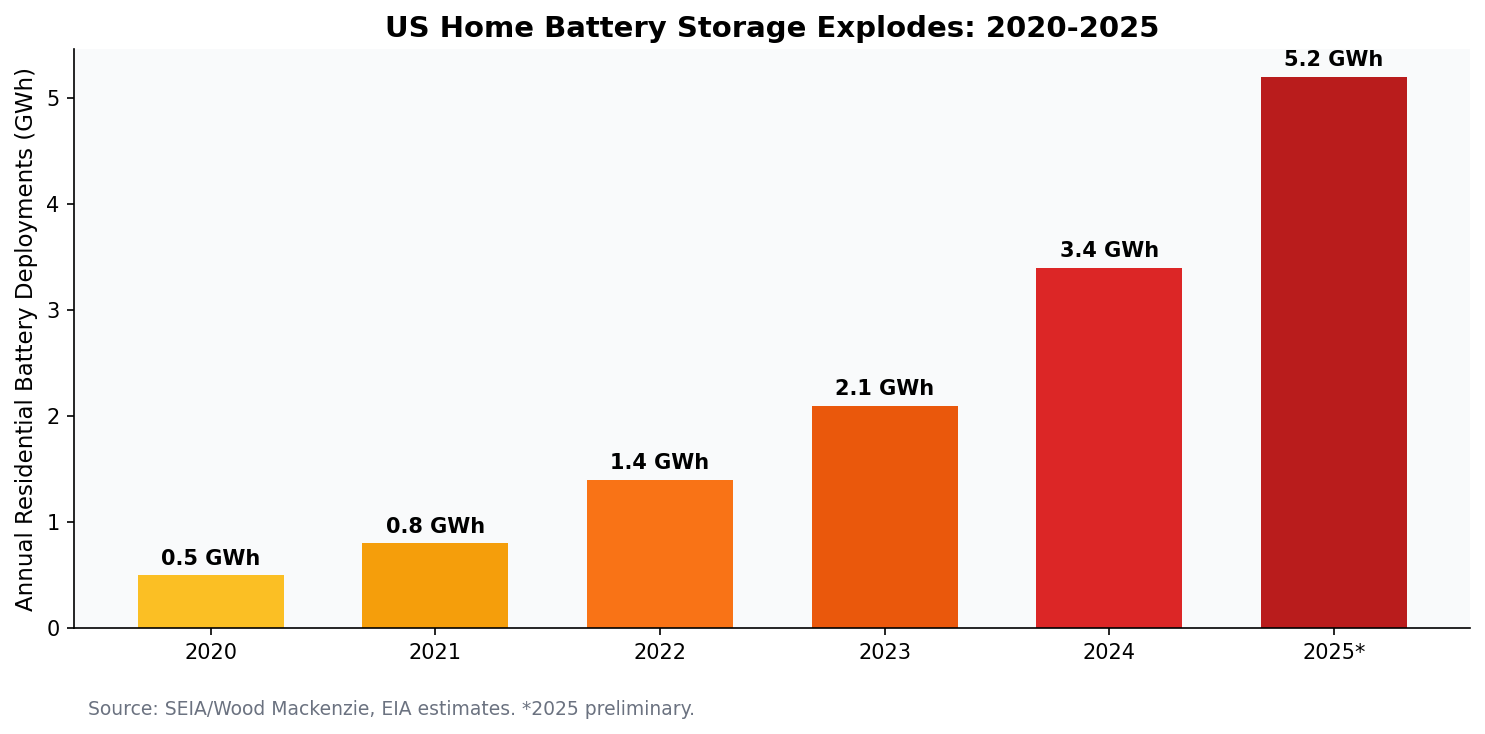
On this week's episode of Electrek's Quick Charge podcast, FranklinWH co-founder and CEO Gary Lam walked listeners through the real-world benefits of a modern home battery system — and importantly, how homeowners can make the most of one with or without a rooftop solar array. The conversation lands at a pivotal moment: US residential battery attachment rates hit record highs in 2025, and grid reliability concerns are pushing more homeowners to look beyond the utility for peace of mind.
If you have been on the fence about storage, Lam's core message is simple — batteries are no longer just a luxury add-on for solar customers. They are becoming a practical resilience and savings tool in their own right. Here is what that shift means for you, and how to act on it.
Why Home Batteries Are Having a Moment in 2026
According to the SEIA/Wood Mackenzie US Solar Market Insight report, residential battery storage deployments grew more than 60% year-over-year in 2024, and that trajectory has continued through 2025. The US Energy Information Administration (EIA) projects small-scale battery capacity to nearly double again by 2027, driven by three forces Lam highlighted in the interview:
- Grid instability: Extreme weather, wildfire-related PSPS events, and aging infrastructure have made multi-day outages more common.
- Rising retail electricity prices: The EIA reports average US residential rates climbed roughly 6% in 2024 and another 4–5% in 2025.
- Time-of-use (TOU) rate expansion: Utilities in California, Hawaii, Massachusetts, and New York have aggressively shifted customers onto peak/off-peak pricing, which rewards shifting load with a battery.
What Lam Says Makes a Good Home Battery System
In the interview, Lam emphasized that not all batteries are created equal. FranklinWH's aGate + aPower system is whole-home rather than partial-home backup, which is a meaningful distinction. The US Department of Energy notes that many early residential batteries could only back up a handful of "critical load" circuits. Modern whole-home systems like FranklinWH's — along with offerings from Tesla, Enphase, and SolarEdge — can power the full panel, including heavy loads like HVAC and EV charging.
The Four Pillars of Battery Value
Lam's framework for homeowner value lines up neatly with research from Lawrence Berkeley National Laboratory:
- Backup power during outages — the most intuitive benefit.
- Self-consumption — storing excess solar production for use after sunset.
- TOU arbitrage — charging off-peak and discharging during expensive peak hours, even without solar.
- Grid services — participating in utility programs (VPPs) that pay you for exported capacity.
That fourth pillar is increasingly important. The California Public Utilities Commission and several East Coast ISOs now compensate homeowners for discharging batteries during grid stress events — turning your wall unit into a tiny power plant.
Solar + Battery vs. Battery-Only: Which Is Right for You?
One of the more interesting moments in the Electrek interview came when Lam acknowledged that a battery-only install can still make financial sense for the right customer — especially in regions with steep TOU differentials. But for most US homeowners, pairing storage with solar remains the highest-value move.
Here is the honest 2026 financial picture:
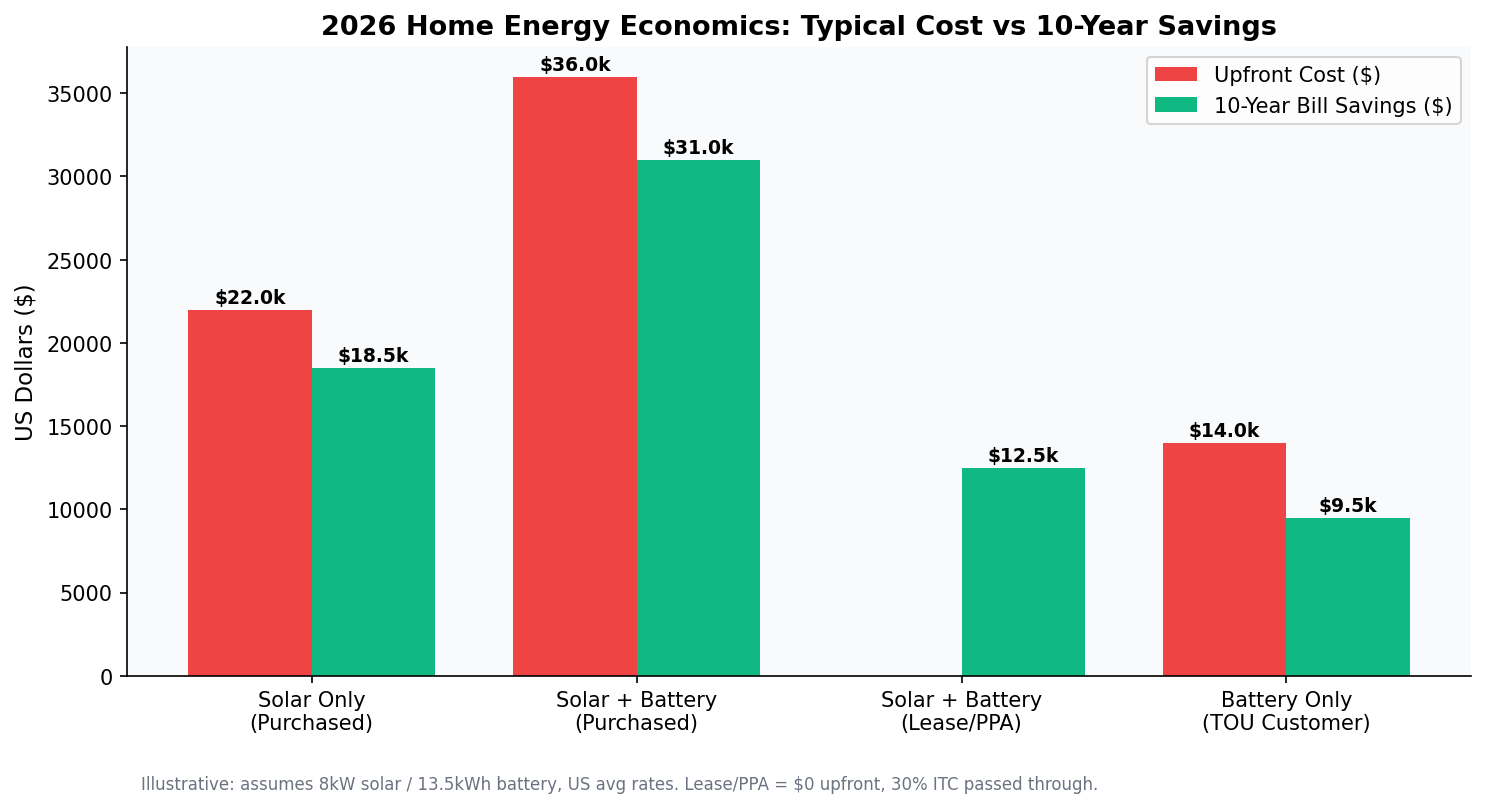
Important 2026 update: The federal 30% Residential Clean Energy Credit (Section 25D) expired at the end of 2025 for purchased systems. However, leased systems and power purchase agreements (PPAs) continue to qualify under Section 48 commercial ITC rules, because the tax benefit flows to the system owner (the third-party financier), who typically passes savings through to the homeowner via lower monthly payments. According to EnergySage marketplace data, this has caused a noticeable shift back toward solar leases and PPAs in early 2026.
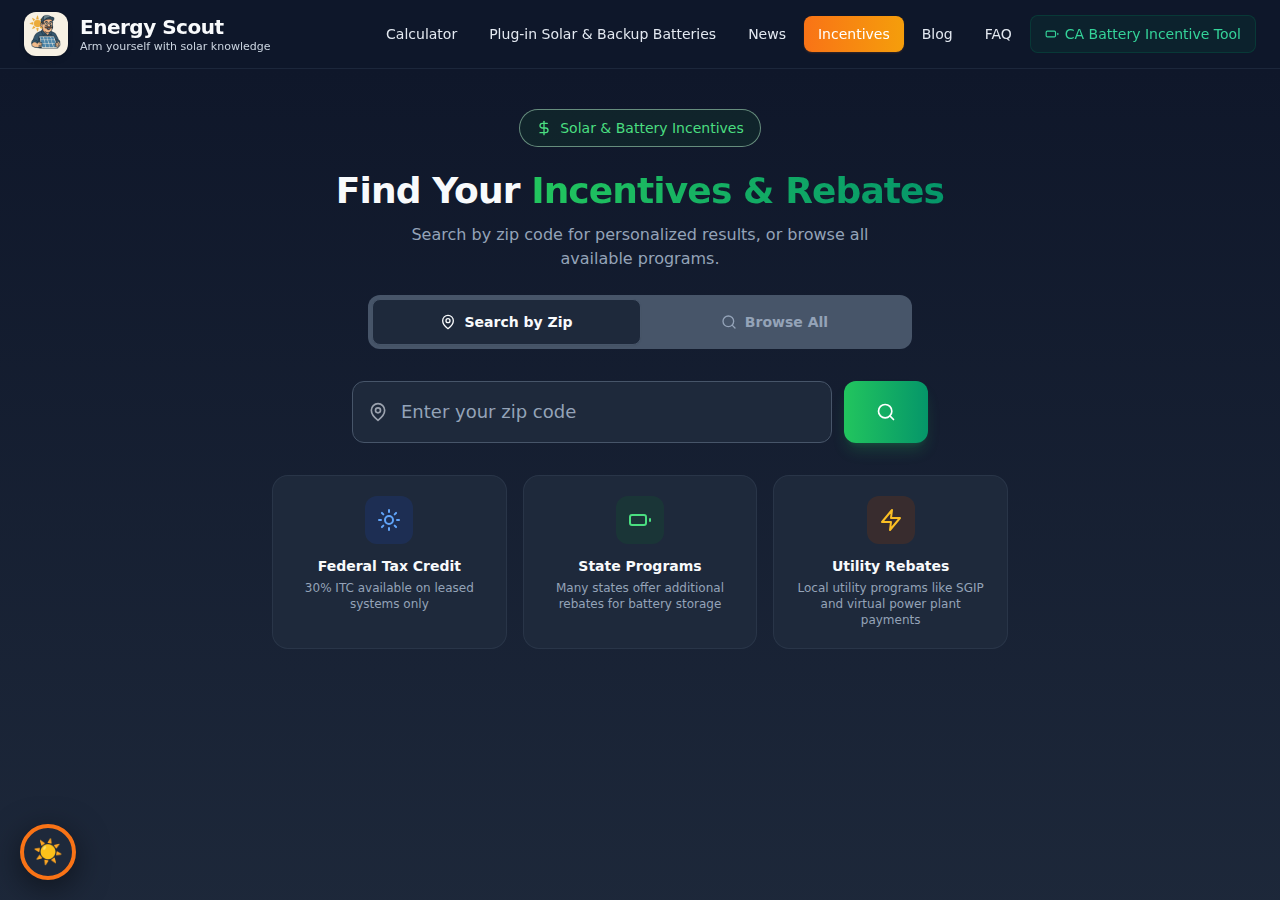
State and utility incentives, however, are still very much alive. California's Self-Generation Incentive Program (SGIP), Massachusetts' SMART program, and numerous utility rebates can knock thousands off a battery install — but they change quarterly.
How to Size a Battery for Your Home
Lam mentioned that most homeowners significantly over- or under-size their first battery. NREL's residential storage modeling suggests the sweet spot for most US homes is 10–20 kWh of usable capacity — enough to cover an evening peak plus essential loads during a 12–24 hour outage.
Questions to Answer Before You Buy
- What are your must-run loads during an outage? (Refrigerator, well pump, medical equipment, internet)
- Do you want whole-home backup or just critical loads?
- Is your utility on TOU rates? What is the peak-to-off-peak differential?
- Does your utility offer a VPP or battery incentive program?
- Will you be adding an EV or heat pump in the next 5 years? (Plan capacity accordingly)
EnergyScout's free solar + storage assessment tool walks through each of these and returns a personalized system size recommendation — no phone call or sales pitch required.

What Lam Got Right About the Installer Problem
One of the most candid moments in the interview was Lam's acknowledgement that the installer matters as much as the equipment. A top-tier battery paired with a rushed install is a recipe for frustration. NREL's 2023 soft cost study found that installation quality accounts for a significant portion of long-term system performance variance — more than the brand of battery itself.
That is exactly why EnergyScout vets local installers, surfaces verified reviews, and shows licensing and certification data upfront. You can browse installers in your area and compare them side-by-side before requesting a single quote.
The Takeaway: Storage Is No Longer Optional
Gary Lam's interview captures a broader industry inflection point. With federal purchase incentives narrowing, retail electricity rates climbing, and grid reliability eroding in many regions, the math on home batteries keeps getting better — not worse. Lam's closing point is worth quoting: a home battery is not just a backup device, it is an energy independence tool that compounds in value every year electricity gets more expensive.
According to EIA's Annual Energy Outlook 2025, residential electricity prices are projected to rise another 15–25% by 2030 in real terms. Homeowners who lock in solar + storage now — whether through ownership, lease, or PPA — are effectively hedging against those increases.
Your Next Step
Ready to see what solar + storage could look like for your home in 2026?
- Run a free solar + battery assessment (2 minutes, no account needed).
- Check your state and utility incentives by ZIP code.
- Compare vetted local installers before you request quotes.
Take the guesswork out of going solar + storage. Visit energyscout.org to get started — it is 100% free and there is never a sales call unless you ask for one.
More Articles
Do Solar Panels Work During a Power Outage?
Most homeowners assume solar panels keep the lights on when the grid goes down. The actual answer surprises people — and the fix is simpler than you think.
Read article Battery StorageChile Hit 75% Solar in March. Here's What U.S. Homeowners Should Take From It
Chile's grid produced 29% of its electricity from solar in March, with peaks at 75%. The bottleneck wasn't generation — it was storage and transmission. Here's the homeowner takeaway.
Read article