Long Island Utilities Eye New Solar Rebates as Federal ITC Ends
With the 30% federal solar tax credit gone for purchased systems, PSEG Long Island and LIPA are weighing new utility-side rebates.
The residential solar playbook is being rewritten in real time. With the federal 30% Investment Tax Credit (ITC) for purchased systems expiring on January 1, 2026, New York utilities PSEG Long Island and the Long Island Power Authority (LIPA) are openly exploring the reinstatement of utility-side rebates last seen more than a decade ago — a shift that could become a national template for how states and local providers fill the gap left by Washington's retreat.[1]
For homeowners, the headline is simpler than it sounds: solar is still one of the best long-term investments you can make on your roof — the path to savings just looks a little different in 2026 than it did in 2025. Here's what's changing on Long Island, what's still available everywhere, and how to move forward without waiting for Congress.
What Actually Changed in January 2026
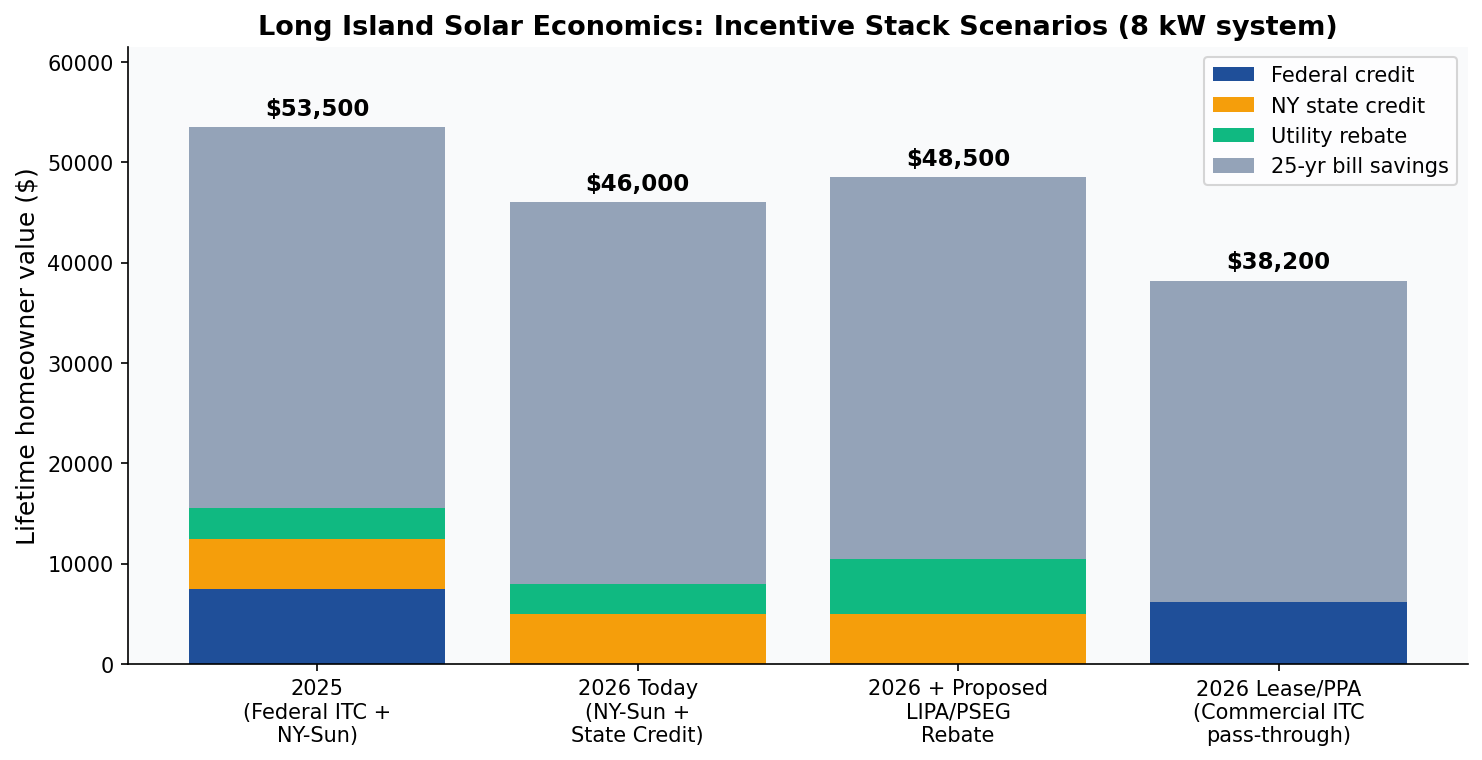
The federal 30% ITC, authorized under Section 25D of the Internal Revenue Code and extended by the Inflation Reduction Act of 2022, ended earlier than originally scheduled for residential systems that homeowners buy. According to the Department of Energy's guidance, any system placed in service after December 31, 2025 no longer qualifies for the 30% personal tax credit.[2]
There is one important exception that most homeowners miss: third-party owned systems — solar leases and power purchase agreements (PPAs) — still qualify because they fall under the commercial ITC (Section 48), which has a longer runway. The installer or financier claims the credit and, in a competitive market, passes the value through as a lower monthly payment.[3]
Why Long Island Is the Canary in the Coal Mine
Long Island was one of the earliest residential solar markets in the country, thanks to aggressive 2000s-era rebates from LIPA that effectively seeded the local installer ecosystem. When those utility rebates sunset, the federal ITC took over as the primary driver. Now, with the ITC gone for purchased systems, the Long Island Press reports that PSEG Long Island and LIPA are evaluating new utility-backed incentives to keep the pipeline healthy.[1]
The local impact is real. Installer EmPower Solar, one of the region's longstanding residential contractors, recently wound down operations — while peers like SUNation are restructuring sales and financing models around leases, PPAs, and bundled battery storage. This reshuffling is a preview of what other high-cost, high-electricity-price markets (California, Massachusetts, Hawaii) are likely to see over the next 18 months.

The Incentives That Are Still Working for You
Despite the federal change, the stack of state, local, and utility programs remains surprisingly deep. Here are the ones most homeowners should know about:
1. New York State's NY-Sun Residential Incentive
NYSERDA's NY-Sun program still offers a per-watt rebate for residential solar installations in most ConEd, National Grid, and PSEG Long Island territories, plus a $5,000 state tax credit (up to 25% of system cost) under New York Tax Law Section 606(g-1).[4] That alone can offset 15–25% of a typical install.
2. Utility-Side Incentives (Coming Back?)
PSEG Long Island and LIPA's proposed reinstatement would likely take the form of upfront capacity rebates or enhanced net-metering credits, paid through the rate base rather than the tax code. Similar programs already exist in Massachusetts (SMART) and Illinois (Illinois Shines).[5]
3. Net Metering and Value of Distributed Energy Resources (VDER)
New York compensates residential solar exports under the VDER tariff, which stacks a capacity value, environmental value, and demand-reduction value on top of energy credits. For most Long Island homeowners, that still produces a bill credit near the retail rate.[6]
4. Federal Battery Storage Credit (Standalone, via ITC for Storage)
Here's the nuance that rewards homeowners who plan ahead: the federal storage ITC (Section 25D for residential batteries ≥3 kWh) was structured separately and has its own phase-out schedule. Pairing a battery with your solar install — or adding one to an existing system — can still unlock meaningful federal value in 2026 for systems placed in service under transitional rules.[7] Check our incentives search tool for current eligibility by ZIP code.
The Economics Still Make Sense — Here's the Math
Lawrence Berkeley National Laboratory's Tracking the Sun report pegs the median installed residential system price at roughly $3.30/W in 2024, down from over $7/W a decade ago.[8] On Long Island, where retail electricity rates exceed 28¢/kWh — nearly double the national average of 16.4¢/kWh tracked by the EIA[9] — the simple payback on a cash-purchased system was already compelling before any tax credit.
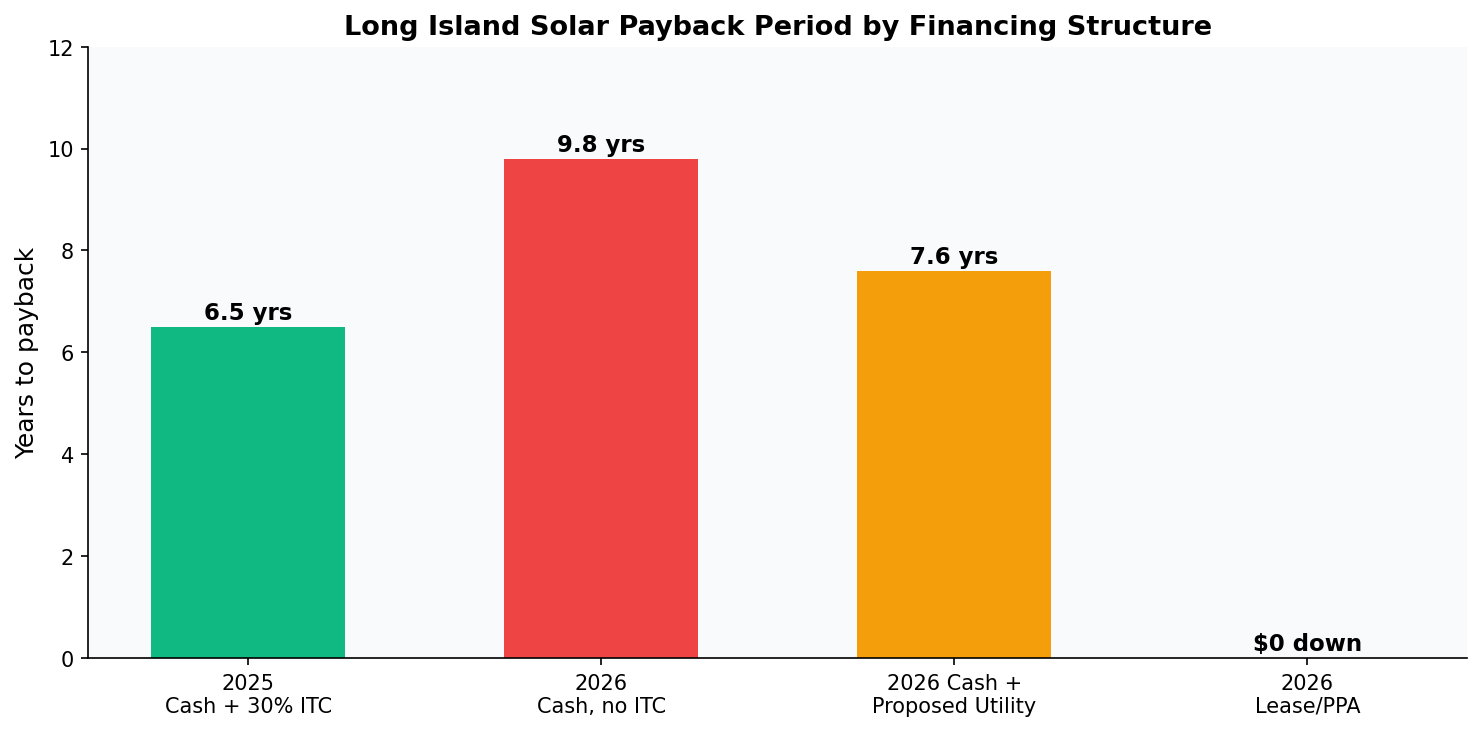
Strip out the 30% federal credit and a typical 8 kW Long Island system that used to pay back in 6–7 years now pays back in 9–10 years. Add NY-Sun, the state tax credit, and (potentially) a reinstated utility rebate, and that number tightens back toward 7–8 years. For a panel warranty that runs 25 years, the post-payback "free electricity" window is still 15+ years.[10]
How Leases and PPAs Changed the Calculus Overnight
Because third-party ownership structures still capture the commercial ITC, a well-negotiated 25-year solar lease or PPA in 2026 often delivers nearly the same monthly savings as a cash purchase would have with the old 30% credit — without any upfront cost. EnergySage's 2024 Marketplace Report found that PPA offers on their platform averaged 20–30% below local utility rates, with escalators capped at 2.9%.[11]
The tradeoffs are real: you don't own the system, long-term IRR is lower than a cash purchase, and some contracts complicate home sales. But for homeowners without the tax appetite to use a $7,000–$10,000 credit, or who simply don't want to deploy capital, a lease/PPA is now the dominant math on Long Island and in other high-rate markets.
What to Do This Month
Rather than waiting to see whether PSEG and LIPA finalize new rebates, most homeowners should start the assessment process now. Incentive programs are typically first-come, first-served with capped funding — when they launch, the queue fills fast.
Three concrete steps:
- Get a personalized production estimate. Use our free solar assessment tool, which pulls NREL's PVWatts data and your local utility rates to model annual kWh, bill offset, and payback under current incentives.
- Map your stack of incentives. Our ZIP-code incentives search surfaces every state, utility, and local rebate applicable to your address — including pending programs in New York.
- Compare vetted local installers. Our provider directory filters for NABCEP-certified, locally licensed contractors with verified reviews — critical as legacy installers like EmPower exit and new entrants fill the gap.
The Bigger Picture
The expiration of the residential ITC doesn't mark the end of home solar — it marks the handoff from federal policy to state and utility innovation. Long Island is simply the first place where that handoff is happening in public. Expect California's CPUC, the Massachusetts DOER, and dozens of co-op and municipal utilities to follow with their own post-ITC designs over the next 18 months.[12]
For homeowners, the winning move is the same as it always was: run the numbers with today's real incentives, choose the financing structure that matches your tax situation, and work with a local installer you can call in five years when you need service.
Ready to Run Your Numbers?
EnergyScout's tools are free, unbiased, and updated continuously as programs like NY-Sun, SMART, and (soon) PSEG/LIPA's utility rebates evolve. Start with a personalized solar assessment — it takes about two minutes and shows your savings under every financing option available in your ZIP code.
Have questions about the 2026 incentive landscape in your state? Visit energyscout.org and we'll walk you through it.
More Articles
Do Solar Panels Work During a Power Outage?
Most homeowners assume solar panels keep the lights on when the grid goes down. The actual answer surprises people — and the fix is simpler than you think.
Read article Battery StorageChile Hit 75% Solar in March. Here's What U.S. Homeowners Should Take From It
Chile's grid produced 29% of its electricity from solar in March, with peaks at 75%. The bottleneck wasn't generation — it was storage and transmission. Here's the homeowner takeaway.
Read article