Massachusetts SMART Program in 2026: Is It Still Worth It?
Massachusetts' SMART program continues to pay homeowners for the solar power they generate.
If you live in Massachusetts and you've been weighing whether to go solar in 2026, you've probably heard about the Solar Massachusetts Renewable Target (SMART) program. It's the state's flagship incentive — a long-running tariff that pays you a fixed rate for every kilowatt-hour your panels produce, on top of the bill savings you already get from net metering. But with the federal 30% Investment Tax Credit (ITC) for purchased residential systems expiring at the end of 2025, many homeowners are rightly asking: does the math still work?
The short answer: yes, for most Massachusetts homeowners — but the path to a strong return looks different than it did even 12 months ago. Let's break it down.
What is the SMART program, in plain English?
SMART is a declining-block production incentive administered by the Massachusetts Department of Energy Resources (DOER) and paid out by the state's three investor-owned utilities: Eversource, National Grid, and Unitil. Instead of a one-time rebate, the program pays you a per-kilowatt-hour rate for 10 years on every kWh your system generates (15 years for community solar and certain low-income projects). [Mass.gov, 2025]
The program launched in 2018 with a 1,600 MW cap and was doubled to 3,200 MW in 2020. As of late 2025, DOER has been working through a major SMART 3.0 redesign to extend the program through the state's 2030 climate targets, and a successor framework is moving forward into 2026. [DOER, 2024]
How the incentive rate works in 2026
SMART uses a declining block structure. As more capacity gets built in each utility territory, the per-kWh rate for new projects in the next "block" steps down. By 2026, most utility territories are deep into the lower blocks, meaning base compensation rates for new residential systems are typically in the $0.04 to $0.08 per kWh range, depending on utility, project size, and block status. [DOER SMART Dashboard, 2025]
Crucially, residential systems can stack adders on top of the base rate:
- Low-income adder — boosts compensation for income-qualified households
- Community shared solar adder — for projects serving multiple subscribers
- Energy storage adder — paired battery storage earns an additional per-kWh bonus
- Building-mounted adder — favors rooftop over greenfield ground mounts
For a typical Massachusetts homeowner adding a battery, the storage adder alone can add several cents per kWh — which is one reason solar+storage has become the default install in the Bay State.
The 2026 reality: federal ITC is gone for owned systems
This is the big shift. The 30% federal Investment Tax Credit (Section 25D) for residential systems purchased outright or financed with a loan expired at the end of 2025 following changes in the 2025 federal budget legislation. Only third-party-owned systems — leases and Power Purchase Agreements (PPAs) — can still claim the commercial 48E credit through their installer, which may then be passed on as a lower monthly rate. [DOE, 2025]
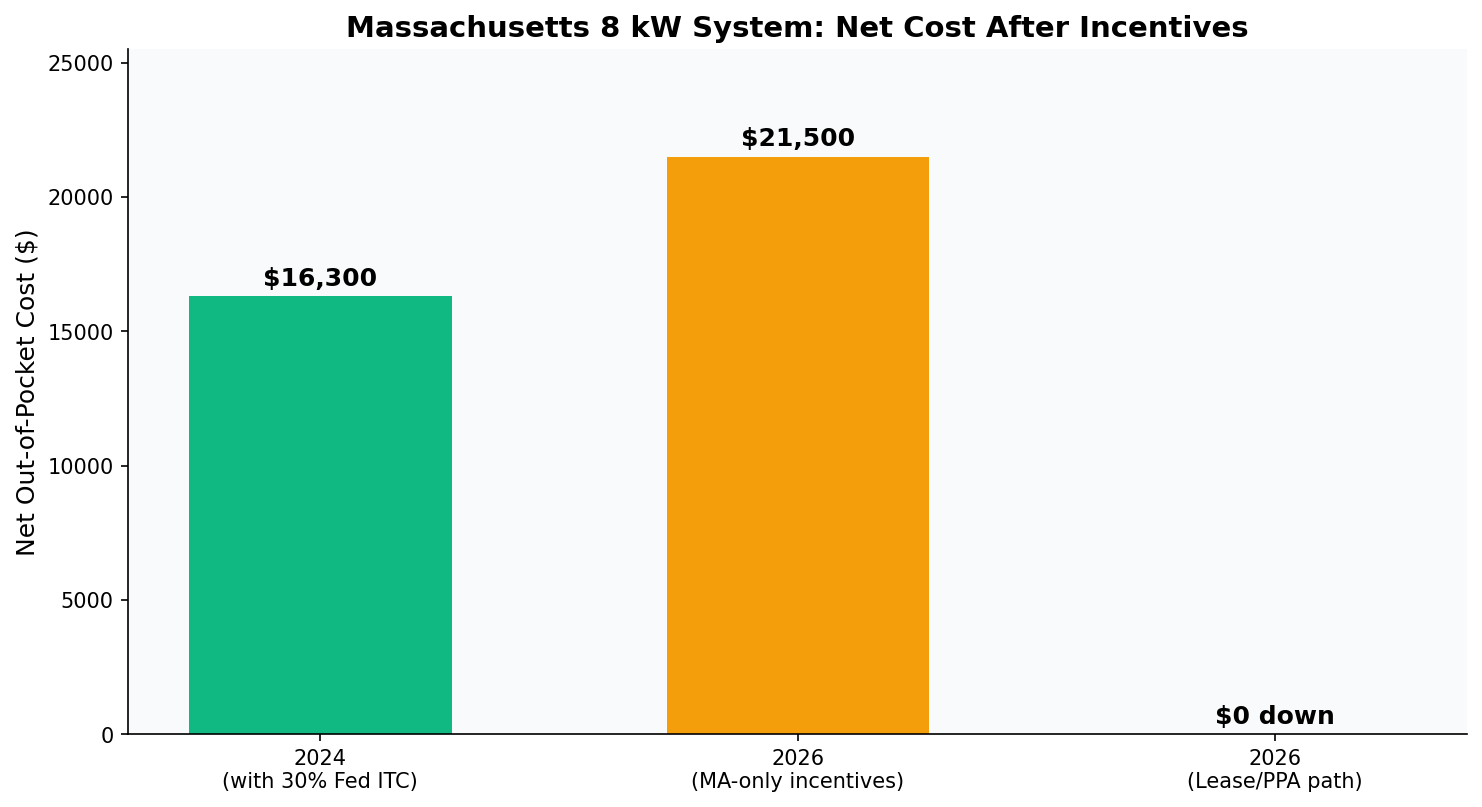
For Massachusetts homeowners, this raises the all-in installed cost by roughly $5,000–$9,000 on a typical 8 kW system compared to 2024. That's a real number — but it's not the whole story.
The Massachusetts state-level offsets that still exist
Even without the federal credit, Massachusetts remains one of the most incentive-rich solar states in the country. In 2026, an owner-occupied household installing residential solar can typically still claim:
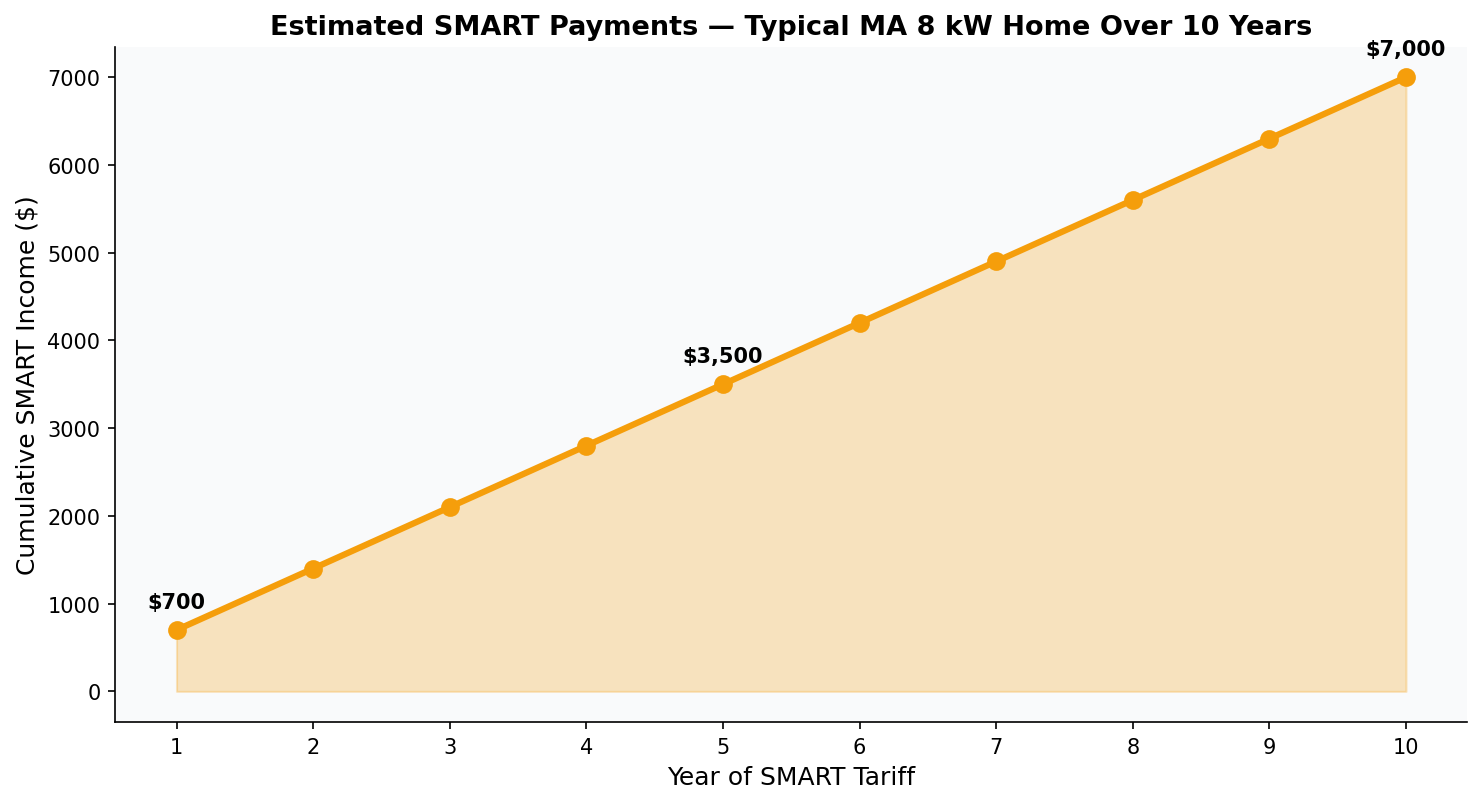
- SMART production payments — 10 years of per-kWh income, often $400–$1,200/year for a typical home system
- Massachusetts Residential Renewable Energy Income Tax Credit — 15% of system cost, capped at $1,000 (Mass. General Laws c. 62 §6(d))
- Sales tax exemption on solar equipment (6.25% saved)
- 100% property tax exemption for 20 years on the added home value from the system
- Net metering — full retail credit for excess generation, one of the strongest net-metering frameworks remaining in the U.S. [SEIA, 2025]
Stack these together and Massachusetts homeowners are still recovering meaningful chunks of system cost — just over a longer horizon than before.
So what's the actual payback in 2026?
Let's run a representative example. A Worcester-area homeowner installs an 8 kW rooftop system in early 2026:
- Installed cost: ~$24,000 (at ~$3.00/W, the 2025 EnergySage Massachusetts median) [EnergySage, 2025]
- MA state income tax credit: –$1,000
- Sales tax exemption: –$1,500 (vs. taxed equivalent)
- SMART payments (10 years, est.): –$5,500 to –$8,000 cumulative
- Net metering bill savings (25 years): –$35,000 to –$50,000 (Eversource residential rates have averaged 26–34¢/kWh in 2024–2025) [EIA, 2025]
Even without the federal ITC, that points to a payback period in the 9–12 year range for most Massachusetts homeowners, with 13–16 years of pure savings after that. The IRR is still attractive compared to most fixed-income investments — and unlike a CD, your panels keep working when electric rates climb. According to Lawrence Berkeley National Laboratory, residential PV systems are routinely producing 90%+ of nameplate capacity well past year 20. [Berkeley Lab, Tracking the Sun 2024]
Should you wait or move now?
Three reasons most Massachusetts homeowners shouldn't wait:
- Electric rates keep climbing. Eversource and National Grid have filed for and received multiple rate increases in 2024–2025, with winter supply rates hitting record highs. Locking in your own generation insulates you from those increases.
- SMART blocks fill up. Once a utility territory's current block fills, new projects move to the next, lower-paying tier. Sitting on the fence usually means a smaller incentive.
- Storage adders are still strong. Pairing a battery in 2026 takes advantage of both the SMART storage adder and Mass Save's residential battery programs (ConnectedSolutions), which pay you for letting the utility tap your battery during summer demand events.
What about leasing or a PPA?
Because the 48E commercial credit still exists for third-party-owned systems through 2026, well-run leases and PPAs in Massachusetts can offer competitive rates with no upfront cost. The trade-off: you don't own the system, you don't get the SMART payments directly (the lessor does), and you give up some long-term value in exchange for predictability and zero out-of-pocket. For homeowners who can't use the state tax credit (because they don't owe enough state tax) or who don't have cash for a down payment, a lease may pencil better than ownership in 2026 — a reversal of the conventional wisdom from prior years.
How to get an honest answer for your specific home
Solar economics in Massachusetts are hyper-local. Your roof's azimuth and shading, your utility, your tax situation, and which SMART block your project lands in all swing the math by thousands of dollars. Cookie-cutter quotes won't capture this.
That's why we built EnergyScout — a free, unbiased tool that uses NREL's PVWatts production model, your local utility rates, and a real-time database of state and federal incentives to estimate your specific savings and payback. You can also see which SMART adders apply to your situation and whether ownership or a lease will likely pencil better in your zip code.

The bottom line for 2026
The federal 30% ITC for purchased residential systems is gone, and that's a real headwind. But Massachusetts has assembled one of the most layered state-level incentive stacks in the country, and the SMART program — even at lower current block rates — continues to make solar one of the few home improvements that actually pays you back. With electric rates climbing and battery adders strong, 2026 is still a reasonable year to install for the typical Bay State homeowner.
Run your own numbers before you talk to an installer. Get a free, unbiased estimate at energyscout.org/assessment, or look up every incentive available in your zip code at our incentive search tool. Knowledge is leverage — and in 2026, you'll need it.
More Articles
Do Solar Panels Work During a Power Outage?
Most homeowners assume solar panels keep the lights on when the grid goes down. The actual answer surprises people — and the fix is simpler than you think.
Read article Battery StorageChile Hit 75% Solar in March. Here's What U.S. Homeowners Should Take From It
Chile's grid produced 29% of its electricity from solar in March, with peaks at 75%. The bottleneck wasn't generation — it was storage and transmission. Here's the homeowner takeaway.
Read article