Massachusetts SMART Program: Still Worth It in 2026?
With the federal solar tax credit expired for purchased systems, Massachusetts homeowners are reassessing solar economics.
If you've been considering solar in Massachusetts, you've likely heard about the Solar Massachusetts Renewable Target (SMART) program. As we move through 2026, many homeowners are asking: is the SMART program still a worthwhile incentive, or has the window for solar savings closed? The good news — Massachusetts remains one of the most rewarding states in the country for residential solar, and SMART continues to deliver real, monthly value to system owners well beyond the initial install.
This guide breaks down how the SMART program works in 2026, what's changed, how it stacks with other state incentives, and how to lock in a strong solar return even after the federal 30% Investment Tax Credit (ITC) expired for purchased residential systems. Let's dig in.
What Is the Massachusetts SMART Program?
Launched by the Massachusetts Department of Energy Resources (DOER) in 2018, the Solar Massachusetts Renewable Target (SMART) program is a declining-block incentive that pays solar owners a fixed per-kilowatt-hour (kWh) rate for the electricity their systems generate. The program is administered through the state's three investor-owned utilities — Eversource, National Grid, and Unitil — and replaced the older SREC (Solar Renewable Energy Credit) program.[1]
Unlike net metering alone, SMART pays you a guaranteed incentive payment for every kWh your system produces, on top of the value you receive from offsetting your own electricity bill. Payments are locked in for 10 years for residential systems under 25 kW — meaning a decade of predictable monthly checks or bill credits.[2]
How SMART Pays Out in 2026
SMART operates in capacity "blocks." As each block fills with enrolled projects, the per-kWh incentive rate steps down for the next block. By 2026, Massachusetts has worked through several blocks, but the DOER expanded the program in 2020 from 1,600 MW to 3,200 MW, and again with administrative updates in 2023 and 2024 to keep capacity flowing.[3]
For a typical residential system in 2026, base compensation rates generally land in the $0.06–$0.13 per kWh range depending on utility territory and block. On top of that, "adders" can boost the rate further:
- Energy storage adder: Pairing your solar with a battery can add roughly $0.02–$0.06/kWh.
- Low-income adder: Income-qualified households can earn an additional $0.03–$0.06/kWh.
- Community solar / off-taker adders: Available for systems serving low-income subscribers.
- Building-mounted adder: A small bonus for rooftop (vs. ground-mount) systems.
For a 7 kW rooftop system producing roughly 8,400 kWh per year, a homeowner in National Grid territory might receive between $600 and $1,000 annually in SMART payments alone — separate from the bill savings of net metering.[4]
The 2026 Federal ITC Reality Check
Here's the most important policy update Massachusetts homeowners need to understand: the federal 30% Residential Clean Energy Credit (the ITC) expired at the end of 2025 for purchased residential solar systems. That means if you buy a system outright or finance it with a solar loan in 2026, you can no longer claim the 30% federal tax credit on your return.[5]
However — and this is critical — third-party-owned systems (leases and Power Purchase Agreements) still qualify because the system owner (the leasing company) can claim the commercial ITC and pass savings through to you in the form of a lower lease rate or PPA price. For many MA homeowners in 2026, a well-priced lease or PPA may actually beat ownership math when the federal credit is off the table.[6]
This makes the SMART program even more important: it's now the primary direct cash incentive Massachusetts homeowners receive for going solar in 2026.
Stacking Incentives: SMART + Net Metering + State Tax Credit
The SMART program isn't the only Massachusetts-specific solar perk. To truly evaluate your 2026 economics, you should layer all of these:
1. Net Metering 2.0
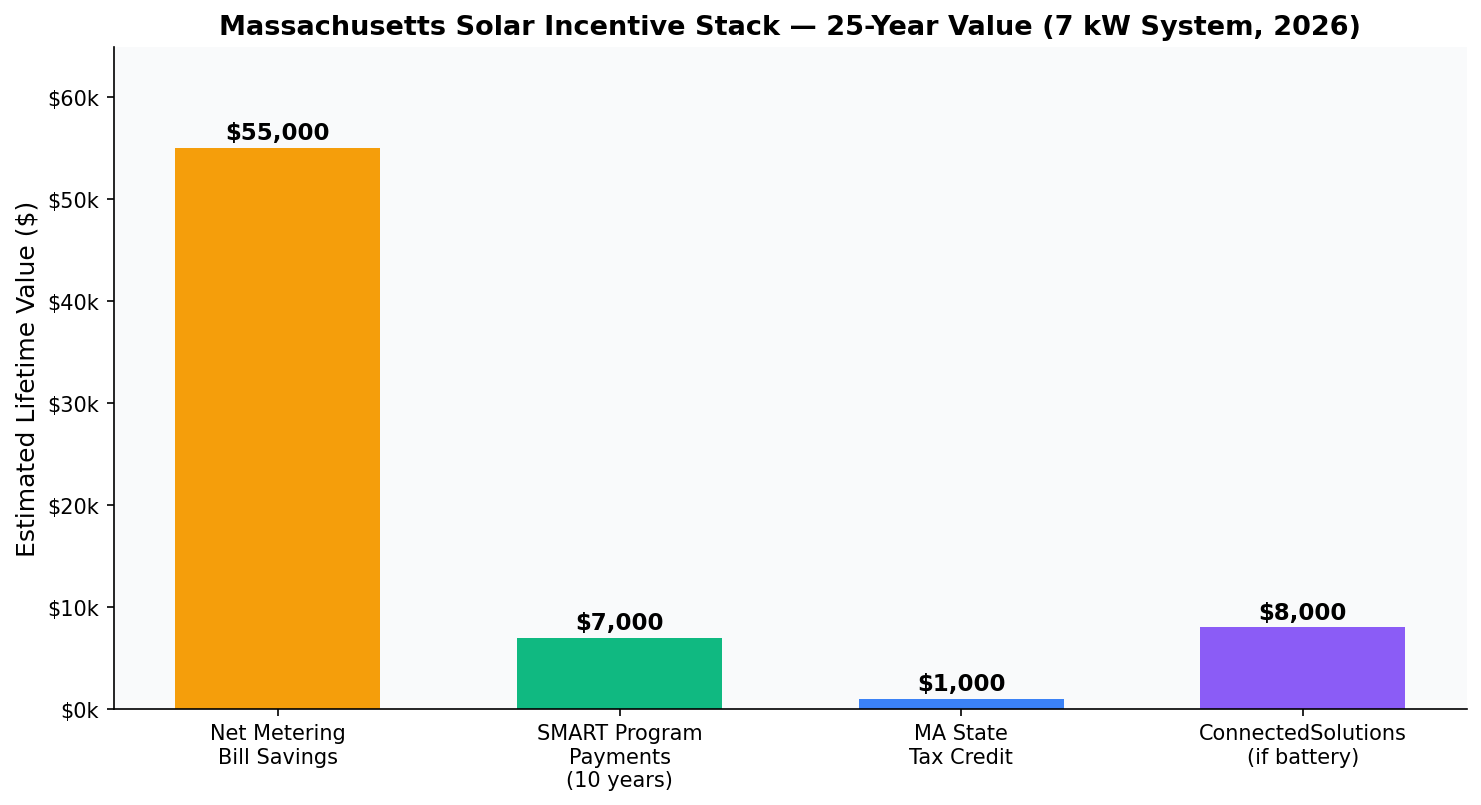
Massachusetts residential systems under 10 kW receive full retail-rate net metering credits — meaning every kWh you export to the grid offsets a kWh you'd otherwise buy at full retail price. With Eversource and National Grid residential rates frequently exceeding $0.30/kWh, this is one of the most generous net metering structures in the U.S.[7]
2. Massachusetts Residential Renewable Energy Income Tax Credit
The state offers a 15% tax credit, capped at $1,000, against the cost of a residential solar installation. Unlike the federal ITC, this state credit is alive and well in 2026.[8]
3. Sales & Property Tax Exemptions
Solar equipment is exempt from Massachusetts sales tax, and the added home value from a solar installation is exempt from local property tax assessment for 20 years.[9]
Is SMART Still Worth It? The 2026 Math
Let's run a realistic scenario for a Boston-area homeowner installing a 7 kW system in 2026:
- System cost (cash purchase): ~$21,000 (~$3.00/W after typical pricing softened post-ITC)
- MA state tax credit: –$1,000
- Net cost: $20,000
- Annual production: ~8,400 kWh
- Net metering savings (at ~$0.31/kWh): ~$2,600/year
- SMART payments (10 years): ~$700/year × 10 = $7,000
- Year-1 total benefit: ~$3,300
- Estimated payback: ~7–8 years
- 25-year net savings: $40,000+
Even without the federal ITC, Massachusetts solar still delivers strong returns thanks to high electricity prices, robust net metering, the SMART production incentive, and the state tax credit.[10]
Should You Add a Battery?
Pairing solar with battery storage has become much more attractive in Massachusetts thanks to:
- The SMART energy storage adder (additional per-kWh payment)
- ConnectedSolutions — a utility program that pays you to discharge your battery during peak demand events, often $200–$1,500+ per year per battery
- Resilience during grid outages (increasingly common with extreme weather)
According to Lawrence Berkeley National Lab's Tracking the Sun report, battery attachment rates on new residential solar installations have climbed sharply, particularly in states like Massachusetts where storage incentives stack neatly with solar incentives.[11]
How to Make the Most of SMART in 2026
Three practical steps for Massachusetts homeowners considering solar this year:
1. Run the Numbers for Your Specific Roof
Solar economics depend heavily on roof orientation, shading, utility territory, and current electricity usage. EnergyScout's free assessment tool combines NREL solar production modeling with your local utility rate to give you a personalized 25-year savings projection.
2. Verify All Eligible Incentives by ZIP Code
Programs change year to year. Use EnergyScout's incentive search tool to confirm exactly which SMART block, utility rebates, and state credits apply to your address.
3. Get Multiple Quotes from Vetted Local Installers
The single biggest factor in your solar ROI is the price you pay per watt. Getting at least three quotes from qualified Massachusetts installers regularly saves homeowners 15–25% versus accepting the first offer.[12]
The Bottom Line
Yes — the Massachusetts SMART program is absolutely still worth it in 2026. With the federal ITC gone for cash-purchased systems, Massachusetts has positioned itself as one of the few states where state-level incentives, generous net metering, and high retail electricity prices combine to make solar genuinely lucrative even without federal support. SMART payments alone can total $6,000–$10,000 over the 10-year incentive window for an average residential system.
The catch: SMART operates in declining capacity blocks, so the rate you lock in today is better than the rate available next year. Acting sooner rather than later directly affects your incentive payment for the entire decade ahead.
Take the Next Step
Find out exactly what your home is worth in solar savings — including current SMART block rates, net metering value, and verified local installer pricing — with a free assessment from EnergyScout. No phone calls, no pressure: just data.
Start your free Massachusetts solar assessment →
Sources
- Massachusetts DOER, "Solar Massachusetts Renewable Target (SMART) Program Overview"
- Mass.gov, "SMART Program Guideline: Compensation Rate Methodology"
- Massachusetts DOER, "225 CMR 20.00 SMART Regulation Updates, 2023–2024"
- EnergySage, "Massachusetts Solar Incentives & Rebates 2026 Guide"
- U.S. Department of Energy, "Residential Clean Energy Credit Sunset Provisions"
- SEIA, "Third-Party-Owned Solar and the Commercial ITC Post-2025"
- Mass.gov, "Net Metering in Massachusetts — Class I Customer Guidance"
- Massachusetts Department of Revenue, "Schedule EC: Residential Energy Credit"
- Mass.gov, "Solar Sales & Property Tax Exemptions (M.G.L. c.59 §5)"
- NREL, "Residential Solar Economics by State, 2025 Update"
- Lawrence Berkeley National Lab, "Tracking the Sun: 2024 Edition"
- EnergySage, "Marketplace Pricing & Quote Comparison Data, 2025"
More Articles
Do Solar Panels Work During a Power Outage?
Most homeowners assume solar panels keep the lights on when the grid goes down. The actual answer surprises people — and the fix is simpler than you think.
Read article Battery StorageChile Hit 75% Solar in March. Here's What U.S. Homeowners Should Take From It
Chile's grid produced 29% of its electricity from solar in March, with peaks at 75%. The bottleneck wasn't generation — it was storage and transmission. Here's the homeowner takeaway.
Read article