Nio Just Hit 100M Battery Swaps. Here's the Home Lesson.
Nio just crossed 100 million EV battery swaps, with 1 million in a single week. The headline is about cars, but the lesson is about home batteries: modular storage, deep cycling, and the economics that make solar+battery work for homeowners.
Nio, the Chinese EV maker, just announced it crossed 100 million battery swaps, including a record 1 million swaps in a single week (InsideEVs, May 2026). The headline is about electric cars in China. The lesson, though, is about something most American homeowners are quietly thinking about: does a home battery actually pay back?
Let's set the EV story aside for a minute and look at what the Nio data actually tells us about lithium-ion storage at scale — and what the same physics and economics mean for a battery hanging on the side of your garage.
What Nio's numbers prove about battery longevity
Nio's swap stations have now cycled batteries 100 million times across roughly 3,300 stations. That's a real-world stress test, not a lab projection. The Chinese Society of Automotive Engineers has reported swap-pool batteries showing 80%+ capacity retention after 1,500–2,000 full cycles, comparable to or better than fixed packs that get fast-charged repeatedly.
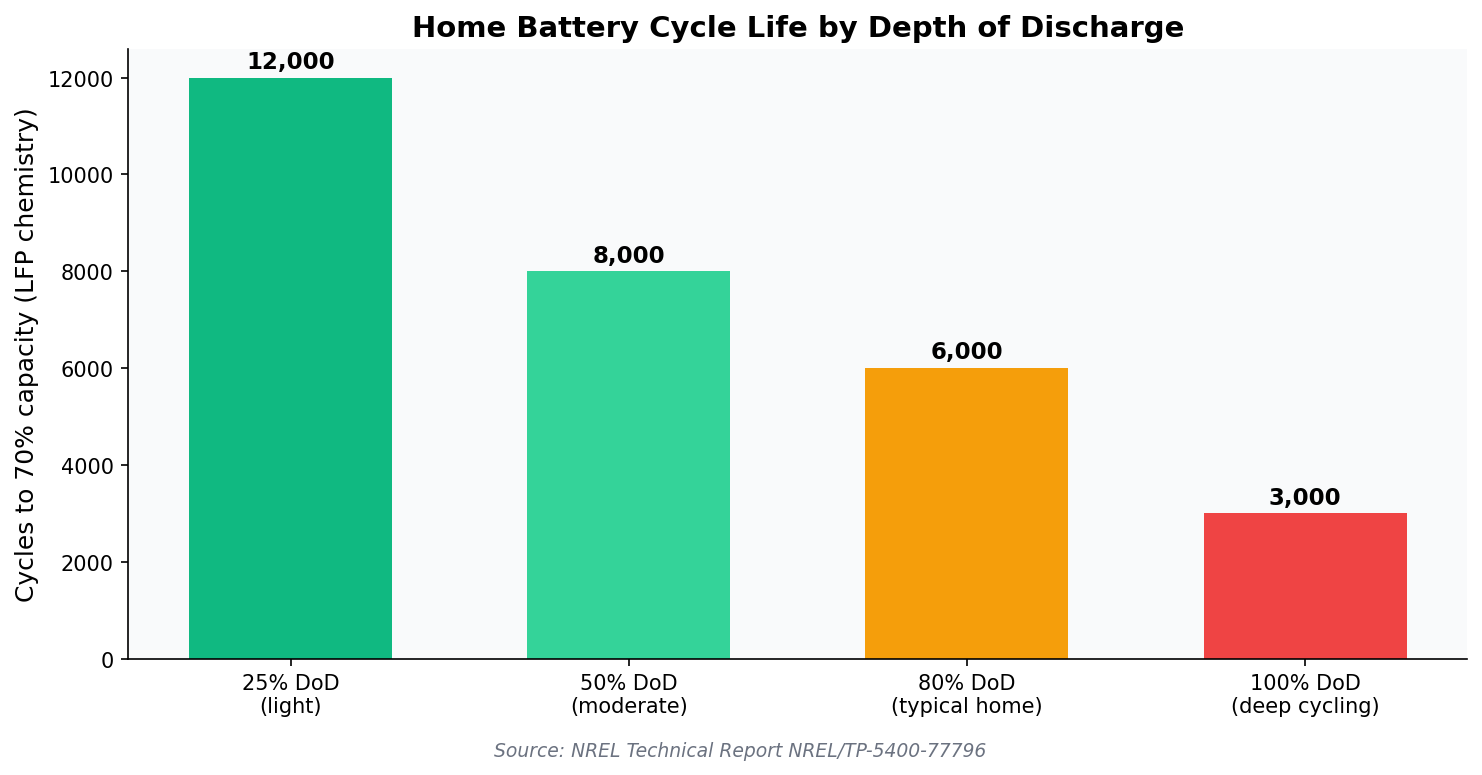
Why does that matter for your house? Because the National Renewable Energy Laboratory (NREL) uses similar cycle data to project home battery lifespans. NREL's modeling assumes a residential lithium iron phosphate (LFP) battery delivers roughly 6,000–10,000 cycles to 70% capacity when cycled gently for daily solar self-consumption (NREL Technical Report NREL/TP-5400-77796).
Translated: a home battery that gets one cycle per day will likely outlast its 10-year warranty. The Nio data is one more piece of evidence that lithium chemistry, when managed by a decent battery management system, is durable.
The home battery math, step by step
Now let's run the numbers a homeowner actually cares about. We'll use real, public data — no marketing math.
1. Sticker price
According to EnergySage's 2025 marketplace data, a 13.5 kWh home battery (think Tesla Powerwall 3, Enphase IQ Battery 5P, or Franklin aPower) installs for $11,000–$16,000 before incentives. The median quote is around $13,500.
2. Federal incentive (the part most homeowners get wrong)
Here's the part the news cycle keeps muddling: the federal 30% Investment Tax Credit (ITC) for purchased systems expired at the end of 2025 under the 2025 budget reconciliation law. Only third-party-owned systems — leases and Power Purchase Agreements (PPAs) — still qualify the system owner (the financier) for the credit, and that benefit may or may not be passed through to you in the lease price (SEIA).
So if you're buying a battery in 2026, plan on full sticker price minus state and utility rebates only. Don't budget around a 30% federal check.
3. State and utility incentives still in play
State incentives are where the real money lives in 2026. Quick examples:
- California SGIP: Up to $1,000/kWh in equity-tier territories, $150–$200/kWh in standard tier (CPUC).
- Maryland Energy Storage Tax Credit: 30% of installed cost, up to $5,000.
- Massachusetts ConnectedSolutions: Up to $1,500/kW of battery output dispatched per summer.
- Connecticut Energy Storage Solutions: Upfront incentives plus performance payments.
You can check what your ZIP code actually qualifies for using EnergyScout's incentive search:

4. The annual savings
A home battery generates value three ways:
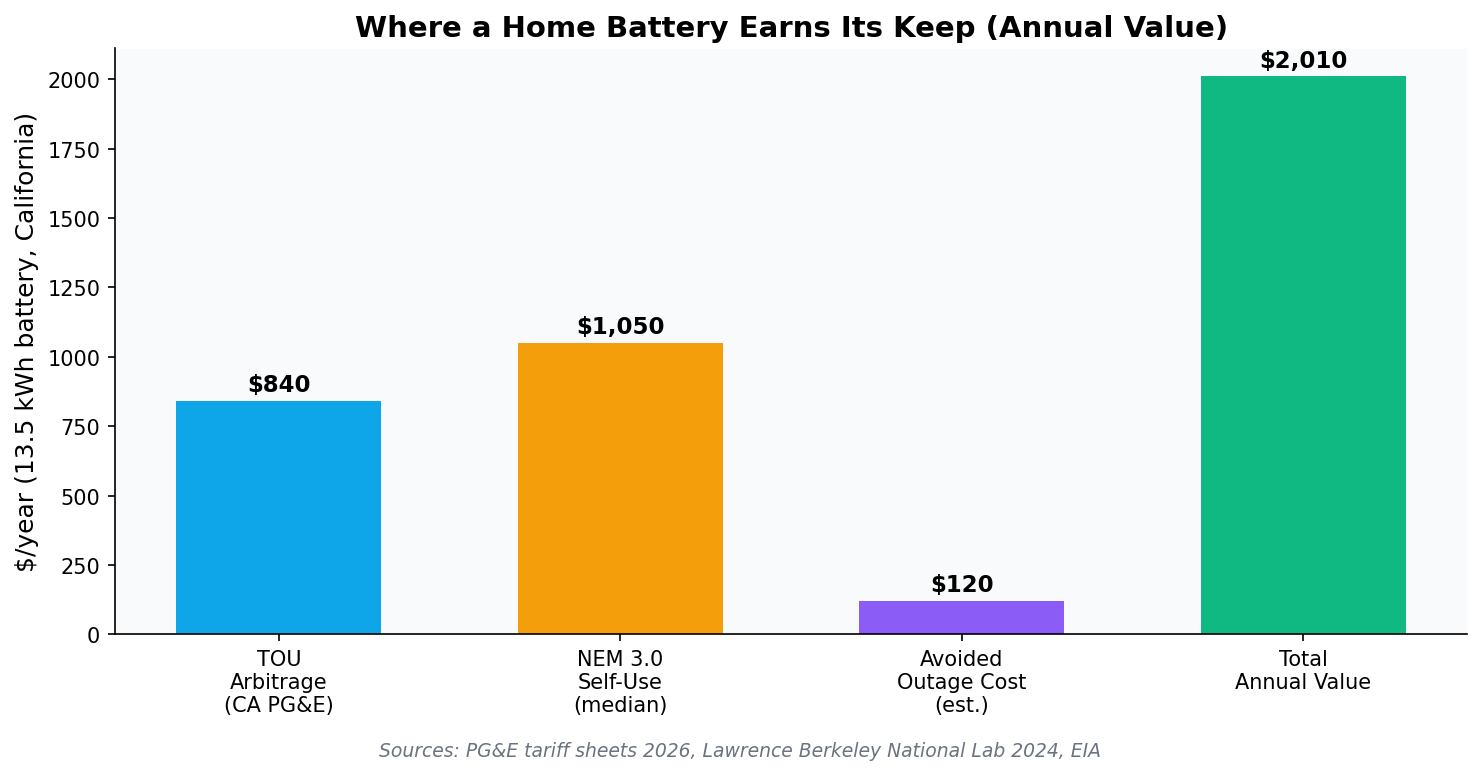
- Time-of-use (TOU) arbitrage: Charge cheap, discharge expensive. In California, the typical PG&E E-TOU-C delta between off-peak (~$0.34/kWh) and peak (~$0.55/kWh) is about $0.21/kWh (PG&E tariff sheets, 2026). A 13.5 kWh battery cycled once daily moves about 4,000 kWh/year, worth roughly $840/year.
- Solar self-consumption under NEM 3.0: California's net billing pays solar exports at avoided-cost rates around $0.05–$0.08/kWh, while imports cost $0.40+. Storing your own kWh instead of selling it back can be worth $0.30+/kWh. Lawrence Berkeley National Lab's 2024 analysis found typical NEM 3.0 households see $700–$1,400/year in additional value from a battery vs solar-only (LBNL EMP).
- Backup value: Harder to quantify, but EIA reports the average U.S. household lost 5.5 hours of power in 2022, with weather-related outages trending up (EIA).
5. Payback
Take the California example: $13,500 sticker, minus $2,025 SGIP standard-tier rebate (13.5 kWh × $150/kWh), nets to $11,475 out of pocket. At ~$1,200/year combined TOU + self-consumption savings, simple payback is 9–10 years on a battery warrantied 10 years and likely to run 12–15.
That's not a screaming deal. It's not a scam either. It's a long-duration infrastructure purchase with utility-like returns — roughly 5–7% annualized, plus resilience.
Why the Nio comparison actually holds up
Critics will argue swap-station batteries and home batteries are different beasts. They're right on details, wrong on principle.
Both rely on lithium chemistry (Nio uses NMC and LFP; home batteries are mostly LFP). Both depend on a battery management system to balance cells and prevent thermal runaway. Both face the same fundamental tradeoff: cycle deeply and often for higher utilization, or cycle gently and rarely for longer life.
Nio's choice — standardized, swappable, deeply utilized packs — is essentially a fleet operator's bet that capital cost per cycle matters more than absolute pack longevity. A homeowner is making the opposite bet: cycle the pack lightly, keep it for 12–15 years, capture utility rate spreads. Same physics, different optimization.
What this means if you're shopping in 2026
Three takeaways for U.S. homeowners watching battery headlines roll in:
- Lithium durability is not the risk anymore. A decade of fleet data says these packs last. The risk is utility rate structure changes (NEM 3.0-style export cuts, TOU spread compression).
- The federal ITC math has changed. If a salesperson quotes you a 30% federal credit on a purchased system in 2026, they're either out of date or running the old script. Verify against IRS guidance before signing.
- State and utility programs are where the value is. Run your ZIP through a database that's actually updated. Stale rebate lists are everywhere online.
Run your own numbers
Battery economics depend on your utility rate structure, your solar production, and your local incentives — not on a generic case study from somebody else's house. EnergyScout's free assessment tool pulls NREL production data for your roof, layers in your state's current incentives, and shows the payback math without a sales pitch.

If you'd rather see what's available from local installers before running the assessment, our providers directory lists vetted companies in your area, with battery brand options and pricing visibility.
Nio's milestone is interesting because it's a quiet, boring announcement — millions of cycles, no press conferences, no "world-changing" claims. That's what a maturing technology looks like. Home batteries are getting there too. The math is no longer speculative; it's just arithmetic. Go check yours at energyscout.org/assessment.
More Articles
Do Solar Panels Work During a Power Outage?
Most homeowners assume solar panels keep the lights on when the grid goes down. The actual answer surprises people — and the fix is simpler than you think.
Read article Battery StorageChile Hit 75% Solar in March. Here's What U.S. Homeowners Should Take From It
Chile's grid produced 29% of its electricity from solar in March, with peaks at 75%. The bottleneck wasn't generation — it was storage and transmission. Here's the homeowner takeaway.
Read article