30.2% Solar Cell Breakthrough: What It Means for Your Roof
Japanese researchers just hit 30.2% efficiency with an all-perovskite tandem solar cell — a leap past today's silicon panels.
Solar just hit a new milestone — and it's the kind that makes installers, engineers, and homeowners all lean in. Japanese researchers have built an all-perovskite tandem solar cell with 30.2% efficiency, pushing past the practical ceiling of traditional silicon panels and hinting at a future where your rooftop produces dramatically more energy per square foot.1
For the typical American homeowner staring at a stubborn utility bill, this isn't just lab news. It's a preview of the hardware that could make solar-plus-battery systems cheaper, smaller, and far more powerful within the next decade. Here's what the breakthrough means — and how you can take advantage of today's solar economics right now while you wait for tomorrow's panels to ship.
What Japanese Scientists Actually Built
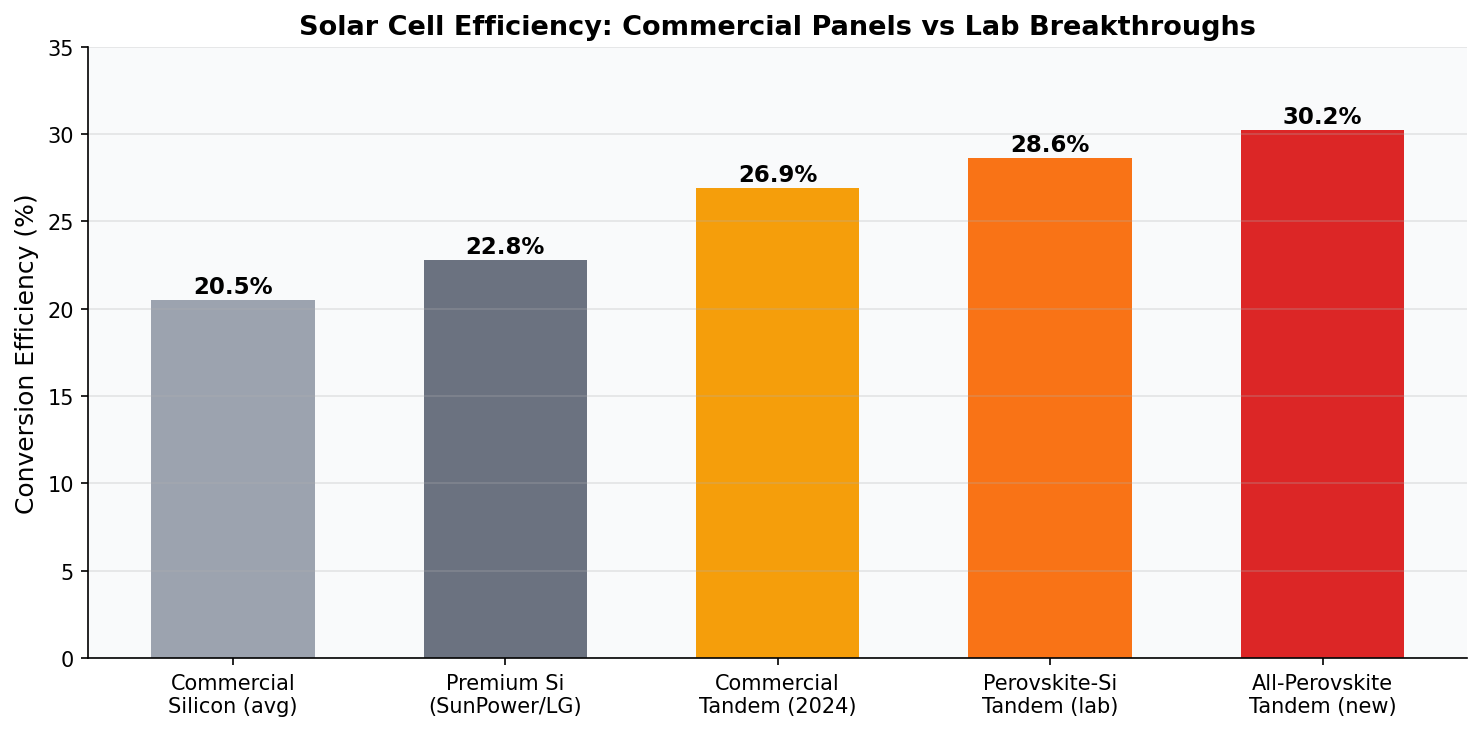
The device is a four-terminal tandem solar cell that stacks two different perovskite layers, each tuned to absorb a different slice of the sun's spectrum. A wide-bandgap top cell captures high-energy blue and green light at 24.4% efficiency. Underneath, a narrow-bandgap bottom cell — built from formamidinium lead iodide (FAPbI₃) nanoparticles — harvests the red and near-infrared light the top layer lets through, adding another 21.5% efficiency.1
Together, the two subcells convert 30.2% of incoming sunlight into electricity. For context, the commercial silicon panels on most American roofs today convert between 19% and 22%. The best monofacial silicon panels from Tier-1 manufacturers hover around 22.8%.2
Why "Spectral Splitting" Matters
Silicon is a one-trick pony: it absorbs a fixed range of wavelengths and wastes the rest as heat. Tandem cells solve that inefficiency by layering materials that each specialize in a different portion of the spectrum. The National Renewable Energy Laboratory's famous "best research-cell efficiency chart" has tracked this climb for decades, and every major leap since 2020 has come from tandem architectures.2
What's new here is that both layers are perovskite — a class of crystalline materials that can be printed or sprayed at low temperatures, unlike silicon which requires energy-intensive furnaces. That opens the door to lighter, flexible, and potentially much cheaper panels.
How Soon Will This Hit Your Roof?
Let's be honest: 30.2% in a university lab doesn't mean 30.2% on your garage roof next year. Commercialization timelines for solar innovations typically run 5–10 years, and perovskites still have durability hurdles — particularly moisture resistance and long-term stability under UV exposure.3
That said, the industry is moving fast. Oxford PV began shipping its first commercial perovskite-on-silicon tandem modules in 2024, and several Chinese and Korean manufacturers have announced pilot production lines for 2026–2027. The U.S. Department of Energy has allocated over $45 million to perovskite durability research through its Solar Energy Technologies Office.3
The practical takeaway: tandem panels will likely be available to residential installers in meaningful volume around 2028–2030, with efficiencies in the 26–28% range at the module level (lab-to-module typically loses a few points).
Why You Shouldn't Wait
It's tempting to say, "I'll hold off until the 30% panels arrive." But the math rarely works out for delay. Here's why:
1. The Federal 30% Tax Credit Already Expired for Purchased Systems
This is the big one. The federal Residential Clean Energy Credit (the 30% Investment Tax Credit) expired at the end of 2025 for purchased residential solar systems. If you buy a system today in 2026, you no longer qualify for that 30% federal credit.4
However, there's a critical exception: third-party-owned systems — leases and Power Purchase Agreements (PPAs) — still qualify under the commercial ITC (Section 48). If you go with a reputable solar lease or PPA, the installer claims the credit and passes the savings to you through a lower monthly payment or cheaper per-kWh rate.4
2. Electricity Prices Keep Climbing
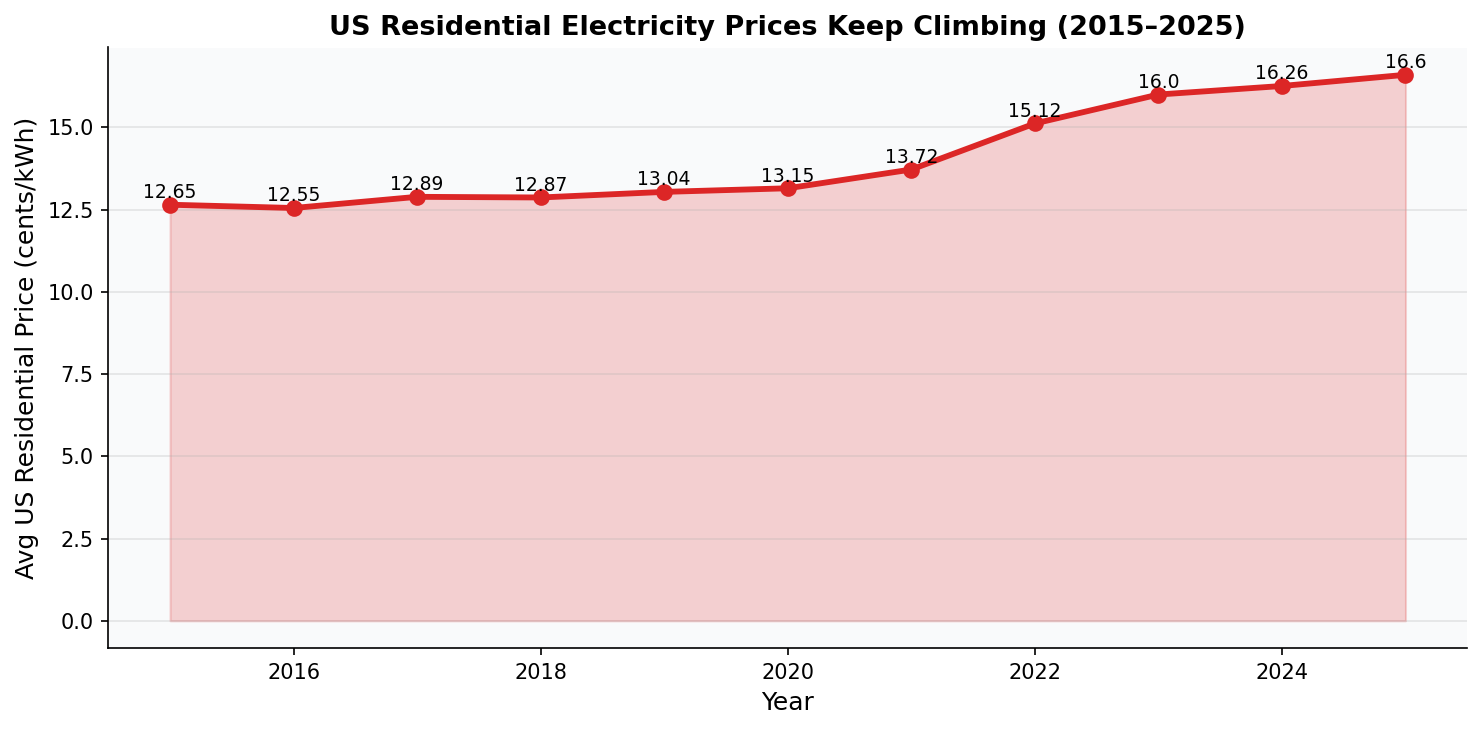
The U.S. Energy Information Administration reports that residential electricity prices rose roughly 28% between 2020 and 2025, outpacing general inflation in most states.5 California, Hawaii, Massachusetts, and New York homeowners have seen some of the steepest hikes. Every month you delay is another month of paying escalating utility rates.
3. State and Local Incentives Are Still Strong
While the federal ITC for owned systems is gone, state rebates, property tax exemptions, net metering programs, and utility-level battery incentives remain generous in many markets. Places like New York, New Jersey, Massachusetts, Illinois, and parts of California and Texas still offer $3,000–$10,000+ in combined incentives.6

The Real Efficiency Gains You Can Get Today
Let's talk numbers. Today's top-tier residential panels — LG, REC Alpha Pure, Panasonic EverVolt, SunPower Maxeon — deliver 21%–22.8% efficiency. That's plenty to power an average 2,000-square-foot American home on a properly sized 7–10 kW system.7
Lawrence Berkeley National Lab's Tracking the Sun report found that the median residential solar system installed in 2024 was 8.6 kW — enough to offset 80–100% of a typical household's annual electricity use in most sunbelt states.8
Pairing with a Battery = The Real Breakthrough
Here's what most homeowners miss: the efficiency of your panels matters less than the efficiency of your whole energy system. A solar array paired with a battery (Tesla Powerwall 3, Enphase IQ Battery, FranklinWH) lets you:
- Store cheap daytime solar and use it during expensive evening peak hours
- Keep your lights and fridge running during grid outages
- Participate in utility demand-response programs that pay you for stored energy
- Unlock time-of-use rate savings that can exceed 40% in California
The California Public Utilities Commission's NEM 3.0 structure, for example, has made batteries almost essential for new California solar projects — and the economics increasingly favor battery pairing in Texas, Arizona, and the Northeast too.9
How to Move Forward Smartly
If you're solar-curious in 2026, here's a practical three-step plan:
Step 1: Get a Personalized Assessment
Use EnergyScout's free assessment tool to estimate your roof's solar potential, annual savings, and ideal system size based on your address, utility rates, and usage. It takes about two minutes and uses NREL's PVWatts model under the hood.
Step 2: Check Your Local Incentives
Stack every dollar you can. Our zip-code incentive search pulls live state, utility, and local rebates for both solar and battery storage so you don't leave money on the table.

Step 3: Compare Vetted Installers
Getting three or more quotes is the single biggest factor in paying a fair price. EnergyScout's installer directory shows licensed, reviewed solar and battery providers in your area — without the spammy lead-selling tactics of the big aggregators.
The Bottom Line
Japan's 30.2% perovskite tandem cell is a preview of the next era of solar — one where your roof produces more electricity, panels get lighter, and system costs keep falling. But the best time to go solar isn't always "when the newest tech ships." It's when the combination of incentives, electricity prices, equipment quality, and financing works in your favor.
For many U.S. homeowners right now — particularly those in states with strong net metering, storage incentives, or time-of-use rates — that time is today, especially via a lease or PPA that still captures the 30% commercial ITC.
Ready to see what solar could save you? Start your free EnergyScout assessment and get a personalized, no-pressure look at your solar-and-battery economics in under two minutes.
More Articles
Do Solar Panels Work During a Power Outage?
Most homeowners assume solar panels keep the lights on when the grid goes down. The actual answer surprises people — and the fix is simpler than you think.
Read article Battery StorageChile Hit 75% Solar in March. Here's What U.S. Homeowners Should Take From It
Chile's grid produced 29% of its electricity from solar in March, with peaks at 75%. The bottleneck wasn't generation — it was storage and transmission. Here's the homeowner takeaway.
Read article