Solar Just Set the Biggest Energy Growth Record in History
Global solar growth in 2025 was the largest ever recorded for any energy source — outpacing oil, gas, and coal in their respective booms. Here's what that historic milestone means for homeowners weighing solar today.
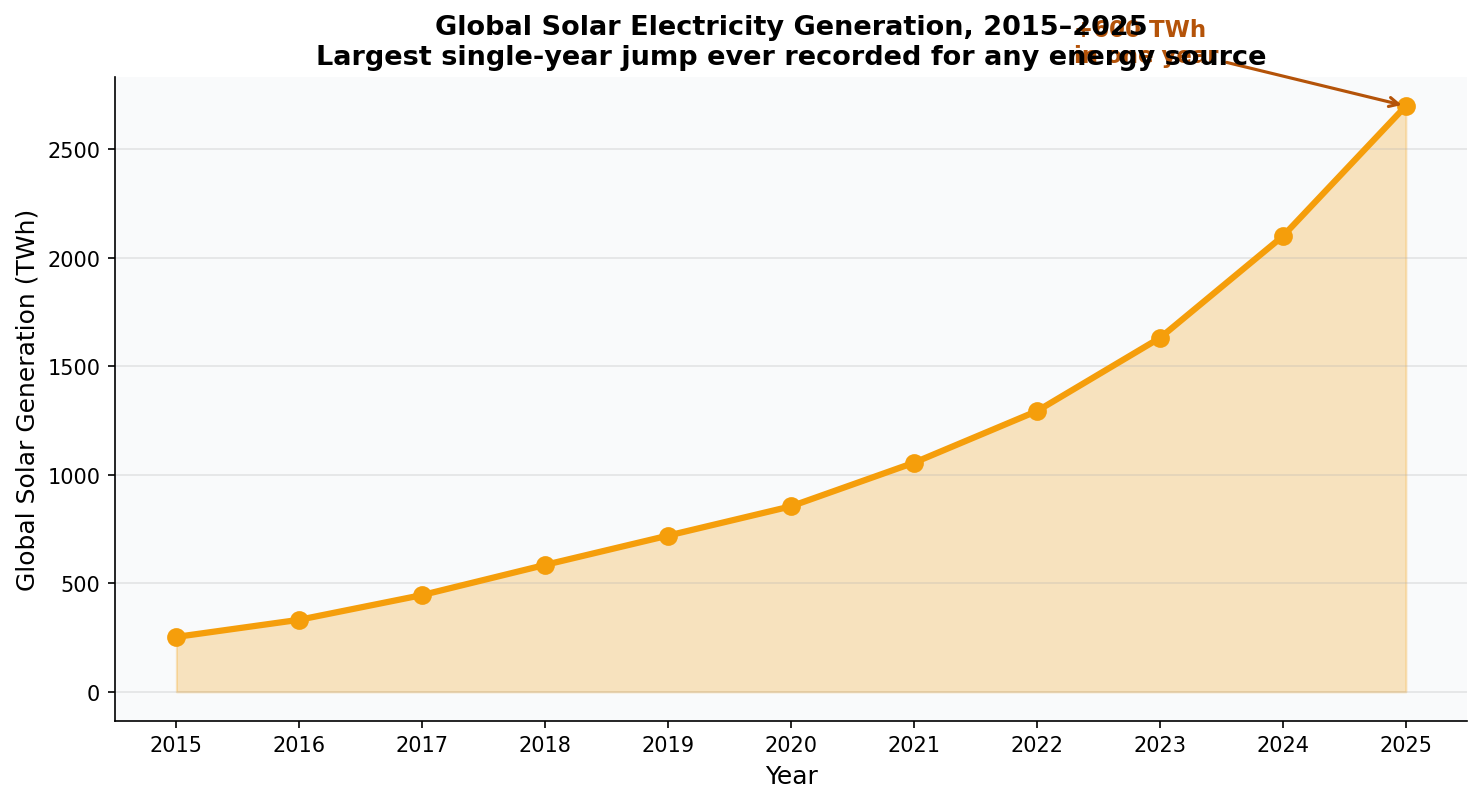
Something quietly historic happened in the world of energy last year — and it deserves more than a footnote. According to fresh analysis covered by Ars Technica on April 21, 2026, the global growth in solar electricity generation was the largest single-year increase ever observed for any energy source, period. Not just any renewable. Any source — including the great oil and gas booms of the 20th century.1
For homeowners, this isn't abstract. When a technology scales this fast, three things follow: prices keep dropping, installer networks deepen, and the case for going solar — especially paired with battery storage — becomes harder to ignore. Let's unpack what happened, why it matters for your roof, and how to act on it.
The Record That Broke Every Record
The International Energy Agency (IEA) tracks year-over-year additions to electricity generation across every fuel: coal, natural gas, nuclear, hydro, wind, solar — everything. In 2025, solar added more terawatt-hours of new generation in a single year than any source has ever added before in the agency's records.2 That includes the peak years of US shale gas, Chinese coal expansion, and the post-WWII oil surge.
The U.S. Energy Information Administration (EIA) reports that solar accounted for the majority of new utility-scale capacity added to the American grid in 2025, and projections show that trend continuing through 2027.3 Lawrence Berkeley Lab's Tracking the Sun series likewise shows installed prices for residential solar continuing their multi-decade decline.4
Why the surge accelerated now
- Module prices collapsed. Global solar module prices fell to historic lows in 2024–2025, making installations cheaper even as labor costs rose.
- Battery storage matured. Lithium-ion battery pack prices dropped below $115/kWh in 2024, per BloombergNEF — making solar+storage genuinely economic without subsidies in many states.
- Grid demand exploded. Data centers, electrification of heat and transport, and rising AC demand created the largest electricity demand growth in two decades, and solar is the fastest source to deploy.
What This Means for Your Home
Record-breaking deployment is great news for the planet — but the more interesting question is: does it change the math for your house? Short answer: yes, in three concrete ways.
1. Hardware is cheaper than ever
SEIA's most recent market report shows the median residential solar system installed in 2025 was around 30% cheaper per watt than in 2018.5 EnergySage's marketplace data confirms the trend at the homeowner level: more competitive bids and tighter pricing across most ZIP codes.6
2. Battery storage is finally a no-brainer in many markets
This is the change very few homeowners realize yet. With solar-only systems, the value proposition depended heavily on net metering. But across states like California, Arizona, and Texas, utilities have moved to time-of-use rates and "net billing" structures that significantly reduce the value of midday solar exports. The CPUC's NEM 3.0 rules in California, for example, dropped export rates by roughly 75% versus the prior regime.7
The fix? Pair solar with a battery. You store cheap midday production and use it during expensive evening peaks. With battery costs at all-time lows and federal incentives still available for storage paired with new solar systems, the payback math now favors solar+battery in most high-rate markets.
3. Installer choice has expanded — but quality varies
Booming demand pulled thousands of new installers into the market. That's good for competition, but bad if you pick the wrong one. Quality, financing structures, and warranty fulfillment vary wildly. Vetted installer directories matter more than ever.
The Federal Incentive Picture in 2026 (Important)
Here's the part the news cycle keeps getting wrong. The federal 30% Investment Tax Credit (ITC) for purchased residential solar systems expired at the end of 2025. If you buy a system outright or finance it with a solar loan in 2026, you do not get the 30% federal credit.
However:
- Leases and Power Purchase Agreements (PPAs) still qualify. The third-party owner (the leasing company) claims the commercial ITC and passes the savings through as a lower monthly payment. For many homeowners — especially those with limited tax appetite — this is now the most attractive financial structure.
- State and utility incentives remain robust. Many states have stepped up with rebates, performance payments, and storage-specific credits. New York's NY-Sun, Massachusetts' SMART program, and Illinois' Shines program all continue.8
- Battery storage incentives exist independently of solar in several states, including California's SGIP and Maryland's energy storage tax credit.
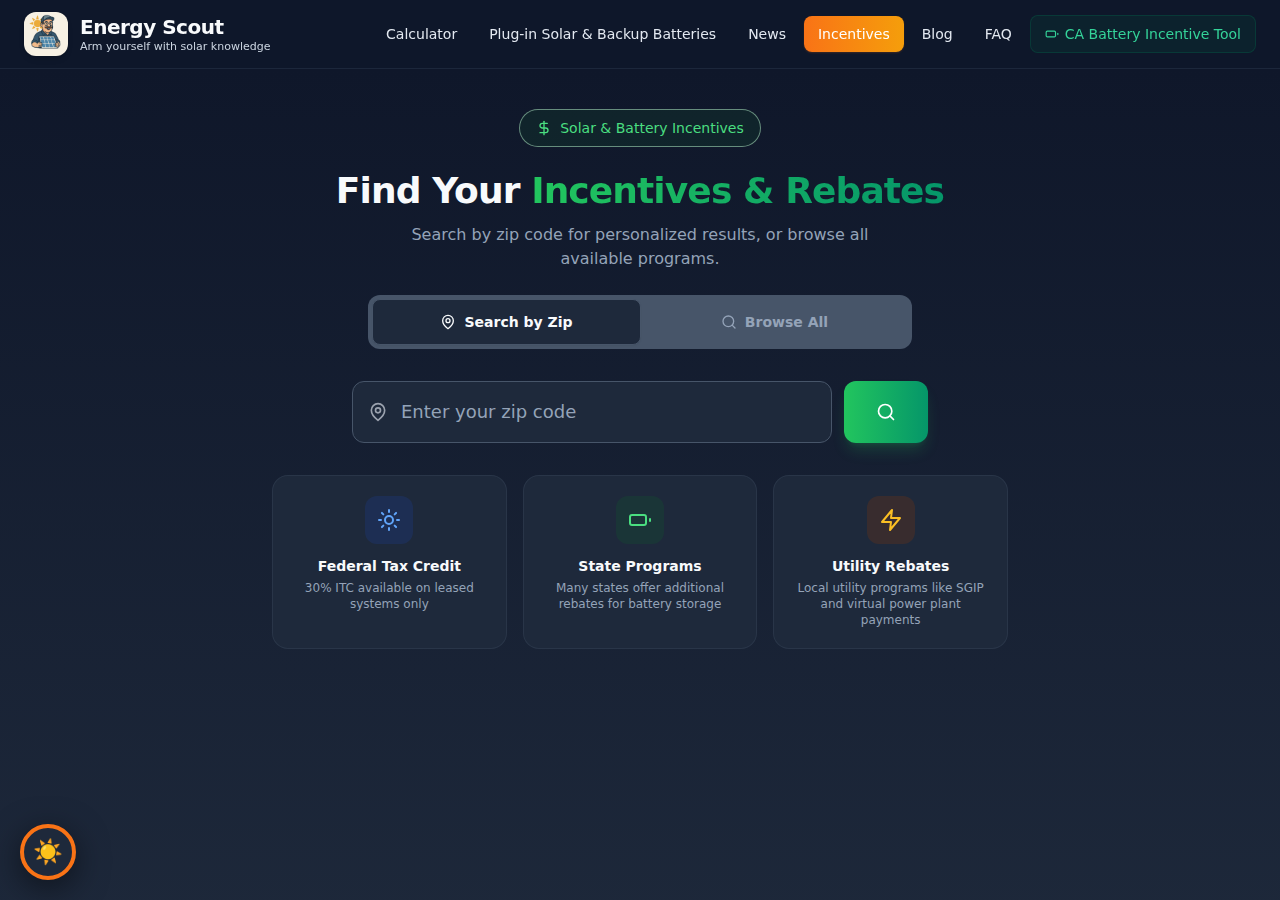
EnergyScout's free incentive search tool pulls the current incentive stack for your ZIP code so you can see exactly what you qualify for in 2026 — no guessing, no outdated 30% ITC assumptions.
So What's the Smart Move in 2026?
The historic surge in solar deployment isn't a reason to panic-buy. It's a reason to be methodical. Here's the EnergyScout playbook for homeowners thinking about solar this year.
Step 1: Get an honest, no-obligation estimate
Before you talk to a single installer, run the numbers yourself. EnergyScout's free solar assessment tool uses NREL's PVWatts model — the same engine used by professional designers — to estimate your roof's production, savings, and payback based on your address and electricity rates.9
Step 2: Identify every dollar of incentive you qualify for
Federal, state, utility, and local incentives stack in unpredictable ways. Knowing your full incentive picture before you negotiate gives you leverage. Use the incentive lookup.
Step 3: Compare 3+ vetted local installers
Get quotes from at least three installers, and use a vetted directory. Cheapest isn't always best — warranty terms, monitoring, and financing structure matter as much as price.

Step 4: Decide the financing structure deliberately
Cash purchase, solar loan, lease, or PPA — each has different tax, ownership, and resale implications. Post-ITC expiration, the cash purchase advantage has narrowed for many households. Run the numbers with and without the ITC available, and pick what genuinely fits your situation.
The Bigger Picture
When a technology grows this fast, it's usually a sign of a phase change in the underlying economics. Solar didn't break the all-time energy growth record because of subsidies — most of the deployment happened in markets where solar is now the cheapest new generation source on a levelized cost basis, full stop.10 The Department of Energy's SunShot program targets, set a decade ago and considered ambitious then, have been met or exceeded across utility, commercial, and residential segments.
For homeowners, this means the question has shifted. It's no longer "will solar work for me?" — for most US homes with reasonable sun exposure, it will. The questions are: which configuration, which financing, and which installer. Those are answerable in an afternoon with the right tools.
Take the Next Step
The largest one-year energy growth ever recorded happened on rooftops, in deserts, and on warehouse roofs all over the world. It can keep happening on yours, too — and the economics have rarely been better.
👉 Run your free EnergyScout assessment in under 2 minutes and see exactly what solar (and storage) could do for your home in 2026. No pushy salespeople. No spam. Just data.
Sources:
1. Ars Technica, "Global growth in solar 'the largest ever observed for any source,'" April 21, 2026.
2. International Energy Agency, Renewables 2025 annual market report.
3. U.S. Energy Information Administration, Short-Term Energy Outlook, 2026.
4. Lawrence Berkeley National Laboratory, Tracking the Sun, 2025 edition.
5. Solar Energy Industries Association (SEIA) / Wood Mackenzie, U.S. Solar Market Insight, 2025.
6. EnergySage, Solar Marketplace Report, H2 2025.
7. California Public Utilities Commission, NEM 3.0 / Net Billing Tariff decision.
8. Database of State Incentives for Renewables & Efficiency (DSIRE).
9. NREL PVWatts Calculator, National Renewable Energy Laboratory.
10. Lazard, Levelized Cost of Energy Analysis, version 17.0.
More Articles
Do Solar Panels Work During a Power Outage?
Most homeowners assume solar panels keep the lights on when the grid goes down. The actual answer surprises people — and the fix is simpler than you think.
Read article Battery StorageChile Hit 75% Solar in March. Here's What U.S. Homeowners Should Take From It
Chile's grid produced 29% of its electricity from solar in March, with peaks at 75%. The bottleneck wasn't generation — it was storage and transmission. Here's the homeowner takeaway.
Read article