Solar and Wind Powered 2025's Global Energy Growth
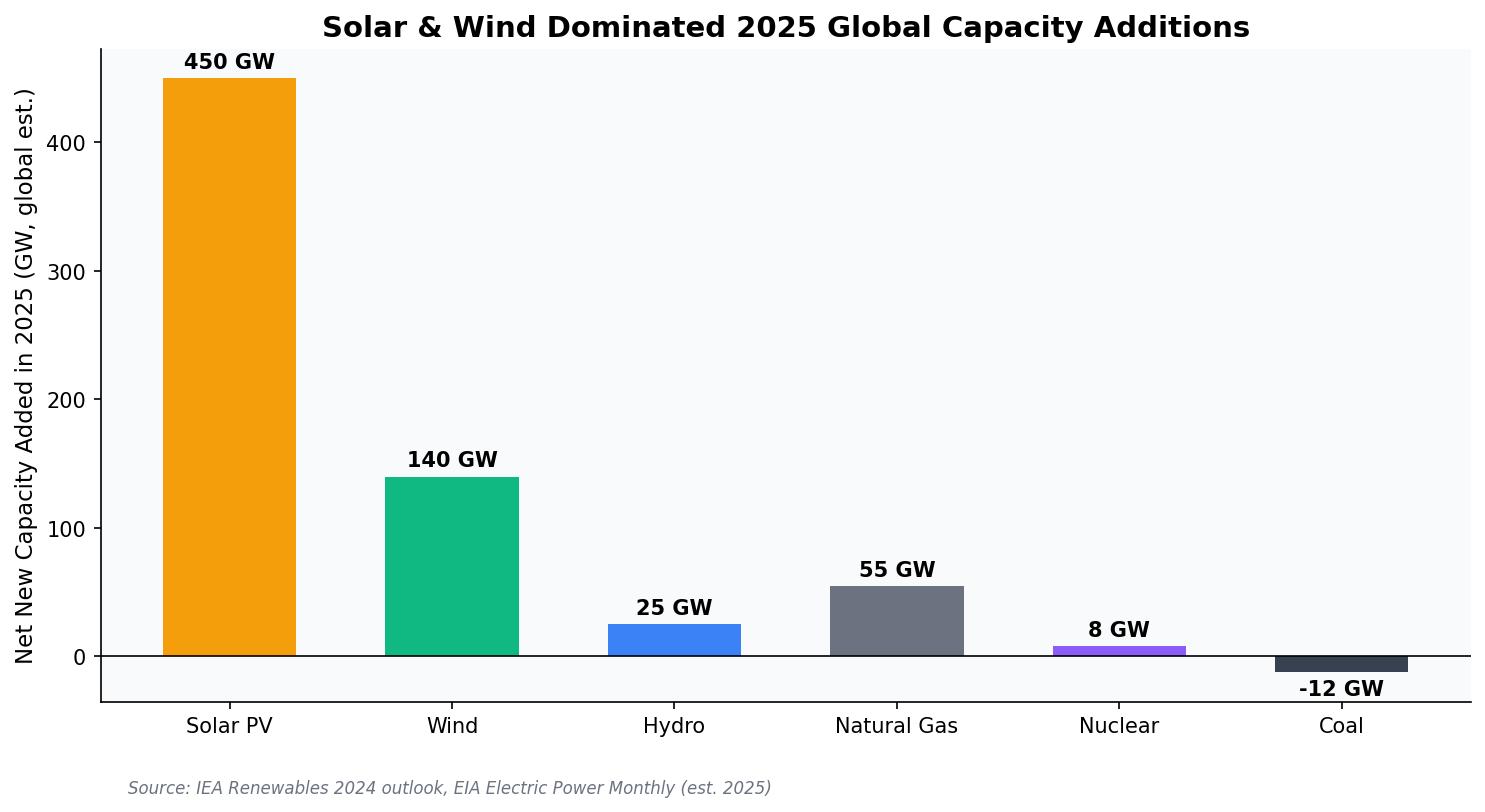
In 2025, solar and wind delivered roughly six times more new electricity capacity than every other power source combined.
The world just quietly crossed a threshold most homeowners haven't heard about yet. According to new global generation data, solar and wind delivered roughly six times more new electricity capacity in 2025 than every other power source combined, and together they supplied nearly all of the year's new electricity demand. Countries like Australia, Spain, Germany, and the Netherlands are now running on grids where renewables are the dominant source of growth — not a supplement, but the main engine.
For a US homeowner staring at another utility rate hike, that's more than a headline. It's a signal that the technology on your roof is finally cheaper, faster to deploy, and more resilient than anything your utility is building. Let's unpack what the 2025 numbers mean and how you can turn this global shift into lower bills at home.
What the 2025 data actually shows
The International Energy Agency (IEA) has tracked renewable capacity additions for over two decades, and 2025 marks the most lopsided year on record. Solar alone accounted for the majority of new global generating capacity, continuing a trend the IEA flagged in its Renewables 2024 outlook, which projected solar PV would account for roughly 80% of renewable growth through 2030.
The US Energy Information Administration (EIA) confirms this isn't just an overseas story. In its Electric Power Monthly, the EIA reported that solar was the fastest-growing source of new US generation for the third year in a row, with utility-scale solar plus distributed rooftop systems continuing to outpace natural gas additions.
Why the shift accelerated
Three forces converged in 2025:
- Module prices kept falling. The National Renewable Energy Laboratory (NREL) tracks installed system costs quarterly. In its U.S. Solar Photovoltaic System and Energy Storage Cost Benchmark, NREL documented residential installed costs continuing a decade-long decline, even as labor and soft costs held steady.
- Battery storage became mainstream. Lawrence Berkeley Lab's Tracking the Sun report shows battery attachment rates for new residential solar systems climbing past 25% nationally and above 80% in California, where net metering reforms made storage essential for payback.
- Interconnection queues cleared. Utilities under pressure from the Department of Energy (DOE) accelerated approvals, shortening the wait between contract signing and turn-on.
Why a homeowner in Ohio should care about Australia
Global scale drives local savings. When Australia, China, and the EU collectively install hundreds of gigawatts of solar, the factories running 24/7 to meet that demand are the same factories supplying panels to your local installer. More volume means lower unit costs, better quality control, and longer warranties — typically 25 to 30 years on panels from Tier-1 manufacturers.
The same is true for batteries. Every Tesla Powerwall, Enphase IQ Battery, or FranklinWH unit installed on a home in Texas benefits from the manufacturing efficiencies forged by grid-scale deployments in Europe and the Asia-Pacific region. The SEIA's U.S. Solar Market Insight reports have consistently shown residential battery costs trailing grid-scale by roughly 18 months — meaning today's home systems are benefiting from 2023-era utility pricing.
What changed in 2026: the ITC reality check
There's one piece of news every homeowner needs to understand clearly. The federal 30% Residential Clean Energy Credit (Section 25D) expired at the end of 2025 for purchased systems. If you buy a solar system today with cash or a loan, you can no longer claim the 30% federal tax credit on your personal return.
However, the Investment Tax Credit (ITC) under Section 48 is still available for commercial systems — which is how third-party-owned leases and Power Purchase Agreements (PPAs) qualify. When a solar company owns the equipment on your roof and sells you the electricity, they claim the ITC and pass a portion of that value through to you in the form of a lower monthly payment.
What this means practically
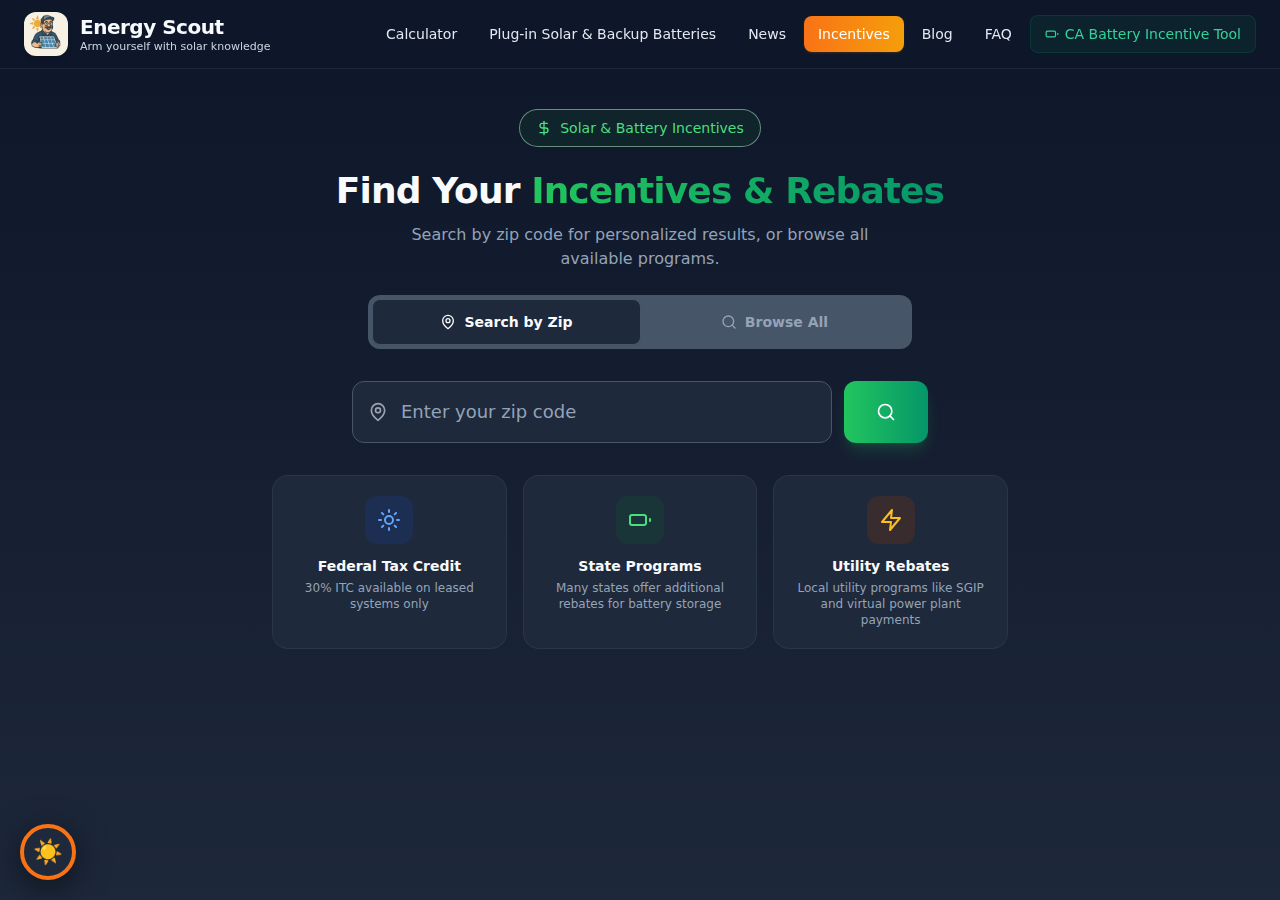
- Cash/loan buyers: No more federal credit, but state and utility incentives still exist — and many are generous. Our zip-code incentive search pulls the current rebates for your exact address.
- Lease/PPA customers: Still benefit indirectly from the 30% ITC, typically reflected as a lower monthly rate than you'd pay your utility.
- Battery-only buyers: Standalone residential batteries also saw the 25D expiration. But commercial-scale batteries tied to a third-party-owned solar system still qualify.
The homeowner's playbook for 2026
With federal credits narrower, the winning strategy is sharper quotes and smarter financing. Here's how to approach it.
1. Get a real-world savings estimate first
Before you talk to an installer, run your address through a free assessment. EnergyScout's solar assessment tool uses NREL's PVWatts model, your utility rate, and Google's solar potential data to estimate annual production and savings. Knowing your rough numbers before a sales call is the single best defense against over-priced proposals.
2. Compare three installers — minimum
EnergySage's annual Marketplace Report has repeatedly shown that homeowners who get at least three quotes save 10–20% versus those who accept the first offer. Our vetted provider directory is filtered for NABCEP-certified installers and customer reviews, so you're comparing apples to apples.

3. Decide: own or lease?
The decision now hinges almost entirely on whether you want the 30% ITC value. If you have significant tax liability and you're planning to stay in your home 7+ years, a cash purchase still wins on lifetime savings — you just don't get a federal kicker to sweeten year one. If you want zero money down and immediate monthly savings, a lease or PPA is structured to deliver exactly that, with the installer capturing the ITC and discounting your rate.
4. Stack state and utility incentives
The California Public Utilities Commission (CPUC) SGIP program still offers storage rebates. New York's NY-Sun program continues megawatt-block incentives. Massachusetts SMART, Illinois Shines, and dozens of utility-specific rebates remain in force. These are not affected by the federal expiration and often make the math work without the ITC.
The bigger picture: homeowners as part of the solution
When the DOE talks about decarbonizing the grid, they're not just talking about utility-scale wind farms in Wyoming. They're counting on every rooftop. Distributed residential solar was one of the fastest-growing segments of new US capacity in 2025, and with battery attachment rates climbing, homeowners are becoming genuine grid participants — selling power back during peak, shaving their own peaks, and riding through outages.
The SEIA estimates residential solar will account for 7–9 GW of new capacity annually through the rest of the decade. That's the equivalent of multiple nuclear reactors — built one roof at a time.
What to do this week
If the 2025 data tells us anything, it's that the window for cheap, well-supported residential solar has never been more open. The ITC change is real, but it's not the end of good economics — it's just a shift in how you capture the value.
- Run a free EnergyScout assessment for your address — takes under two minutes.
- Pull your current state and utility incentives to see what's still on the table.
- Request quotes from 3 vetted installers in your zip code.
The global grid is being rebuilt around solar and wind. You don't have to wait for your utility to catch up. Start at energyscout.org and put the 2025 momentum to work on your next power bill.
More Articles
Do Solar Panels Work During a Power Outage?
Most homeowners assume solar panels keep the lights on when the grid goes down. The actual answer surprises people — and the fix is simpler than you think.
Read article Battery StorageChile Hit 75% Solar in March. Here's What U.S. Homeowners Should Take From It
Chile's grid produced 29% of its electricity from solar in March, with peaks at 75%. The bottleneck wasn't generation — it was storage and transmission. Here's the homeowner takeaway.
Read article