Brooklyn's Sunset Park Solar: Community Power for Renters
Brooklyn's Sunset Park Solar project delivers 20% utility-bill discounts to 200 families and small businesses across two zip codes.
When the 685 kW array on top of the Brooklyn Army Terminal hums to life each morning, it does something most rooftop solar systems can't: it delivers a 20% discount on the electric bill of 200 families and small businesses across two Brooklyn zip codes — whether or not those participants own a single square foot of roof. That's the promise of Sunset Park Solar, a community-owned project profiled this week in Progressive Magazine, and it's quickly becoming the blueprint for how the roughly 80% of U.S. households that can't host panels finally get a seat at the clean-energy table.1
The timing matters. The federal Residential Clean Energy Credit — the 30% tax credit that for a decade made owning a home solar system a no-brainer — expired for purchased systems at the end of 2025.2 Homeowners can still capture the 30% through a third-party-owned lease or power purchase agreement (PPA), where the installer claims the commercial credit and passes savings through. But for renters, low-income households, and anyone with a shaded or north-facing roof, the community solar model that Sunset Park pioneered is becoming the fastest path to savings.
What Makes Sunset Park Different
Unlike a typical community solar farm — where a developer owns the array and sells subscriptions — Sunset Park Solar is governed by UPROSE, a Latino-led environmental justice group that has organized in the neighborhood for decades. Residents helped design the project, and the discount flows directly to their Con Edison bills as a credit, with no enrollment fee, no credit check, and no cancellation penalty. Of the 200 subscriber slots, a majority are reserved for low- and moderate-income households in zip codes 11220 and 11232.3
That governance model — cooperative rather than purely commercial — is increasingly seen as the gold standard. The U.S. Department of Energy's National Community Solar Partnership set a goal of powering 5 million households with community solar by the end of 2025, with a focus on projects that deliver at least 20% bill savings to subscribers.4 Sunset Park hits that number on the nose.
The Numbers Behind the Boom
Community solar is no longer a niche. According to the Solar Energy Industries Association (SEIA) and Wood Mackenzie, the U.S. now has more than 8.6 gigawatts of community solar capacity across 44 states and Washington, D.C., with roughly 1 million subscriber accounts.5 Two states are lapping the field:
- Minnesota recently crossed 25,000 community solar subscribers, making it the per-capita leader. Its "Solar*Rewards Community" program, launched in 2013, is the country's longest-running.6
- New York has permitted more than 1,300 community solar projects under the NY-Sun initiative, adding over 2 GW of capacity and making it the single largest community solar market by installed MW.7
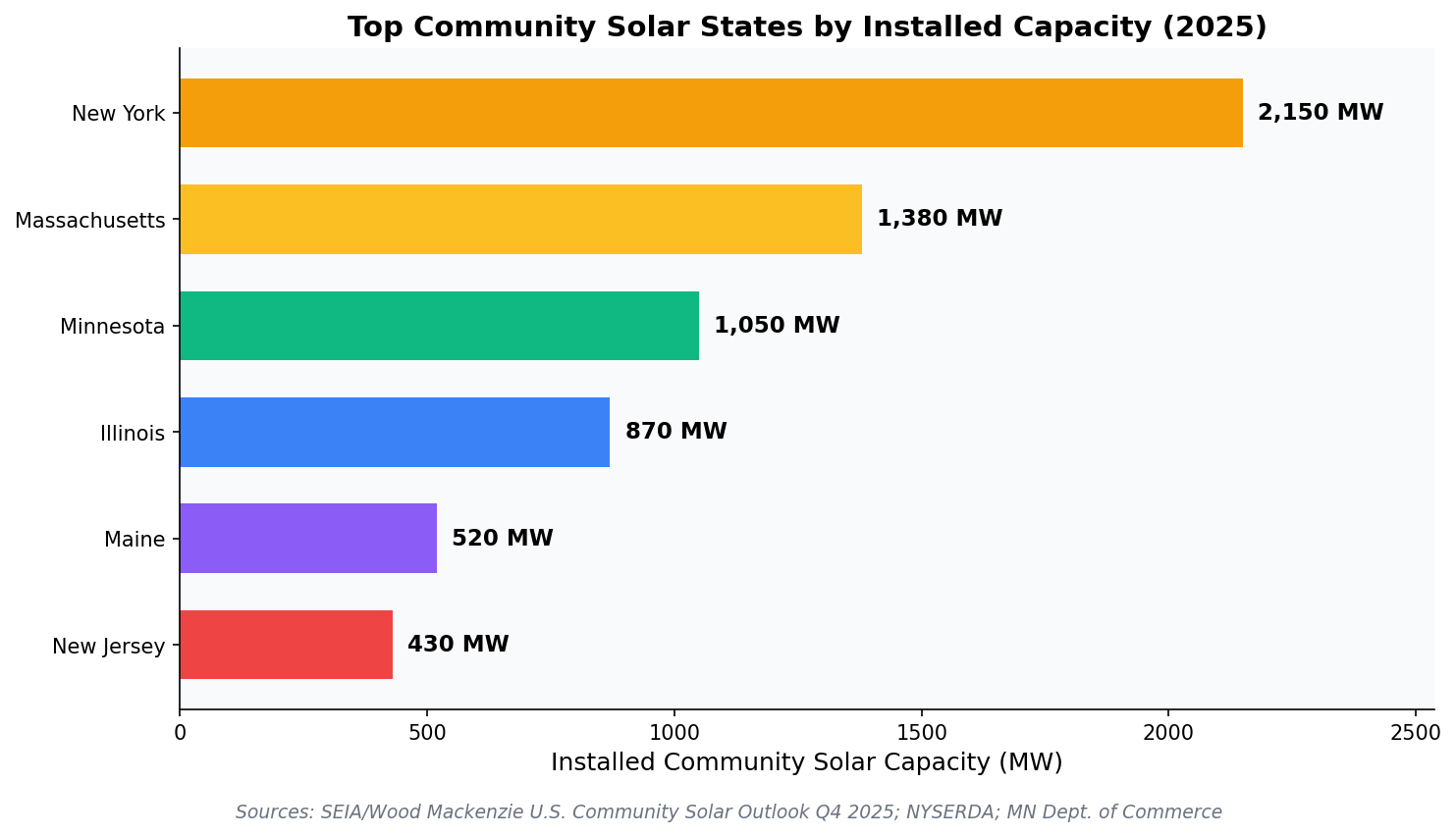
Illinois, Massachusetts, Maine, and New Jersey round out the top six. Together, these states prove the model scales — but only when regulators mandate bill-credit portability and low-income carve-outs.
Who Community Solar Actually Reaches
Rooftop solar has long had an equity problem. A 2023 Lawrence Berkeley National Laboratory study found that the median household adopting residential solar earned about $117,000 — well above the U.S. median of roughly $75,000 — and that adopters were disproportionately homeowners in single-family houses.8 That leaves out:
- Renters (about 35% of U.S. households)
- Condo and co-op residents
- Homeowners with unsuitable roofs (shading, orientation, age, or structural issues)
- Households that don't owe enough federal tax to use a credit
Taken together, that's roughly 80% of U.S. households that cannot practically install rooftop solar — the exact constituency Sunset Park was built to serve.1 Community solar doesn't require a roof, a credit check, or even ownership of the home. In most states, subscribers can take their bill credit with them if they move within the utility's territory.
How the Bill Credits Actually Work
The mechanics are simpler than they sound. A community solar farm generates electricity and feeds it into the grid. The utility measures that output and issues a virtual net metering credit, which is then allocated across subscribers based on their share of the project. That credit appears as a line item on the subscriber's monthly utility bill — typically valued at the retail rate or a regulated community-solar rate.
In a well-designed program like New York's, subscribers pay the community solar developer a subscription fee that is set below the credit they receive, locking in net savings of 10–20% each month. There's no panel on your roof, no inverter in your garage, and no maintenance call to make when a squirrel chews a wire.
Community Solar vs. Rooftop Solar + Battery: Which Is Right for You?
Community solar is a clear win for renters and households without roof access. But if you own your home and have a viable roof, the calculus is different — especially now that battery storage has become the centerpiece of modern residential systems.
According to EnergySage's Solar & Storage Marketplace Report, more than 60% of residential solar quotes in 2025 included a battery, up from under 15% in 2020.9 The reasons are practical:
- Time-of-use rates now dominate in California, New York, Massachusetts, and a growing list of states, making mid-day solar exports worth less and evening consumption worth more. A battery arbitrages the difference.
- Net-metering reforms — most notably California's NEM 3.0 — have cut export credits by up to 75%, making self-consumption (via battery) the core value proposition.10
- Resilience: a battery keeps the fridge, router, and a few lights running when the grid goes down, which matters more every hurricane, heat-dome, and wildfire season.
The federal 30% credit is still available for home solar + battery — but only via a lease or PPA since the end of 2025. Many state and utility incentives stack on top: New York's NY-Sun rebate, Massachusetts' SMART program, California's Self-Generation Incentive Program (SGIP) for batteries, and dozens of local utility rebates.11 Our zip-code incentive search shows you what's available at your exact address in about ten seconds.
What the Sunset Park Model Gets Right
Three features explain why Sunset Park is being copied from Buffalo to Baltimore:
1. Community Ownership, Not Just Community Access
UPROSE's governance role means decisions about pricing, subscriber selection, and eventual reinvestment of surplus revenue stay in the neighborhood. Contrast that with subscription-only models where an out-of-state developer pockets the spread.
2. Anchor Tenant Plus Low-Income Carve-Out
Sunset Park pairs a stable commercial anchor (the Brooklyn Army Terminal) with a guaranteed number of low-income residential slots. The anchor de-risks project financing; the carve-out ensures the savings land where they're needed most.
3. Bill-Credit Simplicity
No separate invoice, no app-based enrollment maze. The discount appears on the same Con Edison bill residents already pay, which dramatically boosts signup and retention — especially in households that have been burned by predatory energy retailers.
How to Find Community Solar Near You
Not every state has a functioning community solar market — as of 2025, only 22 states plus D.C. have enabling legislation, and program designs vary widely.5 Here's a practical checklist:
- Check your state's energy office website or the DOE's National Community Solar Partnership directory. Look for programs with "low-and-moderate-income" (LMI) carve-outs if you qualify.
- Read the subscription contract carefully. A reputable project should have no cancellation fee, a guaranteed minimum discount, and portability within the utility territory.
- Compare against a home solar quote. If you own your home, run the numbers both ways. Our free solar assessment tool models your roof's production, your utility rate, and current incentives in under two minutes.
- Vet the installer if you go the home-solar route. Our local installer directory lets you compare licensed, reviewed contractors in your zip code.
The Bigger Picture
The U.S. Energy Information Administration projects that solar will account for nearly 60% of all new U.S. electricity capacity added in 2026, more than any other source.12 The question is no longer whether the grid goes solar — it's who benefits as it does. Sunset Park's answer: everyone on the block, not just the homeowner with the south-facing roof.
For renters, community solar is the fastest way to lock in bill savings this year. For homeowners, a solar-plus-battery system — financed via a lease or PPA to capture the 30% federal credit, or purchased with state and utility incentives — remains one of the highest-return home upgrades available, especially as utility rates continue their steady climb.
Your Next Step
Whether you rent in Sunset Park or own a split-level in Sacramento, the move is the same: find out what's available where you live. Start with a free, no-obligation assessment at energyscout.org/assessment. In under two minutes you'll see your roof's solar potential, current local incentives, and a side-by-side comparison of community solar programs in your utility territory. No sales calls, no spam — just the numbers.
Sources & Citations
- Progressive Magazine, "Community Solar Puts People in Charge," April 21, 2026.
- IRS, Residential Clean Energy Credit guidance, 26 U.S.C. § 25D (expiration December 31, 2025 for purchased systems).
- UPROSE / Sunset Park Solar project documentation, NYSERDA NY-Sun program records.
- U.S. Department of Energy, National Community Solar Partnership, 2025 Progress Report.
- SEIA & Wood Mackenzie, U.S. Community Solar Market Outlook Q4 2025.
- Minnesota Department of Commerce, Solar*Rewards Community program data, 2025.
- NYSERDA, NY-Sun Community Distributed Generation dashboard, 2025.
- Lawrence Berkeley National Laboratory, "Residential Solar-Adopter Income and Demographic Trends," 2023.
- EnergySage, Solar & Storage Marketplace Report, H2 2025.
- California Public Utilities Commission, Decision 22-12-056 (NEM 3.0), and 2025 implementation data.
- DSIRE, Database of State Incentives for Renewables & Efficiency, 2026.
- U.S. Energy Information Administration, Short-Term Energy Outlook, 2026 capacity additions.
More Articles
Do Solar Panels Work During a Power Outage?
Most homeowners assume solar panels keep the lights on when the grid goes down. The actual answer surprises people — and the fix is simpler than you think.
Read article Battery StorageChile Hit 75% Solar in March. Here's What U.S. Homeowners Should Take From It
Chile's grid produced 29% of its electricity from solar in March, with peaks at 75%. The bottleneck wasn't generation — it was storage and transmission. Here's the homeowner takeaway.
Read article