Tesla's Berlin Math Problem: What It Means for Home Solar
Tesla just claimed a 20% production increase at Giga Berlin, but the numbers don't add up.
On April 23, 2026, Electrek reported that Tesla's Giga Berlin plant manager André Thierig celebrated a "record" Q1 of 61,000 Model Y units and announced a 20% production increase. The factory's listed capacity is more than 375,000 units per year — roughly 93,000 per quarter. Even with the bump, Berlin is operating well below its nameplate rating. [1]
If that capacity-vs-reality gap sounds familiar, it should. Homeowners run into the exact same math problem every time they shop for a rooftop solar system or a home battery. The sticker on the box almost never matches what you get on a Tuesday afternoon in February. Understanding that gap is the single most important skill a solar buyer can develop in 2026.
The capacity-vs-output gap, explained
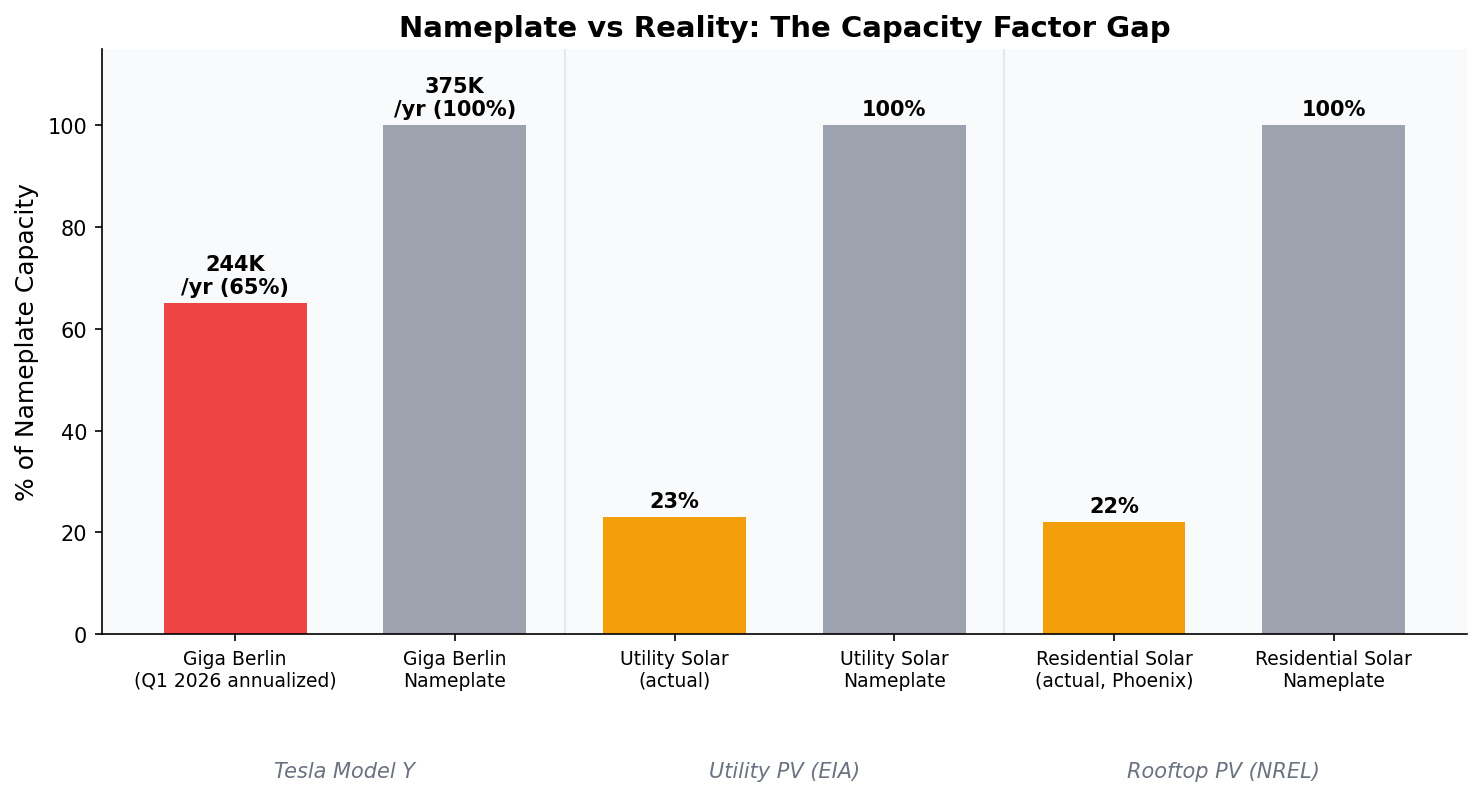
In the utility world, engineers use a metric called capacity factor — the ratio of what a power plant actually produces over a year to what it would produce if it ran flat-out 24/7. According to the U.S. Energy Information Administration, utility-scale solar PV in the U.S. runs at an average capacity factor of roughly 23–24%, while onshore wind averages about 35%. [2] Even the best natural gas combined-cycle plants only hit about 57%.
Tesla's Giga Berlin story is a capacity factor story. The plant's engineering nameplate is 375,000 vehicles. Its actual 2025 output was closer to a 44% capacity factor. A 20% production bump still leaves it well under two-thirds of what the building was designed to do. That gap isn't a failure — it's just how complex systems behave in the real world.
Why this matters for your rooftop
When an installer quotes you a "10 kW system," that 10 kW is the DC nameplate — the theoretical maximum the panels could produce under laboratory test conditions (1,000 W/m², 25°C cell temperature, perfectly clean glass). In the field, your array will almost never hit that number. The National Renewable Energy Laboratory's PVWatts tool bakes in a default "system losses" factor of around 14% to account for inverter efficiency, wiring, soiling, shading, and temperature. [3]
That means a 10 kW system in Phoenix might produce roughly 16,000–17,000 kWh per year — not the 87,600 kWh the nameplate would suggest if it ran 24/7. NREL's own tracking puts typical residential solar capacity factors between 15% (Seattle) and 22% (Phoenix, Las Vegas). [4]
How to read a solar quote without getting fooled
Here is the translation layer every homeowner should use when comparing proposals. It's the same skill that would have caught Tesla's Berlin math:
1. Compare annual kWh production, not panel wattage
A reputable installer will give you an estimated first-year production in kWh. That number already accounts for your roof's pitch, azimuth, shading, and local weather. Two 10 kW systems on two different roofs in two different cities can legitimately produce very different numbers. The Lawrence Berkeley National Laboratory's Tracking the Sun report shows median residential system output varies by more than 40% across U.S. climate zones. [5]
2. Ask for the degradation curve
Solar panels lose output over time. Quality Tier-1 modules typically degrade about 0.5% per year, so by year 25 you're at roughly 87% of year-one production. NREL's long-term monitoring confirms this for modern panels. [6] If a quote shows flat production for 25 years, that's a red flag.
3. Get a battery usable-capacity number, not just kWh
A 13.5 kWh Tesla Powerwall 3 has 13.5 kWh of usable capacity, but many competing batteries are quoted at nameplate and have a lower depth-of-discharge ceiling. SEIA recommends comparing batteries on usable kWh, round-trip efficiency, and warrantied cycles. [7]

The 2026 incentive landscape is different than you've heard
One big shift homeowners need to understand: the federal 30% Investment Tax Credit for purchased residential solar systems expired at the end of 2025. In 2026, only leases and third-party-owned PPAs can still capture the commercial ITC, because the tax credit flows to the system's owner (the financier), not the homeowner. Cash buyers and loan buyers no longer get a federal credit on new installations. [8]
That doesn't mean solar got worse. It means the math shifted. Many state and utility incentives are still very much alive — and in several states they're more valuable than the old federal credit. California's SGIP battery rebate, New York's NY-Sun program, Massachusetts' SMART tariff, and Illinois' Shines program continue to offer meaningful dollars. [9]

Run the numbers for your exact ZIP code
EnergyScout's incentive search tool pulls the current federal, state, utility, and local programs available for your specific address. It also flags whether a lease/PPA or a cash purchase is likely to produce better lifetime economics for your situation — the answer is different in California than in Texas than in Ohio.
The EV-solar-battery feedback loop
Here's where the Tesla story comes full circle. Even running below nameplate, Giga Berlin still shipped about 240,000 vehicles last year, and every one of those Model Ys will plug into a grid somewhere. The Department of Energy projects U.S. residential EV charging demand will roughly triple by 2030. [10] If you charge an EV from a utility-only grid mix that still averages around 60% fossil generation, you're doing better than gasoline — but not nearly as well as you could.
Pairing rooftop solar with a home battery and an EV creates a virtuous loop:
- Daytime: panels charge the battery and the car
- Evening: battery powers the house during peak tariff hours
- Night: off-peak utility rates handle anything the battery didn't cover
- Outage: the battery keeps essentials running and the car becomes a mobile power bank
EnergySage's 2025 Solar Marketplace Report found that households combining solar + battery + an EV achieved average utility-bill offsets of 92% — versus 68% for solar-only homes. [11]

How to find an installer that won't oversell you
The biggest risk in 2026 isn't that solar doesn't work — it's that a high-pressure door-knocker sells you a system sized for their commission, not your roof. A few filters that eliminate most bad actors:
- NABCEP-certified lead designer on the crew
- Minimum 10-year workmanship warranty on the install itself, not just the equipment
- Written production guarantee in kWh, with a make-whole clause if the system underdelivers
- Local business license and physical address in your state (not a national call center)
- At least 25 reviews on independent platforms like Google, EnergySage, or SolarReviews
EnergyScout's vetted installer directory pre-screens local companies against these criteria and only lists installers with verified licensing and insurance.
The takeaway: trust the math, not the nameplate
Tesla's Giga Berlin story is a useful reminder that nameplate capacity is a marketing number. Real-world output is what pays your bills — whether you're a factory, a utility, or a homeowner with a south-facing roof. When you get a solar quote, ignore the panel wattage and focus on three numbers: expected first-year kWh, warrantied year-25 kWh, and your household's actual consumption. If those three numbers tell a coherent story, you're looking at a real proposal. If they don't, you're looking at a sales pitch.
Next step
Start with a free, no-pressure solar assessment for your specific address. In about two minutes, EnergyScout's assessment tool will pull NREL's PVWatts production estimate for your roof, overlay your local utility rates, and show you an apples-to-apples comparison across cash, loan, lease, and PPA paths — no phone number required.
Ready to find out what your roof can actually produce? Get your free EnergyScout assessment →
More Articles
Do Solar Panels Work During a Power Outage?
Most homeowners assume solar panels keep the lights on when the grid goes down. The actual answer surprises people — and the fix is simpler than you think.
Read article Battery StorageChile Hit 75% Solar in March. Here's What U.S. Homeowners Should Take From It
Chile's grid produced 29% of its electricity from solar in March, with peaks at 75%. The bottleneck wasn't generation — it was storage and transmission. Here's the homeowner takeaway.
Read article