Tesla HW3 Won't Get Unsupervised FSD: A Solar Wake-Up Call
Elon Musk admitted millions of Tesla HW3 vehicles won't get unsupervised FSD. The lesson for homeowners
On Tesla's Q1 2026 earnings call, CEO Elon Musk publicly acknowledged what many Tesla owners had quietly feared: the roughly 4 million vehicles running on the company's Hardware 3 (HW3) computer will not receive unsupervised Full Self-Driving (FSD) capability. As reported by The Verge, Musk admitted that the HW3 platform — installed in Teslas built between roughly 2019 and 2023 — simply lacks the compute headroom to handle the next generation of autonomy software.
It's a striking moment for a brand that for years marketed FSD as a forever-upgrade. But it also opens a useful window for homeowners who bought into the Tesla ecosystem expecting cars, solar, and batteries to all evolve together. If your car's "future-proof" hardware turned out to have an expiration date, what does that mean for your home energy plan?
The answer, fortunately, is empowering. Unlike automotive silicon, the economics of rooftop solar and battery storage are still moving in homeowners' favor — and the tools to make a smart, durable decision have never been better.
What Musk actually said — and why it matters beyond cars
According to Tesla's own communications and reporting from The Verge, HW3 cars will continue receiving "supervised" FSD updates, but the unsupervised, robotaxi-grade autonomy will be reserved for vehicles with HW4 and the upcoming AI5 chip. For the estimated 4 million HW3 owners, that means the most-hyped feature of their purchase contract is now permanently out of reach without a hardware retrofit Tesla has not committed to providing for free.
This is not just a Tesla story. It's a case study in how quickly "future-ready" technology can become "good enough for today, but not tomorrow." Homeowners considering large energy investments — rooftop solar, batteries, EV chargers, even heat pumps — should take this as a prompt to ask harder questions about what they're buying, who stands behind it, and whether the savings math holds up even if a manufacturer's roadmap changes.
The good news: home solar economics don't depend on one company's roadmap
Unlike a vehicle's autonomy stack, a rooftop solar system's value is grounded in physics and your local utility rate — not a software promise. The U.S. Department of Energy's Solar Energy Technologies Office notes that modern crystalline-silicon panels are warrantied to produce at least 80–85% of their nameplate output after 25 years, and field data from Lawrence Berkeley National Laboratory's Tracking the Sun report shows real-world degradation closer to 0.5% per year.
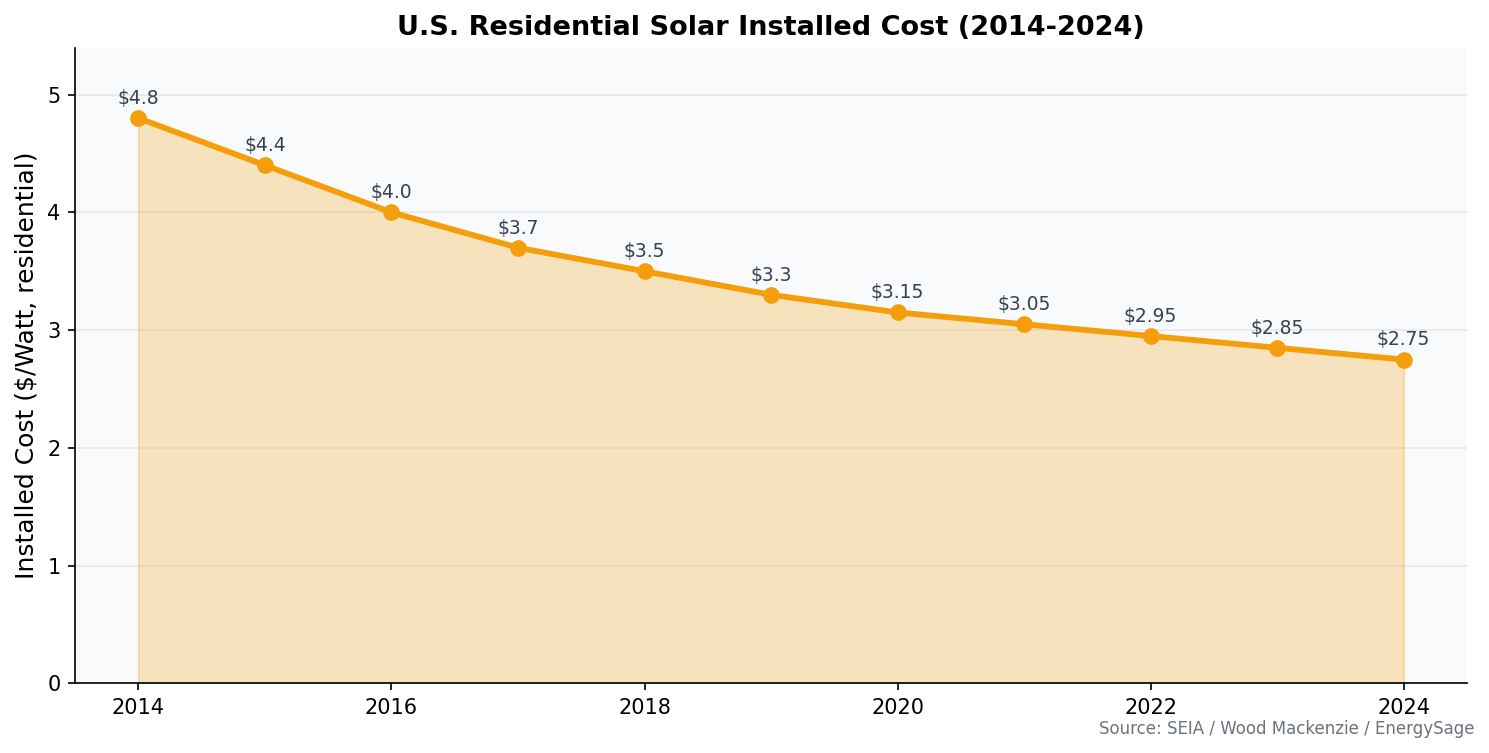
That durability is why solar-plus-storage continues to pencil out even as policy shifts. According to the Solar Energy Industries Association (SEIA), the U.S. installed more than 50 GW of solar capacity in 2024 alone, and residential prices have fallen more than 60% over the past decade. EnergySage's 2024 marketplace data pegs the average pre-incentive residential system at roughly $2.75–$3.10 per watt installed.
The 2026 incentive reality: what changed, and what's still on the table
One important update homeowners need to internalize: the federal 30% Investment Tax Credit (ITC) for purchased residential solar systems expired at the end of 2025. As of 2026, only solar leases and Power Purchase Agreements (PPAs) — where a third party owns the system — still qualify for the commercial-side ITC, with the savings typically passed through as lower monthly payments.
That doesn't mean the math is broken. It means the optimal structure depends more than ever on your situation:
- If you want ownership and long-term equity: a cash purchase or solar loan still produces strong lifetime savings in most high-rate utility territories, especially when paired with a battery to offset peak time-of-use rates.
- If you want zero upfront cost and a predictable bill: a lease or PPA from a reputable installer can lock in a rate below what your utility charges today, and the third-party owner captures the ITC on your behalf.
- If your state has additional incentives: many states, utilities, and municipalities offer rebates, performance payments, or low-interest financing that stack on top of any federal benefit. The DSIRE database and CPUC programs in California are good starting points.
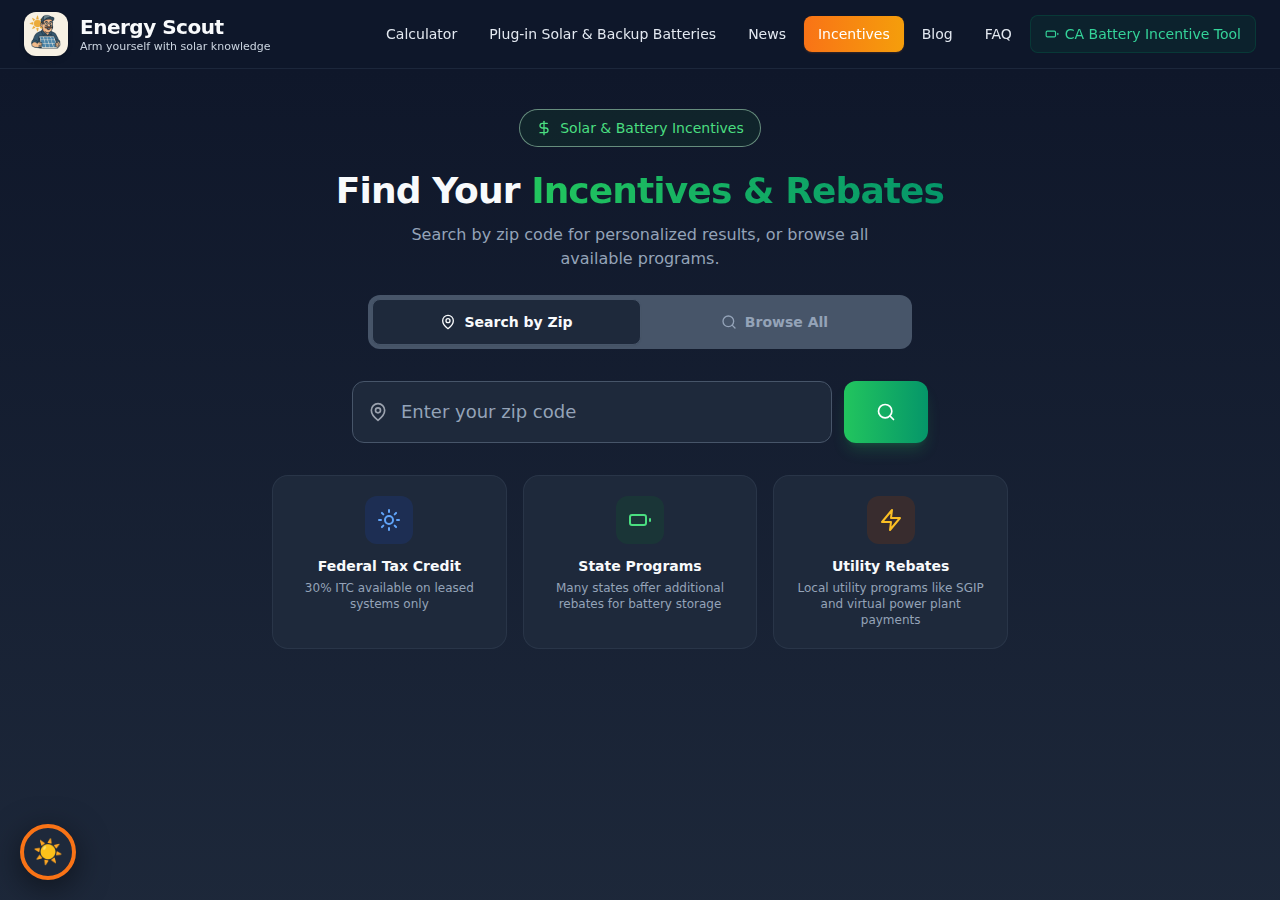
To see exactly what's available where you live, use EnergyScout's solar and battery incentives ZIP code search. It pulls federal, state, and utility-level programs into one view so you don't have to chase down a dozen agency websites.
Why batteries are the real "FSD moment" for home energy
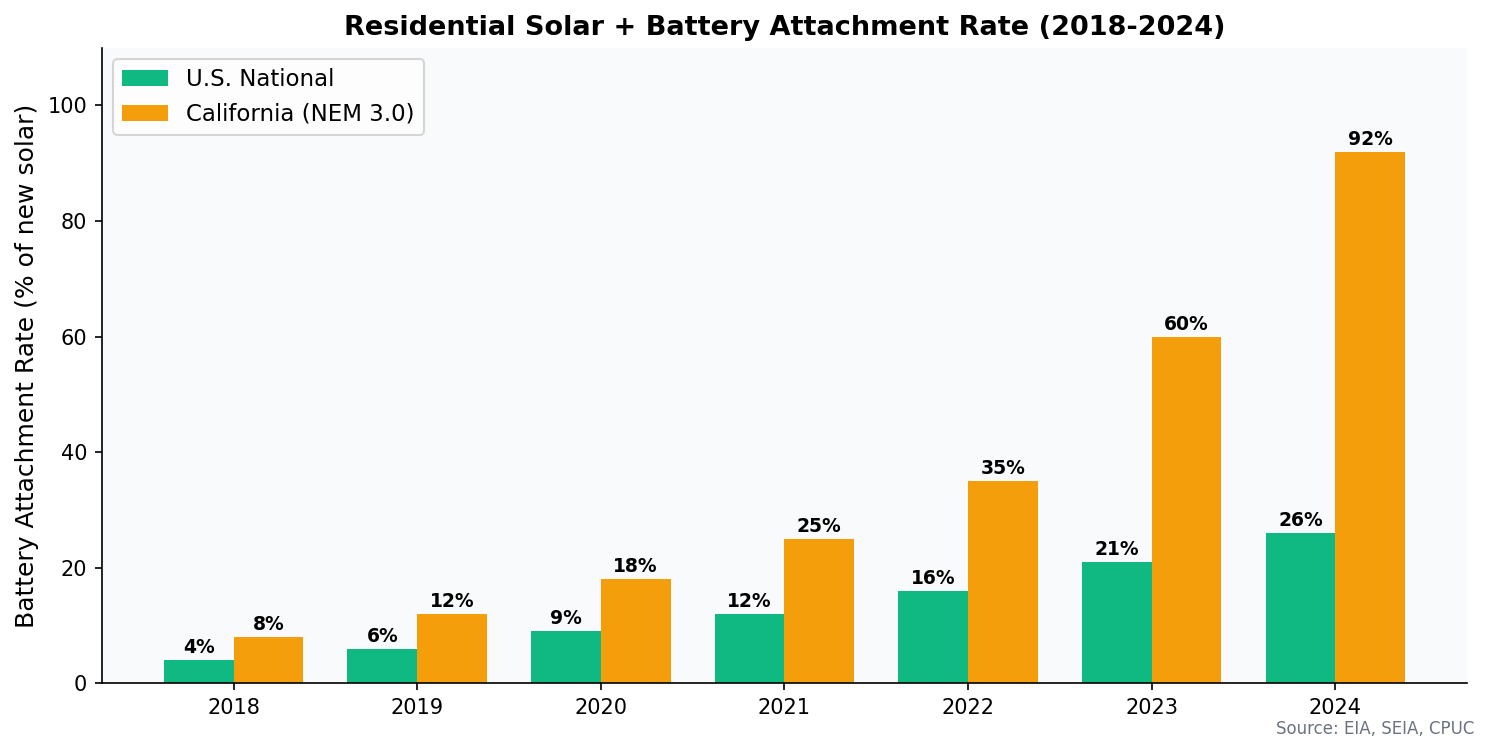
If FSD was the headline feature Tesla used to differentiate its cars, battery storage is rapidly becoming the differentiator for residential solar. According to the U.S. Energy Information Administration (EIA), residential battery attachment rates on new solar installs have climbed past 25% nationally and exceed 90% in markets like Hawaii, Puerto Rico, and parts of California with revised net-metering rules.
The reasons are practical:
- Time-of-use arbitrage. Utilities increasingly charge two to four times more for evening electricity than midday power. A battery lets you store cheap solar production and discharge during expensive peak hours.
- Backup resilience. Grid outages from wildfires, hurricanes, and ice storms have grown more frequent. A properly sized battery keeps your fridge, internet, and a few circuits running for hours or days.
- NEM 3.0 and successor tariffs. In California and other states, export compensation has dropped sharply, making self-consumption (via a battery) the highest-value use of your solar production.
The National Renewable Energy Laboratory (NREL) has consistently found that solar-plus-storage systems offer better lifetime economics than solar alone in most modern utility rate structures — and unlike a car's autonomy chip, a home battery's value grows as electricity rates rise.
How to avoid your own "HW3 moment" with home energy
The lesson from Tesla's HW3 admission isn't to distrust technology — it's to buy with eyes open. A few principles that apply equally well to solar and batteries:
1. Demand transparent assumptions
A good proposal shows your current utility rate, an explicit rate-escalation assumption (5–6% per year is industry-typical, per EIA data), expected production in kWh, and a clear payback period. If a quote is just a monthly payment with no math, ask for the full breakdown.
2. Choose hardware with deep ecosystem support
Pick inverters and batteries from manufacturers with strong financial standing and multiple software partners. Open standards like Sunspec and CTA-2045 protect you from being stranded if one vendor's app goes dark.
3. Vet your installer, not just the equipment
Workmanship warranties, install volume, and local reviews matter more than the badge on the panel. EnergyScout's vetted local providers directory filters for licensing, insurance, and customer satisfaction so you can compare competing bids on equal footing.

4. Right-size, then plan for growth
If you're considering an EV (Tesla or otherwise), a heat pump, or an electric water heater in the next five years, factor that load into your solar sizing today. Adding panels later is more expensive per watt than installing the right system the first time.
Turning a Tesla headline into a homeowner advantage
Musk's HW3 admission is a reminder that even the most aggressive technology promises can age out. But it's also a useful catalyst. The same homeowners feeling burned by an autonomy roadmap can take direct, durable control of their household energy bill — locking in lower rates, hedging against utility hikes, and adding resilience their car can't.
The economics are real. According to NREL and SEIA, a typical residential solar-plus-battery system in a high-rate market still pays for itself in 8–12 years and delivers 15+ years of mostly-free electricity after that — regardless of which company makes your car.
Get a personalized estimate in minutes
EnergyScout was built to make the homeowner's side of the energy transition as transparent as possible. Our free solar assessment tool uses NREL solar resource data and your local utility rates to estimate production, savings, and payback for your specific roof — no sales pressure, no email wall.
From there, you can compare incentives in your ZIP code and request quotes from vetted local installers who compete on price and quality. Whether you choose to own, lease, or PPA, you'll have the numbers to make a decision you won't second-guess in five years.
Don't let someone else's roadmap dictate your energy future. Start your free EnergyScout assessment at energyscout.org and see what solar-plus-storage looks like for your home today.
More Articles
Do Solar Panels Work During a Power Outage?
Most homeowners assume solar panels keep the lights on when the grid goes down. The actual answer surprises people — and the fix is simpler than you think.
Read article Battery StorageChile Hit 75% Solar in March. Here's What U.S. Homeowners Should Take From It
Chile's grid produced 29% of its electricity from solar in March, with peaks at 75%. The bottleneck wasn't generation — it was storage and transmission. Here's the homeowner takeaway.
Read article