U.S. Solar Gets a Tandem-Module Boost: What It Means for You
A new U.S. manufacturing partnership is bringing tandem perovskite-silicon modules to rooftops.
A new manufacturing partnership between U.S.-based solar companies Solx and Caelux is poised to reshape what American homeowners can expect from rooftop solar. The collaboration pairs Solx's Aurora hybrid module with Caelux's perovskite-coated glass to deliver higher energy yield from the same roof space — a technology leap timed perfectly for a post-ITC market where efficiency, not tax credits, drives the value proposition.1
For homeowners weighing a solar-plus-battery investment in 2026, this announcement matters. It signals that U.S.-sourced modules are catching up on performance — and that the next generation of rooftop panels will squeeze noticeably more kilowatt-hours from the same footprint. Here's what the Solx-Caelux partnership means for your home, and how to decide whether to buy now or wait for the tech rollout.
What Solx and Caelux Actually Built
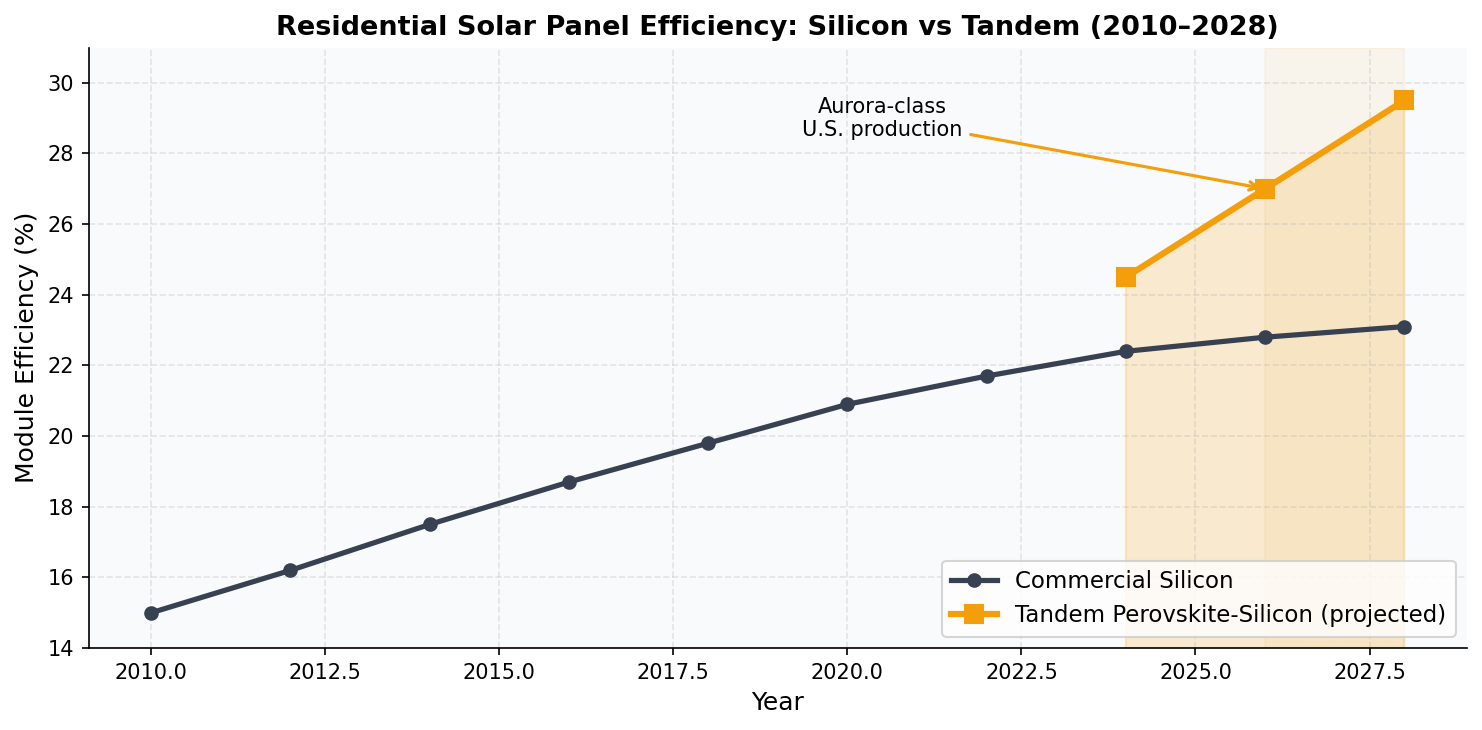
The Aurora module is a hybrid design: a standard silicon photovoltaic cell captures most of the visible spectrum, while Caelux's perovskite-coated cover glass harvests additional high-energy photons that silicon-only panels convert inefficiently. The tandem approach is one of the most-watched frontiers in solar research because lab prototypes have exceeded 33% efficiency — well beyond silicon's theoretical ceiling near 29%.2
What makes the announcement distinct from earlier perovskite news is the manufacturing piece. Caelux is producing its glass at a factory in Baldwin Park, California, and Solx is assembling finished Aurora modules in the United States. That matters for three reasons:
- Domestic content bonuses still apply to commercial and utility projects under what remains of the Inflation Reduction Act, making U.S.-made panels more attractive to installers bidding commercial work.3
- Supply chain resilience insulates buyers from tariff and shipping shocks that plagued 2022–2024 rooftop installs.
- Warranty confidence improves when the manufacturer has a domestic service footprint rather than a distant support desk.
Why This Arrives at Exactly the Right Moment
The residential solar market changed dramatically at the start of 2026. The federal 30% Investment Tax Credit for purchased residential systems expired, leaving leases and power purchase agreements (PPAs) as the only homeowner structures still eligible for the credit. That shift raised the bar for purchased systems: to beat a lease's monthly economics, a cash or loan-financed panel has to generate more electricity per dollar spent.4
Higher-efficiency panels are the most direct answer. A module that produces 10–15% more energy from the same roof area lowers the cost per kilowatt-hour without requiring any subsidy. Lawrence Berkeley Lab's Tracking the Sun data shows median residential system efficiency has climbed every year since 2010, and each step up typically shaves the payback period by 6–12 months.5
What "Higher Efficiency" Looks Like on a Real Roof
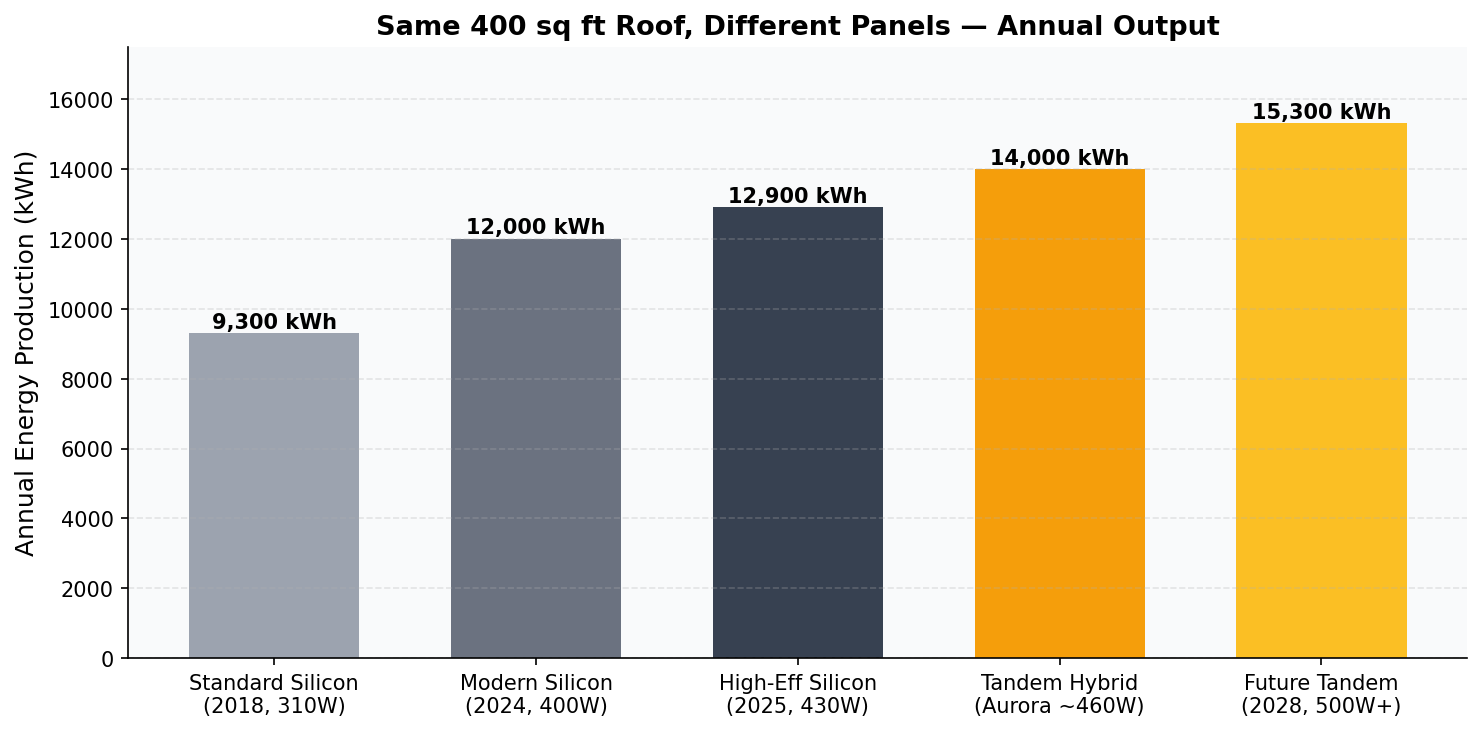
Consider a typical 1,800-square-foot home in a sunny state with 400 square feet of usable south-facing roof. With conventional 400-watt silicon panels, the homeowner fits roughly 20 modules for an 8 kW system producing about 12,000 kWh per year. Swap in Aurora-class tandem panels at an expected 450–475 watts per panel and the same roof delivers closer to 14,000 kWh per year — enough to cover a heat pump, an EV charger, or both without adding a single square foot of hardware.
That extra output also reshapes battery sizing. Homeowners pairing solar with storage (the fastest-growing segment per the SEIA/Wood Mackenzie Solar Market Insight) can charge a 10–13.5 kWh battery entirely from midday surplus even on shorter winter days, improving self-consumption from ~40% to north of 70%.6
Buy Now or Wait for Aurora?
The most common question homeowners ask when a new panel technology is announced is whether to delay the purchase. The honest answer from the data: don't wait — size your decision to your electricity bill, not to a press release.
Three reasons why:
- Availability lag. Manufacturing announcements typically precede homeowner availability by 12–24 months. Early Aurora modules will go to commercial and utility buyers who order in megawatt lots. Residential channel availability at competitive pricing is more realistic for late 2027.
- Price premium during rollout. New high-efficiency panels launch with a 15–25% price premium over commodity silicon, per EnergySage marketplace data. That premium typically erodes over 3–5 years — but during the early window, the extra watts don't pencil out versus today's mid-tier panels.7
- Your utility bill keeps rising. EIA data shows residential electricity prices rose 6.2% in 2024 and another 4.1% in 2025. Every month spent waiting is a month of premium rates.8
The smarter framing is to match today's panels to your roof, lock in a lease or PPA if you want the tax credit, and let Aurora-class panels come to the commercial rooftops first — where the economics will be proven under real-world conditions before residential installers warranty them.
What Homeowners Should Do in 2026
Whether you buy current-generation silicon or hold for tandem modules, the starting step is the same: understand your roof, your bill, and your local incentives. EnergyScout's free solar assessment tool uses NREL irradiance data and your ZIP code to estimate annual production, 25-year savings, and the panel count your home can actually accommodate.

State and utility incentives are where most of the remaining purchased-system economics live in 2026. Depending on where you live, you may still find:
- State income tax credits (active in New York, South Carolina, Arizona, and others)
- Utility battery rebates (notably in California under SGIP and in Massachusetts under ConnectedSolutions)9
- Net metering or net billing that credits excess exports to the grid
- Property tax exemptions that prevent your assessed home value from climbing with a new system
Run your ZIP code through EnergyScout's incentives search to see the full stack of federal, state, and utility programs available at your address in minutes.
Choosing an Installer Ready for Next-Gen Panels
One practical way to future-proof today's purchase is to select an installer experienced with high-efficiency modules and battery integration. Ask prospective contractors:
- Do you install panels rated above 430 W? (A yes indicates comfort with larger, heavier modules.)
- What's your warranty process when a manufacturer discontinues a product line?
- Can you design the racking to accommodate future panel swaps in 15 years?
EnergyScout's vetted local installer directory filters by licensure, insurance, customer reviews, and battery certification, so you can focus conversations on the questions above rather than on trust basics.
The Bigger Picture: American PV Is Competing on Technology Again
For more than a decade, the rooftop solar conversation in the U.S. centered on cost — specifically, whether domestic manufacturing could match Asian pricing. The Solx-Caelux partnership signals a shift in strategy. Rather than race commodity prices to the bottom, U.S. manufacturers are competing on performance, using technology differentiators (tandem cells, perovskite coatings, integrated hardware) to justify premium pricing in a post-ITC market.
Per NREL's 2024 Photovoltaic System Cost Benchmark, module efficiency gains have accounted for the majority of residential cost reductions over the past decade — more than labor, soft costs, or balance-of-system improvements. If Aurora-class panels deliver on their lab performance at scale, the next decade of residential solar will look very different from the last, with smaller arrays producing more power per square foot and pairing naturally with home batteries and EV chargers.10

Your Next Move
The best rooftop solar system is the one designed for your home, your bill, and your timeline — not the one chasing whichever module is trending in industry press. Use the tools below to find out exactly what makes sense at your address today, and you'll be well-positioned to benefit whether you install current-generation silicon now or upgrade to tandem panels in a future repower.
Start with a free EnergyScout assessment at energyscout.org — no sales calls, no commitment, just personalized savings data built from NREL production models and your local utility rates.
More Articles
Do Solar Panels Work During a Power Outage?
Most homeowners assume solar panels keep the lights on when the grid goes down. The actual answer surprises people — and the fix is simpler than you think.
Read article Battery StorageChile Hit 75% Solar in March. Here's What U.S. Homeowners Should Take From It
Chile's grid produced 29% of its electricity from solar in March, with peaks at 75%. The bottleneck wasn't generation — it was storage and transmission. Here's the homeowner takeaway.
Read article