Virtual Power Plants: Get Paid to Share Your Battery
Virtual power plants are quietly turning home batteries into income-generating assets. Here's how homeowners are earning up to $1,500 a year
Imagine your home battery not only powering your fridge during a blackout — but earning you cash on hot summer afternoons when the grid needs help. That's the promise of virtual power plants (VPPs), and they're scaling faster than most homeowners realize. According to the U.S. Department of Energy, VPPs could provide 80–160 GW of flexible capacity by 2030, roughly enough to replace 80–160 large coal plants (DOE Liftoff Report, 2023).
For homeowners with solar-plus-battery systems, this represents a new revenue stream that can meaningfully shorten payback periods and boost the lifetime value of a system. In many service territories, VPP payments have become the single biggest "extra" on top of straight solar self-consumption savings. Let's unpack how VPPs actually work, how much you can earn, what to watch out for, and how to plug in.
What Is a Virtual Power Plant?
A virtual power plant is a network of distributed energy resources — rooftop solar, home batteries, smart thermostats, EV chargers, and even heat pump water heaters — aggregated and dispatched as a single coordinated "plant." Instead of firing up a gas peaker plant when demand spikes, the utility asks thousands of enrolled homes to temporarily discharge batteries or trim loads.
The National Renewable Energy Laboratory (NREL) notes that VPPs deliver capacity at roughly 40–60% the cost of traditional peaker plants, while also reducing emissions and strengthening grid reliability (NREL, 2024). For participants, it's a win-win: the grid gets clean, fast-responding flexibility, and homeowners get paid for hardware they already own.
How It Works in Practice
On a typical hot August afternoon, wholesale electricity prices might spike from $40/MWh to $400/MWh in just an hour. A utility or aggregator sends a dispatch signal to enrolled batteries, which automatically discharge a portion of their stored energy into the home (offsetting grid draw) or directly back to the grid. The event usually lasts 2–3 hours, after which your battery refills from solar the next day. You barely notice it happened — but your dashboard shows the earnings.
How Homeowners Actually Get Paid
VPP compensation typically comes through one of three structures:
- Upfront enrollment bonuses — one-time payments of $500–$1,250 just for signing up your battery.
- Per-event payments — $1–$2 per kWh dispatched during grid events (often 10–60 events per year).
- Annual capacity payments — a fixed check (sometimes $400–$1,500/year) for keeping your battery available.
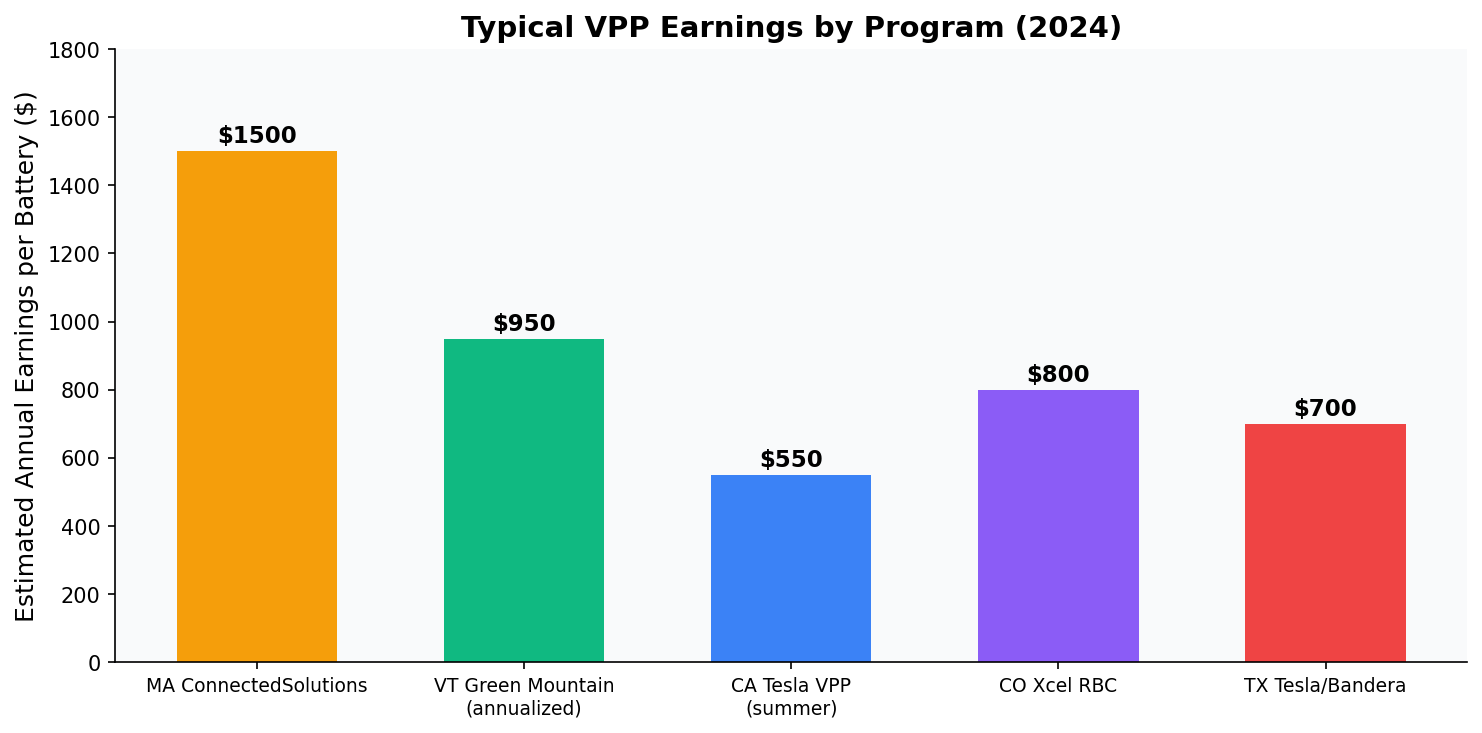
In Massachusetts, the ConnectedSolutions program has paid participating homeowners up to $1,500 per year per battery for summer and winter peak-shaving events (EnergySage). Green Mountain Power's "bring your own device" program in Vermont offers $850 upfront plus ongoing bill credits. Tesla's California VPP, operated with PG&E, has paid enrollees about $2/kWh during grid events — with some participants earning $500–$600 per summer (Tesla Energy).
Sunrun, the largest residential solar installer in the U.S., reported that its VPP fleet dispatched over 48 MWh during peak events in 2023, generating meaningful revenue for its lease and PPA customers without requiring any homeowner action.
The Scale Is Exploding
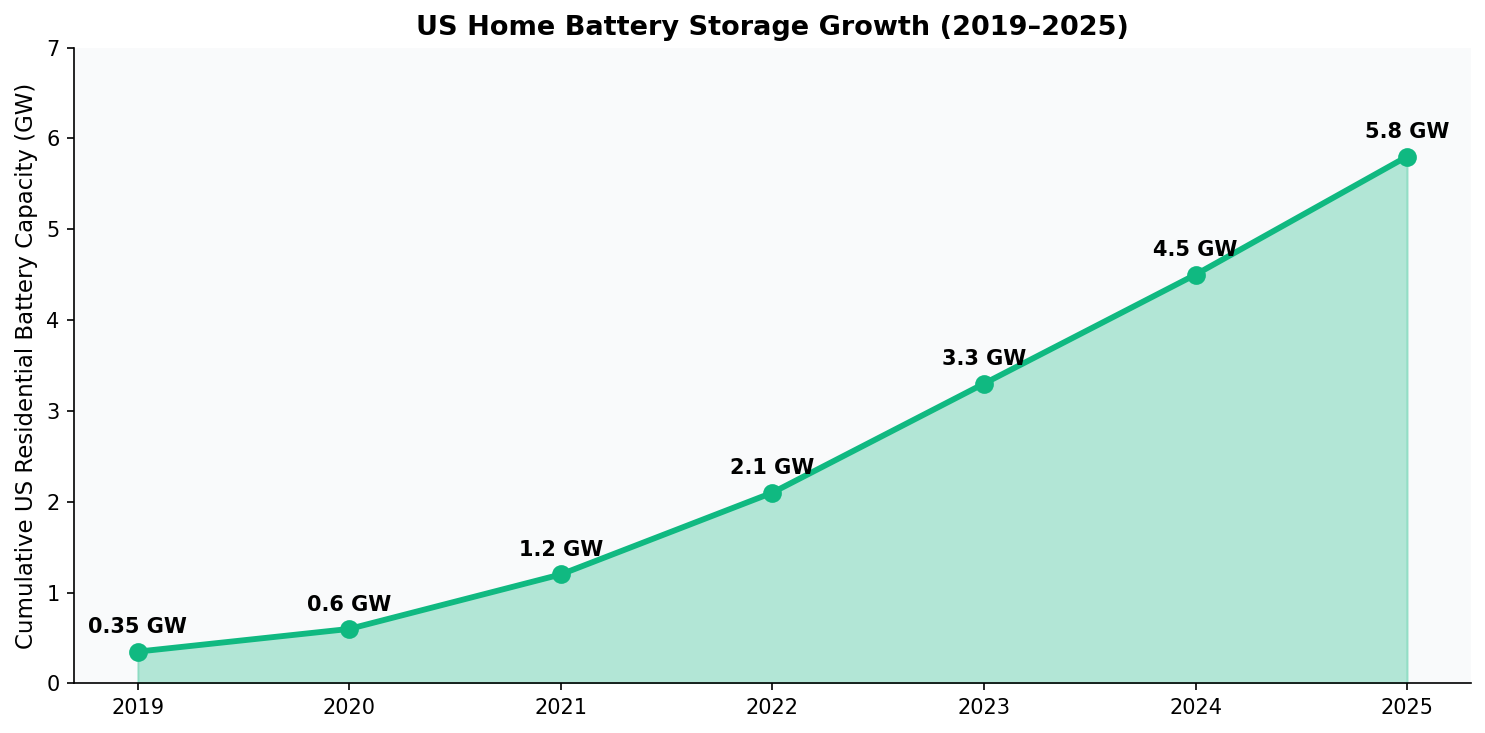
The Lawrence Berkeley National Laboratory reports that U.S. behind-the-meter battery storage capacity grew more than tenfold between 2019 and 2024, with residential installations driving much of the growth (LBNL, 2024). The Energy Information Administration (EIA) expects another 30+ GW of battery capacity to come online by 2026 (EIA, 2024).
That's critical because demand is surging. AI data centers, vehicle and building electrification, and extreme weather are stressing grids — and building new transmission or gas plants takes 5–10 years. VPPs can be stood up in months using hardware already sitting in garages and basements. It's one of the rare grid upgrades that doesn't require breaking ground.
Which Utilities Offer VPP Programs Today?
The list is growing fast, but standout programs include:
- Massachusetts & Rhode Island — National Grid and Eversource ConnectedSolutions
- California — PG&E Emergency Load Reduction Program, Tesla VPP, Sunrun/OhmConnect, SCE ELRP
- Vermont — Green Mountain Power Powerwall program
- Texas — Tesla/Bandera Electric VPP, Base Power
- Colorado — Xcel Energy Renewable Battery Connect
- New York — ConEd Dynamic Load Management, Sunrun partnerships
- Connecticut — Eversource/UI ConnectedSolutions
- Puerto Rico — LUMA Battery Emergency Demand Response
To see what's available in your ZIP code, EnergyScout's incentive search tool aggregates state, utility, and VPP programs so you can quickly compare the cash-back potential of different battery setups before you buy.
Do VPPs Make Solar + Storage Worth It?
Here's where it gets interesting. The federal 30% Residential Clean Energy Credit (ITC) for purchased systems expired at the end of 2025. Only leases and third-party-owned PPAs still qualify for the credit in 2026 and beyond. That's changed the math — but VPP revenue can partially fill that gap and, in some states, completely reshape the economics.
Consider a typical $15,000 battery installation:
- Without VPP: Savings come mainly from self-consumption and backup value. Payback often 10–14 years.
- With VPP participation: Add $800–$1,500/year in direct payments. Payback can drop to 6–9 years.
- Lease/PPA + VPP stacking: Little to no upfront cost, plus a share of VPP revenue, plus the ITC (for the leasing company, which often passes savings through).
According to SEIA, the combination of VPP income and time-of-use arbitrage is now the single biggest driver of residential battery adoption in states like Massachusetts, California, and Vermont (SEIA, 2024).
What to Watch Out For
VPP programs aren't all identical. Before enrolling, make sure you understand:
- Minimum reserve settings — most programs let you keep 20–30% of battery capacity for your own backup. Confirm this protects you during outages.
- Number of annual events — 30 events is normal; 60+ means more cycling and faster battery wear.
- Warranty interaction — a few manufacturers explicitly cover VPP cycling; others don't. Check before enrolling.
- Contract length — programs often lock you in for 5–10 years, with exit fees.
- Compatible hardware — Tesla Powerwall, Enphase IQ, Sonnen, SolarEdge, and FranklinWH are most commonly supported.
- Tax treatment — VPP payments are generally taxable income; consult your accountant.
A qualified local installer can walk you through program-specific fine print. EnergyScout's vetted installer directory lets you filter for pros experienced with VPP-enabled batteries in your area.
How to Get Started
Joining a VPP typically follows four steps:
- Assess your home. Determine if solar + battery makes sense given your roof, usage, and local rates. EnergyScout's free assessment tool handles this in about 60 seconds.
- Check your utility's VPP program. Some programs only accept specific battery models, so confirm compatibility before purchasing.
- Install with a VPP-savvy contractor. Proper commissioning and enrollment are critical; a wrong setting can lock you out of payments.
- Enroll and monitor. Most programs use an app so you can track dispatches, earnings, and battery status in real time.
The Big Picture
VPPs are quietly becoming one of the most attractive value streams for residential solar+battery. The Department of Energy projects $10 billion in annual VPP payments to consumers by 2030 as enrollment scales (DOE, 2023). With ITC changes reshaping solar economics, tapping grid-services revenue is a smart way to keep payback periods short and savings high.
Better still, VPPs align homeowner incentives with grid reliability and decarbonization goals. Every dispatched kilowatt-hour is one less needed from a gas peaker. Your battery is no longer just a personal resilience tool — it's a piece of shared infrastructure that pays dividends.
Think of it this way: your battery used to just power your home. Now it can power your neighborhood — and pay you for the privilege.
Ready to See What Your Home Could Earn?
Start with a free, no-pressure assessment from EnergyScout. We'll show you what solar + battery could save you, which incentives and VPP programs your ZIP code qualifies for, and connect you with vetted local installers experienced with VPP enrollment.
More Articles
Do Solar Panels Work During a Power Outage?
Most homeowners assume solar panels keep the lights on when the grid goes down. The actual answer surprises people — and the fix is simpler than you think.
Read article Battery StorageChile Hit 75% Solar in March. Here's What U.S. Homeowners Should Take From It
Chile's grid produced 29% of its electricity from solar in March, with peaks at 75%. The bottleneck wasn't generation — it was storage and transmission. Here's the homeowner takeaway.
Read article