When Your State Changes Net Metering: What to Do Now
When states like California, Hawaii, and Arizona overhauled net metering, panic followed. The reality? Solar still pays — but the playbook changed.
If you've been researching solar and suddenly noticed your state's payback period jump from 7 years to 11, you're not imagining it. Net energy metering (NEM) — the policy that lets your utility credit you for excess solar power — is being rewritten across the country. California's NEM 3.0 slashed export credits by roughly 75%. Hawaii ended traditional net metering back in 2015. Arizona, Nevada, and several others have followed with their own versions.
The good news: solar still works. The math just changed. Here's exactly what happens when your state rewrites the rules — and how to design a system that still delivers strong returns.
What Net Metering Actually Does
Net metering is the billing arrangement that turns your solar array into a two-way meter. When your panels produce more than your home uses (typically midday), excess electricity flows to the grid and your utility credits you for it. At night or on cloudy days, you draw from the grid and apply those credits.
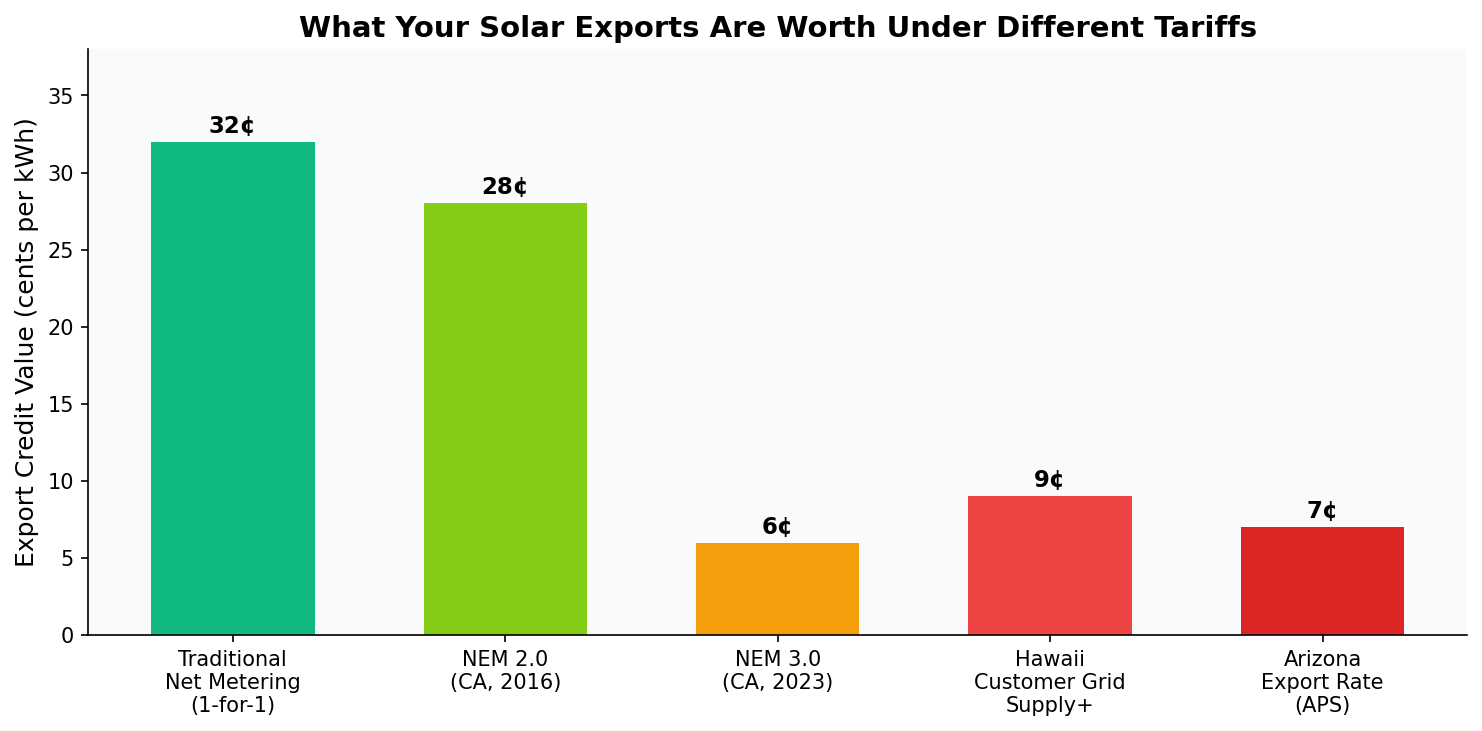
Under traditional 1-for-1 net metering, every exported kilowatt-hour is worth the same as a kWh you'd buy — usually 25 to 45 cents in high-cost states. According to the National Renewable Energy Laboratory (NREL), this retail-rate compensation has been the single biggest driver of residential solar adoption in the U.S. for two decades.
The problem? As solar penetration grew, utilities argued that retail-rate exports shifted grid maintenance costs onto non-solar customers — the so-called "cost shift." Lawrence Berkeley National Laboratory has studied the issue extensively and found the cost-shift impact is real but typically smaller than utilities claim. Still, regulators have been moving away from full retail compensation.
What Changes When Your State Rewrites the Rules
When a public utilities commission approves a new tariff (often labeled NEM 2.0, NEM 3.0, NBT, or a "successor tariff"), several things typically shift at once:
1. Export credits drop dramatically
Under California's NEM 3.0, exported solar is now valued using an Avoided Cost Calculator — essentially what the utility would have paid a wholesale generator. The California Public Utilities Commission decision means many midday export hours pay just 4–8 cents per kWh, versus 30+ cents under NEM 2.0.
2. Time-of-use rates become the default
Most successor tariffs require time-of-use (TOU) billing, where electricity costs more in the evening (4–9 PM) when solar production has tapered off. This penalizes solar-only systems that export midday and import in the evening.
3. Fixed grid charges may appear
Some states add monthly grid-access or demand charges for solar customers. These usually run $8–$25/month but can be higher in markets like Hawaii's commercial tariffs.
4. Existing customers are usually grandfathered
Almost every NEM transition includes a grandfathering window — typically 10 to 25 years from the date a system is interconnected. If you install before a rule change takes effect, you generally lock in the old terms. This is why installers see a rush of permits in the months before a transition.
The New Math: Why Batteries Now Matter
Under traditional net metering, the grid was effectively a free battery. Export at noon, import at 7 PM, no penalty. Under successor tariffs, that arbitrage disappears — and a real battery captures the value instead.
Here's the shift in plain terms: instead of exporting midday power for 6 cents, you store it and use it during the 4–9 PM peak when grid power costs 50–60 cents. That's a 40-to-50-cent-per-kWh swing for every stored kilowatt-hour.
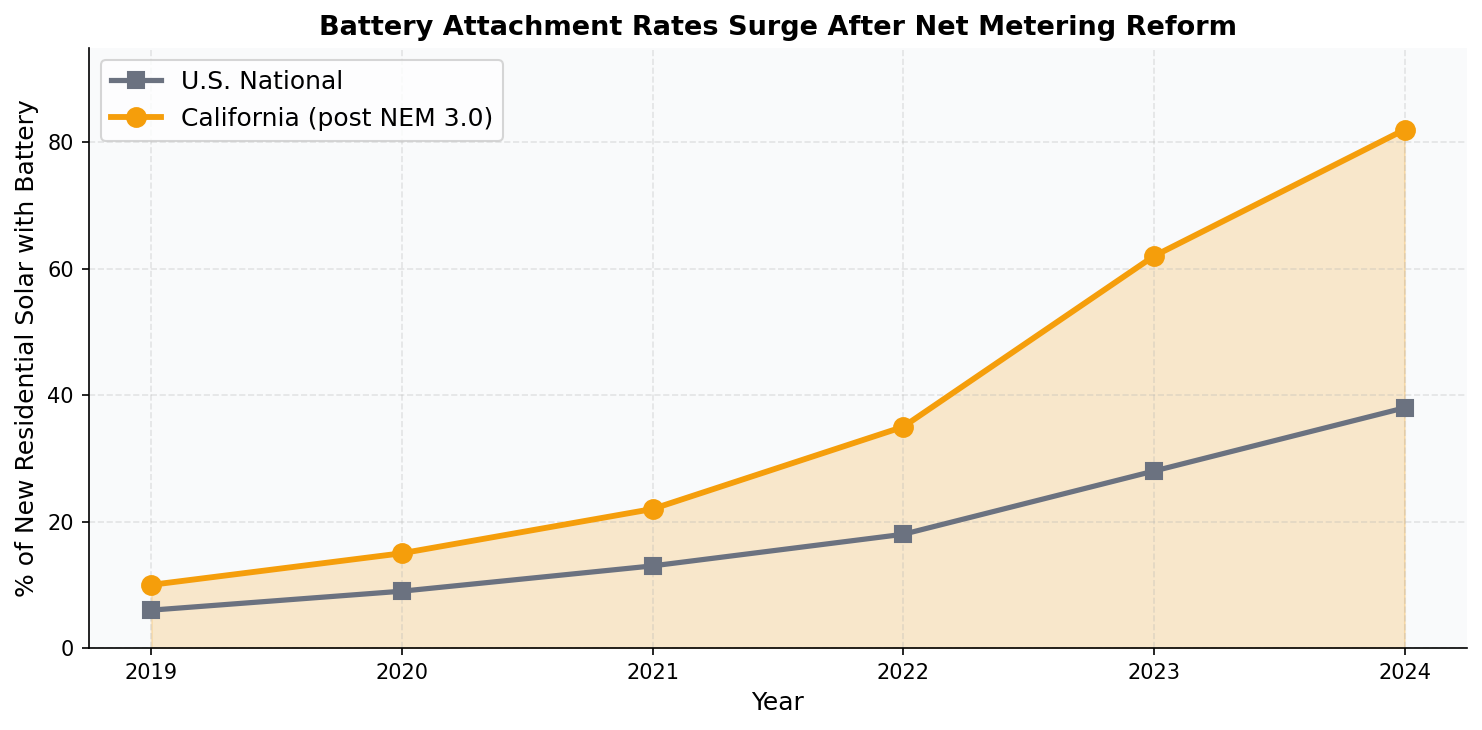
According to EnergySage's 2024 marketplace data, attachment rates for batteries on new residential solar systems have jumped from under 10% in 2020 to over 60% in markets with reformed net metering. In California specifically, SEIA's Q2 2024 Solar Market Insight Report found that more than 80% of new residential solar installations now include storage.
Sizing changes too
Under 1-for-1 net metering, oversizing a system by 10–20% was smart — every extra kWh banked credits. Under reformed tariffs, oversizing is wasted money, because excess production is paid pennies. The new sweet spot is a right-sized array paired with a battery sized to cover evening loads.
What to Do If Your State Just Changed (or Is About To)
Step 1: Find out exactly what tariff you'd interconnect under
Rules vary not just by state but by utility. A homeowner in PG&E territory faces different rules than one in SMUD. Check your utility's interconnection page or use EnergyScout's incentive search by ZIP code to see what's currently available in your area.

Step 2: Run the numbers with a battery in scope
A solar quote that doesn't model your time-of-use rate and battery dispatch is useless under reformed net metering. Ask any installer to show you:
- Hourly production curve vs. your hourly consumption
- What gets exported (and credited at the new rate)
- What the battery can shift to peak hours
- 20-year cash flow including TOU rate escalation
Step 3: Reassess incentives — federal and state
Important update: the federal 30% Investment Tax Credit (ITC) for purchased residential systems expired at the end of 2026. Leases and power purchase agreements (PPAs) can still claim the commercial ITC, which is why third-party-owned solar is making a comeback. According to the U.S. Department of Energy, many states still offer their own credits, rebates, and property-tax exemptions stackable on top.
Step 4: Get multiple quotes from local installers
National lead-gen sites often route you to whoever paid the highest referral fee. EnergyScout's verified installer directory connects you directly with local pros who understand your utility's specific tariff.
Real-World Example: The California NEM 3.0 Transition
Consider a homeowner in San Diego with a 6 kW system and 13 kWh battery, installed under NEM 3.0. According to U.S. Energy Information Administration data, San Diego retail residential rates average around 47 cents/kWh — among the highest in the nation. Even with export credits at 5–8 cents, the battery captures most of the value by shifting solar production to 5–8 PM peak hours.
Modeled payback under NEM 3.0 with battery: roughly 8–10 years. Without battery: 14+ years. The battery isn't optional anymore in most reformed-tariff markets — it's what makes the economics work.
The Bigger Picture: Solar Isn't Going Away
It's tempting to read NEM reform as the end of rooftop solar. The data says otherwise. SEIA projects U.S. residential solar installations will continue growing through 2030, with battery attachment driving most new value. Utility rates are climbing 4–6% annually in many markets, which steadily improves solar's relative economics regardless of net metering tweaks.
What's actually happening is a maturation. The era of "slap panels on the roof and bank credits" is over in some states. The era of "design a system that hedges your specific rate exposure" is just beginning — and it rewards homeowners who do their homework.
Next Step: Get a Free, Tariff-Aware Assessment
Don't trust generic online calculators that haven't been updated for your state's current rules. EnergyScout's free solar assessment tool uses NREL's PVWatts production model, your actual ZIP code's electricity rates, and current net metering rules to show you a realistic 25-year savings projection — battery included where it matters.
Whether your state already changed the rules or is debating it now, there's still a clear path to lower bills and energy independence. You just need a quote that's honest about the new math.
More Articles
Do Solar Panels Work During a Power Outage?
Most homeowners assume solar panels keep the lights on when the grid goes down. The actual answer surprises people — and the fix is simpler than you think.
Read article Battery StorageChile Hit 75% Solar in March. Here's What U.S. Homeowners Should Take From It
Chile's grid produced 29% of its electricity from solar in March, with peaks at 75%. The bottleneck wasn't generation — it was storage and transmission. Here's the homeowner takeaway.
Read article