Cattle Under Solar Panels: What Agrivoltaics Means for You
Silicon Ranch flipped the switch on a utility-scale solar farm where cattle roam under single-axis tracking panels. The economics behind dual-use solar reveal lessons every homeowner should understand before sizing a rooftop system.
On May 1, 2026, Silicon Ranch flipped the switch on something most people have only seen in renderings: a commercial-scale solar farm where cattle graze under moving panels. According to Electrek, the project uses single-axis trackers raised high enough that full-grown cows can move freely beneath the array. It is a textbook example of agrivoltaics — using the same acre for both electricity and agriculture.
You probably do not own 1,000 acres of pasture. So why should a homeowner care? Because the engineering choices Silicon Ranch made — tracker height, panel spacing, ground cover, shading tolerance — mirror the exact trade-offs you face when sizing a rooftop or ground-mount system at home. The math scales down.
What is agrivoltaics, in numbers?
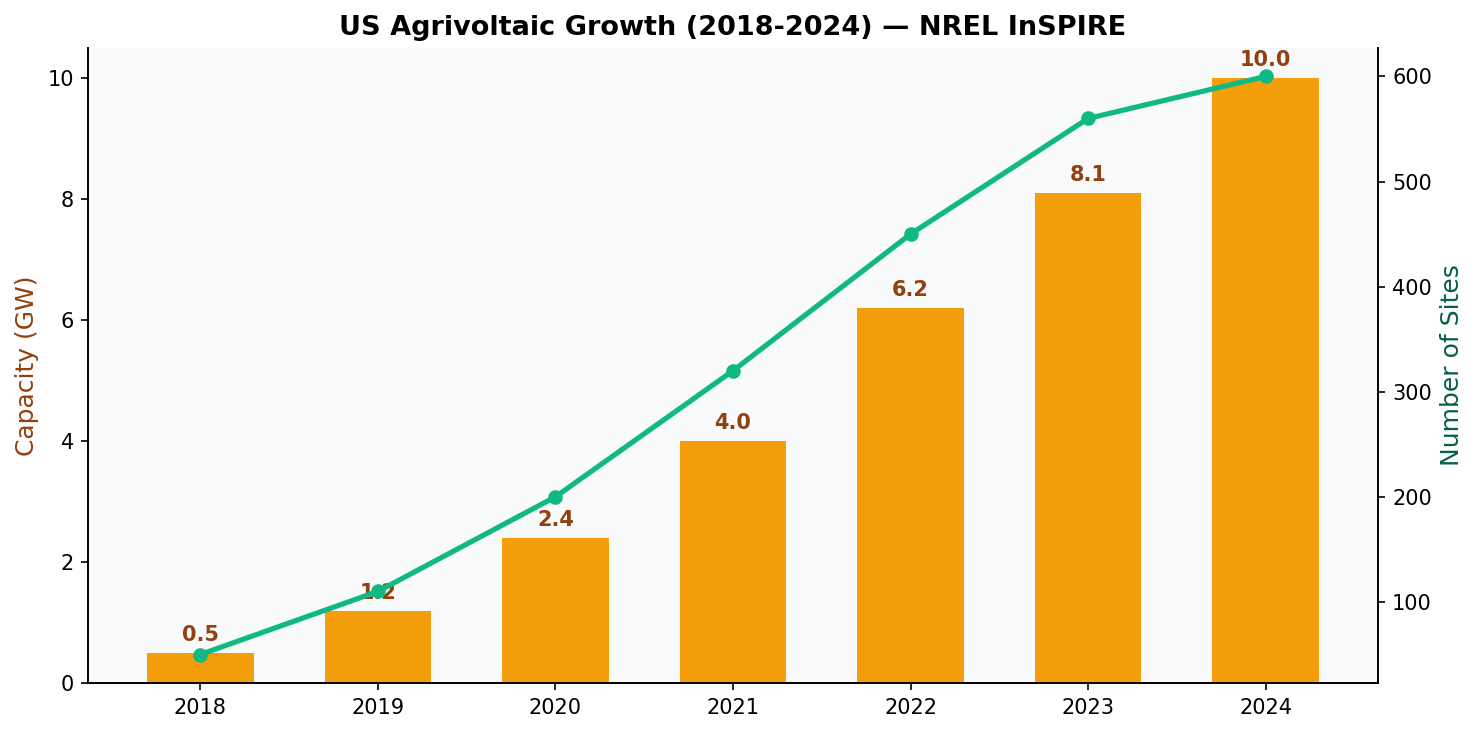
The U.S. Department of Energy's InSPIRE program defines agrivoltaics as co-locating solar production with agriculture — grazing, crops, or pollinator habitat. As of late 2024, the National Renewable Energy Laboratory (NREL) tracked more than 600 agrivoltaic sites across 39 states, totaling about 10 GW of capacity (NREL OpenEI).
The cattle-friendly design Silicon Ranch chose is rarer than sheep grazing, which is the dominant solar livestock use today. Sheep can fit under standard 2-meter clearance arrays. Cattle need closer to 8 feet of clearance, which costs more steel up front but unlocks a much larger pool of working ranchland.
The hidden lesson: panels do not need direct sun every minute
The single biggest myth we hear from homeowners is that any shade kills a solar system. Agrivoltaic farms prove otherwise. NREL's research shows that crops grown under partial shade from PV panels often use water 14–29% more efficiently, and panel temperatures drop because of the cooler microclimate — which actually boosts panel output (NREL, 2022).
For a homeowner, the takeaway is not that you should plant tomatoes under your roof array. It is that modern panels with bypass diodes and string-level optimizers handle partial shading far better than the systems your neighbor installed in 2014. A chimney shadow at 9 a.m. is not a deal-breaker.

Show me the rooftop math
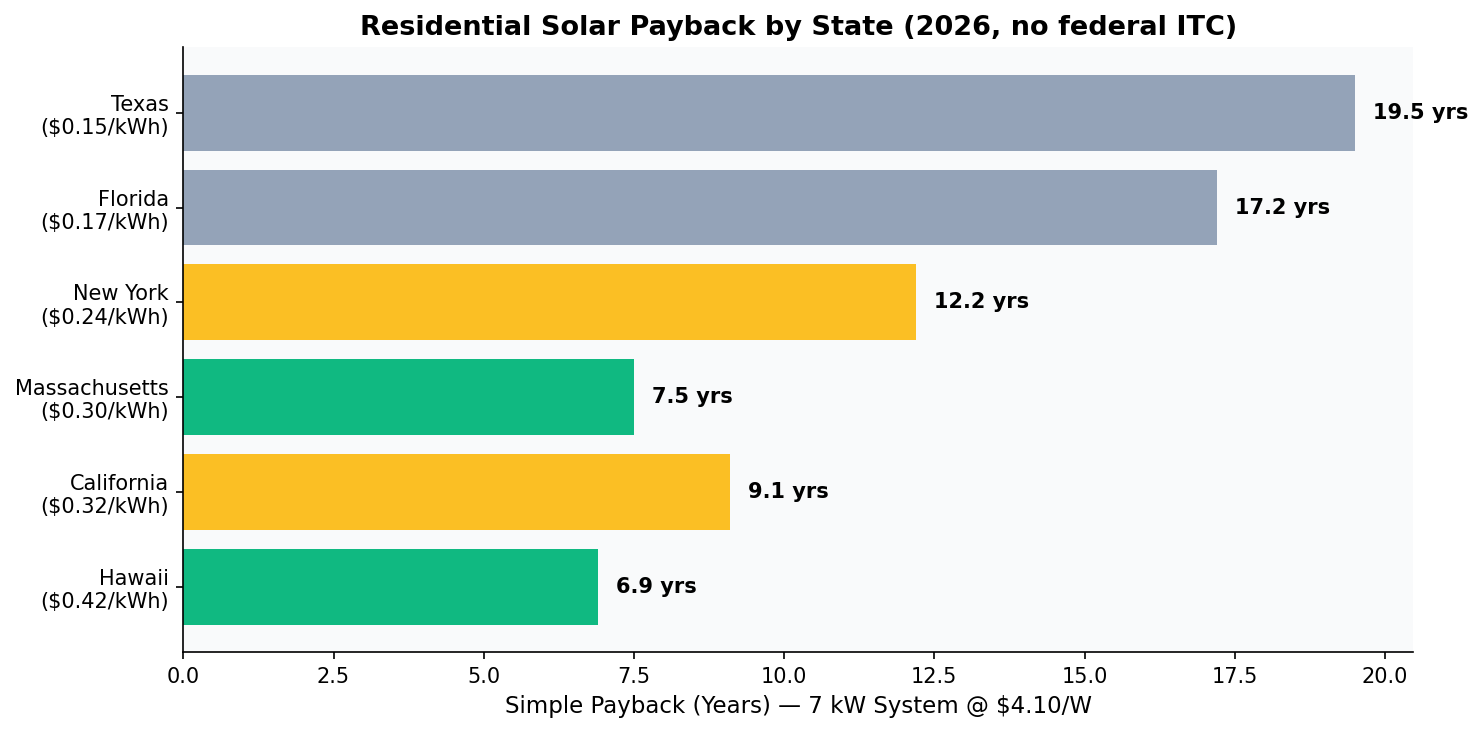
Let's translate utility-scale economics to your roof. The Lawrence Berkeley National Lab's Tracking the Sun 2024 report pegged median residential installed cost at $4.10/watt before incentives. A 7 kW system — typical for a single-family home — costs roughly $28,700 installed.
Here is how that pencils out in three rate environments, using EIA's 2025 average residential rates:
- Texas (~$0.15/kWh): 7 kW × 1,400 kWh/kW/yr = 9,800 kWh annually. At $0.15, that's $1,470/year. Simple payback ≈ 19.5 years.
- California (~$0.32/kWh): Same 9,800 kWh = $3,136/year. Payback ≈ 9.1 years.
- Massachusetts (~$0.30/kWh + SMART rebates): $2,940/year in offset plus state production incentives. Payback ≈ 7–8 years.
Production estimates come from NREL's PVWatts calculator, which is the same tool EnergyScout uses to localize its assessments to your ZIP code, roof tilt, and azimuth.
The 2026 incentive landscape — what actually still applies
This is where a lot of consumer guides got obsolete. The federal Investment Tax Credit (ITC) for purchased residential solar systems expired at the end of 2025. If you buy a system today, the 30% federal credit no longer applies. However:
- Third-party owned systems (leases and PPAs) still qualify for the commercial ITC under Section 48E, and the savings get passed through to homeowners as lower monthly payments (SEIA).
- State and utility incentives remain robust in California (SGIP for batteries), New York (NY-Sun), Massachusetts (SMART), Illinois (Illinois Shines), and a dozen other states.
- Net metering rules are shifting fast. California's NEM 3.0 cut export rates by ~75% in 2023, which is exactly why pairing solar with a battery now matters more than ever in CA (CPUC).

What Silicon Ranch's project really proves
The headline is cute: cows under panels. The substance is more important. Silicon Ranch is demonstrating that a single acre can produce roughly 350–400 MWh of electricity per year and still support 1–2 head of cattle. That dual yield is what utility procurement officers care about.
For a homeowner, the parallel is simpler: your roof is already there. It is not productive land you are taking out of service. It is unused real estate. Every kWh your panels produce is one you do not buy from the grid — at retail rates that EIA forecasts will rise 2.4% per year through 2030.
If you are evaluating solar in 2026, ask three questions
- What does my roof actually produce? Don't trust national averages. NREL's PVWatts uses your address, tilt, and shading to give a real number.
- What's my marginal grid rate — not my average? Tiered rate plans charge much more for the last 200 kWh than the first. Solar offsets the expensive top tier first.
- Do I need a battery? If you are in California, Hawaii, or any state with weak net metering, the answer is almost certainly yes. The EnergySage 2024 marketplace report showed battery attach rates above 80% in CA.
Run your own numbers
Silicon Ranch did the math on 1,000 acres. The math on your roof is no different in structure — just smaller. EnergyScout's free assessment plugs your address into the same NREL PVWatts model, layers in your local utility rate, and shows you a payback estimate without an installer cold-calling you afterward.
If you want to skip the assessment and just see what incentives apply in your ZIP, the incentive search tool pulls from DSIRE and state databases in real time. And if you are ready to compare quotes, our vetted installer directory shows local options with verified licenses and insurance.

Cattle grazing under solar panels is not a gimmick. It's proof that good engineering finds two uses for one resource. Your roof is that resource at home — the question is just whether the math works for you. Find out in about two minutes at energyscout.org.
More Articles
Do Solar Panels Work During a Power Outage?
Most homeowners assume solar panels keep the lights on when the grid goes down. The actual answer surprises people — and the fix is simpler than you think.
Read article Battery StorageChile Hit 75% Solar in March. Here's What U.S. Homeowners Should Take From It
Chile's grid produced 29% of its electricity from solar in March, with peaks at 75%. The bottleneck wasn't generation — it was storage and transmission. Here's the homeowner takeaway.
Read article