Court Blocks Anti-Renewable Rules: What It Means for Homeowners
A federal court ruling has blocked many of the administration's anti-renewable policies, restoring momentum for solar projects nationwide. Here's what the decision means for homeowners weighing solar and battery storage in 2026.
On April 22, 2026, a federal court issued a sweeping ruling that blocked many of the current administration's most aggressive anti-renewable policies, including freezes on permitting for utility-scale solar and wind projects on public lands and restrictions on grid-interconnection queues. Ars Technica reported that the court found the rules were enacted without the procedural review required by federal law, and ordered agencies to resume normal processing of clean-energy applications [Ars Technica, 2026].
The decision is good news for the solar industry — and surprisingly relevant to homeowners. Even though most rooftop solar projects don't depend directly on federal land-use rules, what happens at the utility level shapes electricity prices, grid access, and the value of a home solar-plus-battery system. Here's what the ruling changes, what it doesn't, and how to take advantage of the renewed momentum.
What the court actually decided
The ruling addressed three main areas of federal policy that had slowed renewable deployment over the past year:
- Public-lands permitting freezes for utility-scale solar and wind, which the Bureau of Land Management had paused under interim guidance.
- Interconnection queue restrictions that limited how quickly new clean-energy projects could connect to the grid.
- Funding clawbacks targeting state energy offices and DOE-backed loan programs supporting domestic solar manufacturing.
The court found the agencies had bypassed the Administrative Procedure Act's notice-and-comment requirements. As a practical matter, that means projects that had been stuck in limbo can now move forward, and pending applications must be processed on the timelines that existed before the freezes [Ars Technica, 2026].
This is a temporary, procedural win — the administration can attempt the rules again with proper rulemaking — but it restores roughly 12–18 months of policy stability that the industry had been bracing to lose.

Why this matters for your electric bill
Utility-scale solar is the cheapest new source of bulk electricity in most of the United States. Lazard's 2024 Levelized Cost of Energy analysis put unsubsidized utility solar at roughly $33/MWh, compared to $108/MWh for new coal and $39/MWh for new combined-cycle gas [Lazard LCOE+, 2024]. The Energy Information Administration (EIA) projects solar will provide more than 14% of U.S. electricity by 2027, up from 5% in 2022 [EIA Annual Energy Outlook].
When permitting freezes delay these projects, utilities are forced to keep older, more expensive plants online — and ratepayers ultimately pay the difference. A 2024 Lawrence Berkeley National Laboratory study found that interconnection delays add an estimated 5–8% to wholesale electricity costs in regions with the longest queues [Berkeley Lab Queued Up, 2024]. Removing those bottlenecks pushes prices in the right direction for households.
What changes for rooftop solar — and what doesn't
Let's be direct about one thing the ruling does not change: the federal 30% Investment Tax Credit (ITC) for purchased residential solar systems expired at the end of 2025 and was not restored. As of 2026, only third-party-owned systems — leases and Power Purchase Agreements (PPAs) — can still capture the 30% commercial ITC, with the savings passed through to homeowners as lower monthly payments. That's a major reason leases have surged from roughly 25% of new residential installs in 2023 to nearly half of installs in early 2026, according to SEIA/Wood Mackenzie tracking [SEIA U.S. Solar Market Insight].
What the court ruling does help with for rooftop owners:
- State and utility programs are stabilizing. Funding clawbacks targeting state energy offices were a major source of uncertainty for state rebate programs. With those clawbacks blocked, programs in states like New York, Massachusetts, Illinois, and California are more likely to honor previously announced rebate budgets through their full 2026 cycle.
- Battery storage incentives remain robust. The 30% ITC for standalone battery storage (Section 48E) was not affected by the ITC sunset for solar PV — it remains in effect through 2032 under current law [DOE Homeowner's Guide].
- Net-metering and interconnection workloads at utilities should normalize. Several utilities had cited federal uncertainty as a reason to slow residential interconnection approvals. With the policy fog clearing, expect approval times to improve.
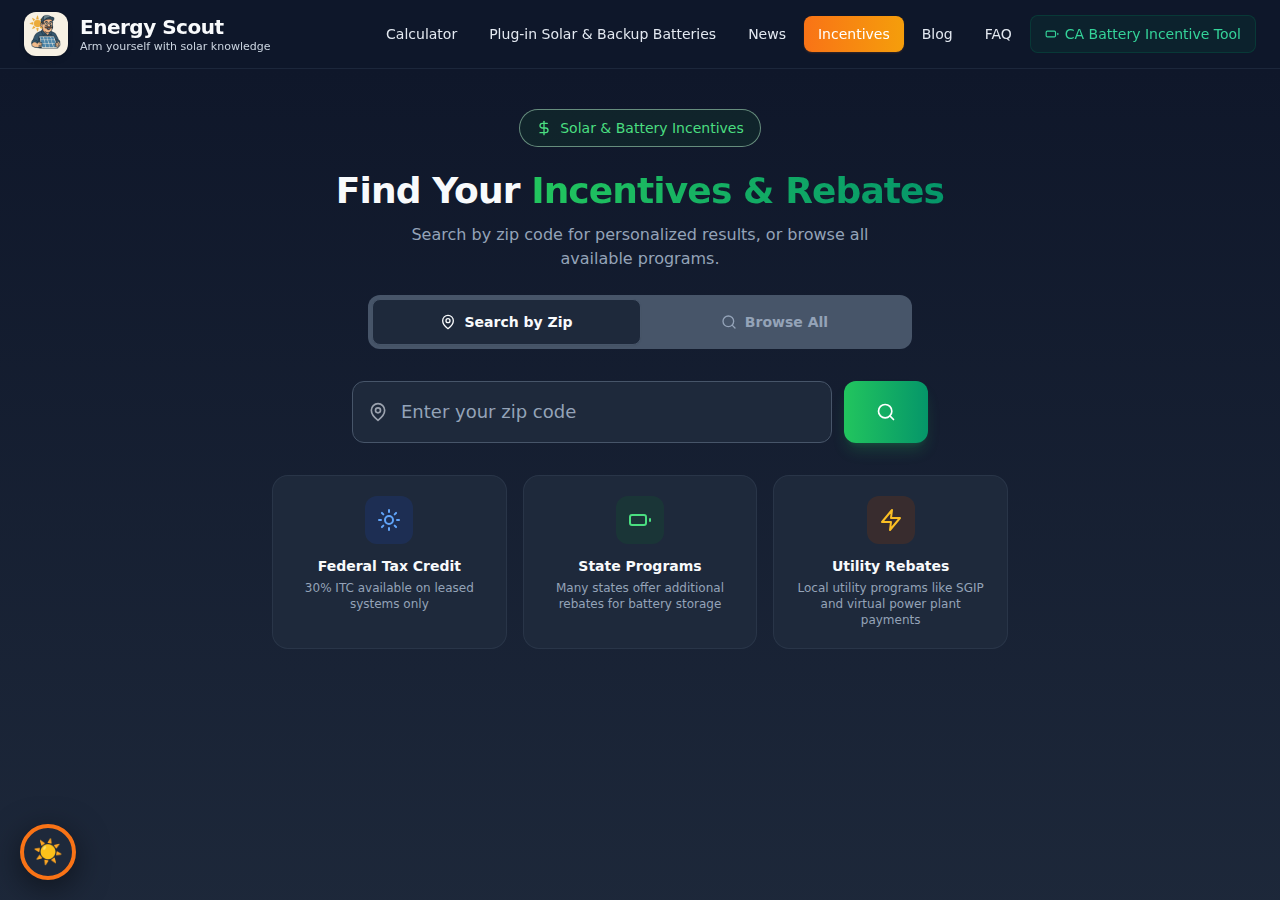
If you want to see exactly which incentives apply to your address — including state rebates, utility programs, and battery storage credits — EnergyScout's incentives search tool pulls live data from DSIRE and utility filings.
Why batteries are the smartest 2026 play
Even with the ITC gone for purchased solar PV, the math for solar-plus-battery still works in most states — and in many it has actually improved because:
- Module prices fell roughly 35% from 2023 to 2026 as Chinese oversupply pushed wholesale costs down [EnergySage Marketplace data].
- The standalone battery ITC means a $15,000 home battery still gets ~$4,500 back at the federal level.
- Many utilities have shifted to time-of-use rates, where peak rates are 2–3x off-peak. Batteries shift consumption from peak to off-peak automatically [CPUC TOU rate filings].
- NEM 3.0 and similar net-billing reforms in California, Idaho, and Hawaii heavily favor self-consumption — exactly what a battery enables.
NREL modeling suggests a typical 6 kW solar + 13 kWh battery system in a TOU-rate territory now has a payback of 8–11 years, even without the residential ITC, when paired with the standalone storage credit [NREL Installed System Cost benchmarks].

How to take advantage of the policy reset
If you've been waiting for the dust to settle before going solar, the court ruling gives you a clearer window to act. Here's a practical sequence:
1. Run a free assessment
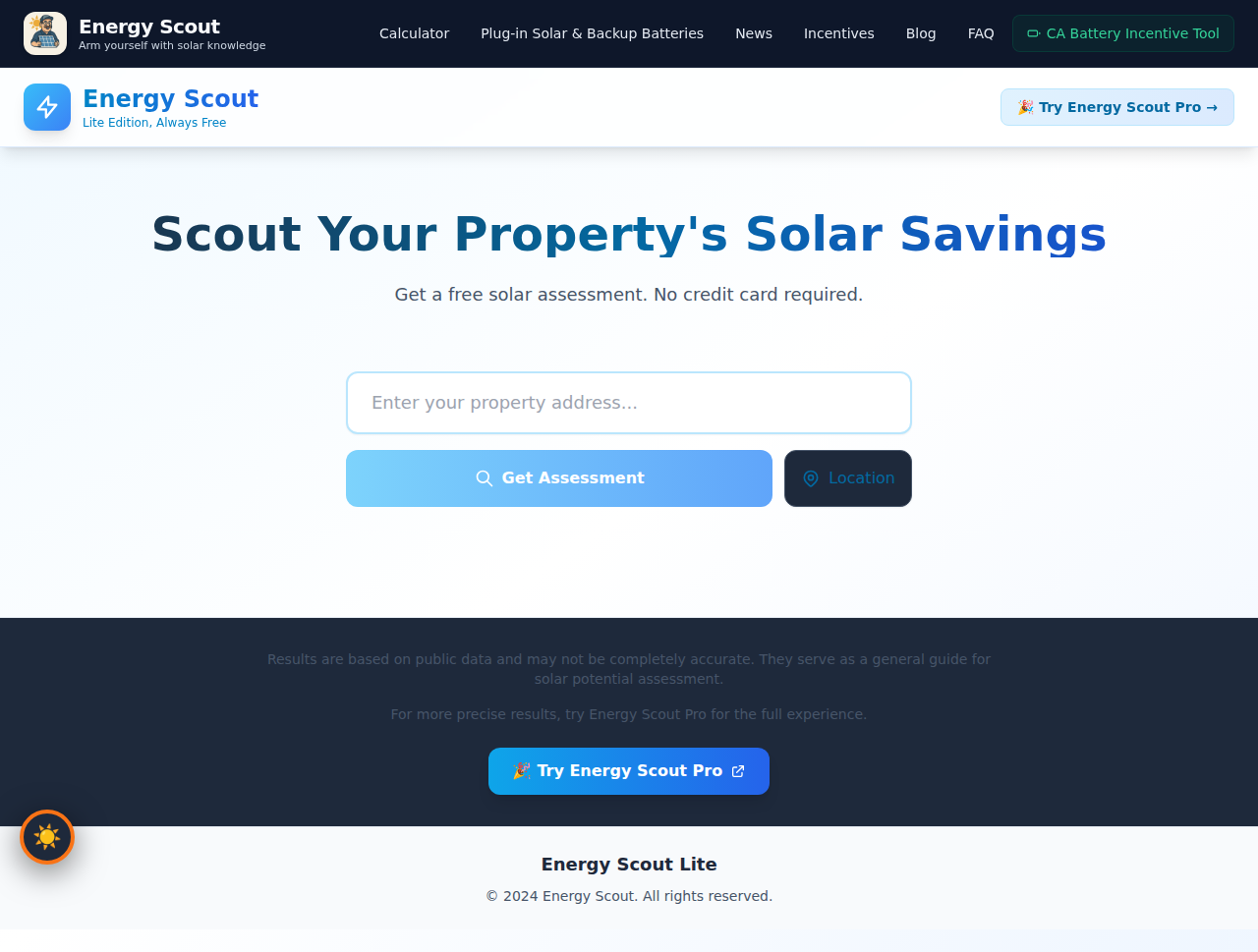
Start with EnergyScout's solar assessment tool. It uses NREL's PVWatts model with your local irradiance, utility rates, and roof orientation to estimate annual production and 25-year savings — without needing an installer to come knock on your door.
2. Stack the right incentives
Use the incentives search to identify state rebates, utility programs, and the standalone battery ITC. In states like Massachusetts (SMART), New York (NY-Sun), Illinois (Illinois Shines), and California (SGIP for batteries), incentive stacking can recover 30–45% of system cost even without the residential solar ITC.
3. Compare lease vs. cash carefully in 2026
This is the single biggest decision homeowners face this year. A lease/PPA still captures the 30% ITC (passed through by the lessor), while a cash purchase does not. But cash purchases earn the full long-term savings and avoid escalator clauses. EnergySage's 2026 marketplace data shows lifetime savings still favor cash purchases by roughly 25–40% in most states despite losing the ITC, but only if you can finance at reasonable rates [EnergySage buy vs. lease guide].
4. Get vetted local quotes
The court ruling will accelerate utility-scale projects, which means installer crews previously locked into commercial work may have more residential capacity in late 2026 — potentially good news for pricing. EnergyScout's provider directory lets you compare local installers vetted via Google Places and BBB data.

The bigger picture
One court ruling doesn't end the policy back-and-forth around renewable energy. The administration is likely to attempt the rules again through proper rulemaking, and Congress could revisit the ITC at any point. But the underlying economics — solar as the cheapest new generation source, batteries shifting from luxury to standard, time-of-use rates rewarding self-consumption — are pulling in the same direction regardless of which party sits in the White House.
For homeowners, that means the question isn't really whether to engage with solar; it's how to engage in the smartest, lowest-risk way given current incentives. The ruling gives you a more stable runway to make that decision.
Take the next step
If your roof gets reasonable sun and your utility bill is north of $120/month, there's a good chance solar-plus-battery makes financial sense — even without the residential ITC. Start with a free, no-obligation assessment at energyscout.org and see what your specific numbers look like before talking to any installer.
More Articles
Do Solar Panels Work During a Power Outage?
Most homeowners assume solar panels keep the lights on when the grid goes down. The actual answer surprises people — and the fix is simpler than you think.
Read article Battery StorageChile Hit 75% Solar in March. Here's What U.S. Homeowners Should Take From It
Chile's grid produced 29% of its electricity from solar in March, with peaks at 75%. The bottleneck wasn't generation — it was storage and transmission. Here's the homeowner takeaway.
Read article