CPUC Rejects SoCalGas $66M Hydrogen Pipeline Charge
On April 30, 2026, the CPUC denied SoCalGas's request to bill customers $66 million for the Angeles Link hydrogen pipeline. We break down the ruling, what it saves the average ratepayer, and how solar+battery compares to staying on the gas system.
On April 30, 2026, the California Public Utilities Commission (CPUC) issued a written decision rejecting Southern California Gas Company's application to charge customers $66 million to fund early development of the Angeles Link hydrogen pipeline project. The ruling, covered by CleanTechnica, sends a clear signal: California regulators are no longer willing to let gas utilities pre-bill ratepayers for speculative infrastructure that may never serve homes.
If you live in SoCalGas territory — roughly 21 million people across central and southern California — this decision matters for two reasons. First, it keeps a small but real charge off your monthly bill. Second, it underscores a bigger trend: the economics of staying connected to the gas system are getting worse, not better. We'll show the math.
What the CPUC actually decided
The Angeles Link is SoCalGas's proposed pipeline to deliver "clean" hydrogen into the LA Basin for industrial and power-generation use. The utility asked the CPUC to approve a memorandum account that would have let it recover roughly $66 million in early planning, permitting, and engineering costs from existing gas customers — before any pipeline was built and before the project had been proven cost-effective.
The Commission said no. Per the CPUC ruling, ratepayer-funded recovery requires a clear demonstration that the project benefits the customers being charged. The Public Advocates Office, which represents ratepayers in CPUC proceedings, had argued the project's beneficiaries (industrial users, refineries, gas-fired generators) are not the same households who would foot the bill (CPUC Public Advocates Office).
The practical result: SoCalGas can keep developing Angeles Link, but with shareholder dollars — not customer dollars — until the project clears a higher bar.
How much would $66M have cost the average household?
SoCalGas serves about 5.9 million meters. Spread across that base, $66 million is roughly $11 per meter, typically collected over 2–3 years. That's not a budget-buster on its own — but it's the latest line item in a steadily climbing gas bill.
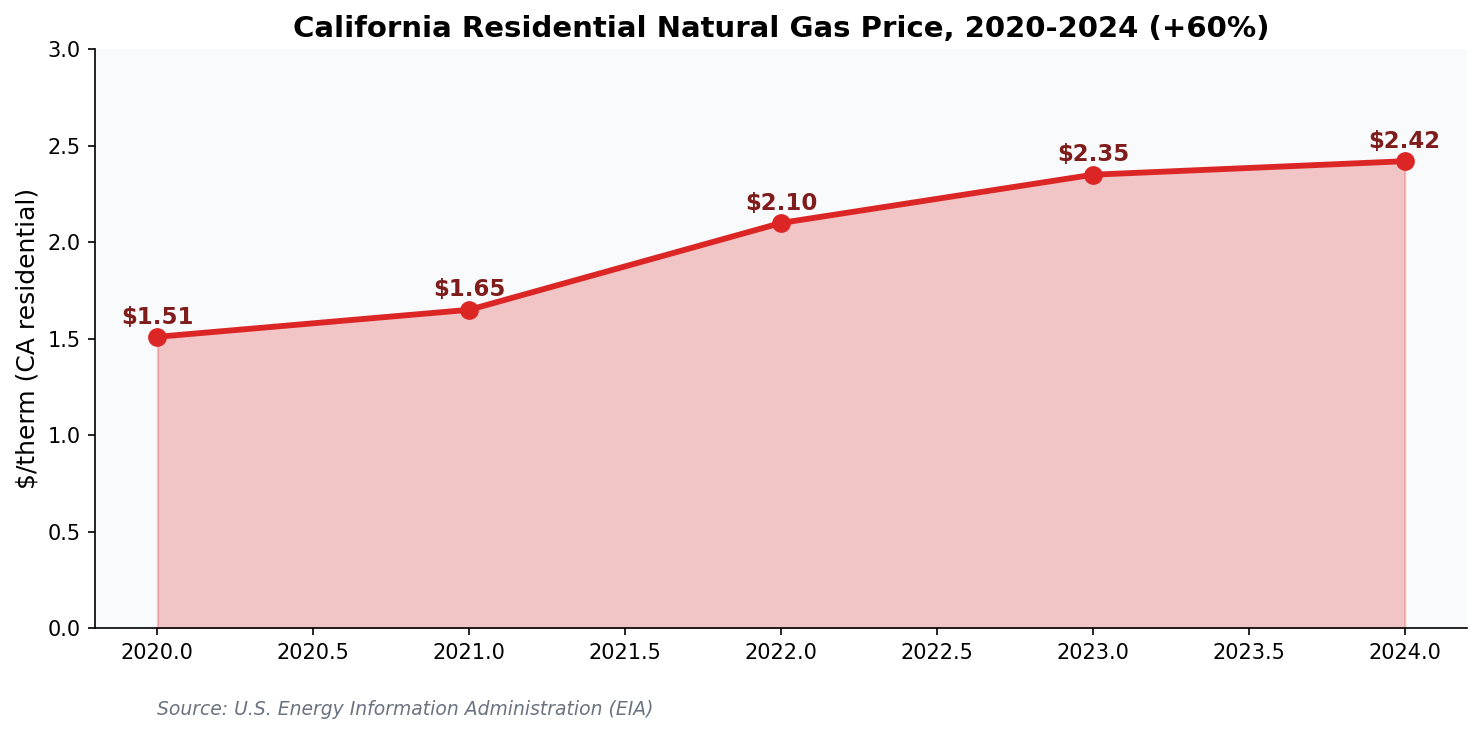
According to the U.S. Energy Information Administration, the average California residential natural gas price hit $2.42 per therm in 2024, up from $1.51 in 2020 — a 60% increase in four years (EIA Natural Gas Prices). The typical SoCalGas household uses roughly 35 therms in winter, which means recent rate moves have added $30+ to a single January bill.
Why this fits a bigger pattern
The CPUC has tightened scrutiny on gas-system spending across the board. In 2023 it directed utilities to begin planning for managed gas-system decline as building electrification scales (CPUC Natural Gas Decarbonization). Lawrence Berkeley National Laboratory has documented the "utility death spiral" risk for gas: as customers electrify, fixed pipeline costs spread across fewer ratepayers, raising bills for the customers who remain (LBNL Energy Markets & Policy).
For homeowners, this is the quiet story behind decisions like the SoCalGas ruling. Gas bills aren't just rising because of commodity prices — they're rising because the system itself is becoming more expensive to maintain per remaining customer.
The solar + battery math, with real numbers
Let's run a typical Southern California scenario. A 7 kW rooftop solar system in Los Angeles produces about 10,800 kWh per year, based on NREL's PVWatts model (NREL PVWatts). At SCE's average residential rate of roughly $0.34/kWh, that's $3,672 in annual electricity offset.
Add a 10 kWh battery (one Tesla Powerwall 3 or equivalent) and you can shift solar production into peak evening hours, when SCE's time-of-use rates can hit $0.55/kWh. Real-world EnergySage data shows battery owners typically capture an additional $300–$600/year in TOU arbitrage, plus backup value during PSPS events (EnergySage Marketplace Data).

Installed cost and payback
Per the most recent SEIA/Wood Mackenzie U.S. Solar Market Insight report, the residential solar national median installed cost was $2.95/watt in late 2025, with batteries adding roughly $1,000/kWh installed (SEIA Research). For our 7 kW + 10 kWh example:
- Solar: 7,000 W × $2.95 = $20,650
- Battery: 10 kWh × $1,000 = $10,000
- Combined gross cost: $30,650
Important federal tax credit note: The 30% federal Investment Tax Credit (ITC) for purchased residential solar systems expired at the end of 2025. As of 2026, only leases and third-party-owned PPAs still qualify for the commercial 48E credit, which the lessor passes through as lower payments (DOE Homeowner's Guide to Federal Tax Credits). California's Self-Generation Incentive Program (SGIP) still offers battery rebates of $150–$1,000/kWh depending on equity tier (SGIP Program).
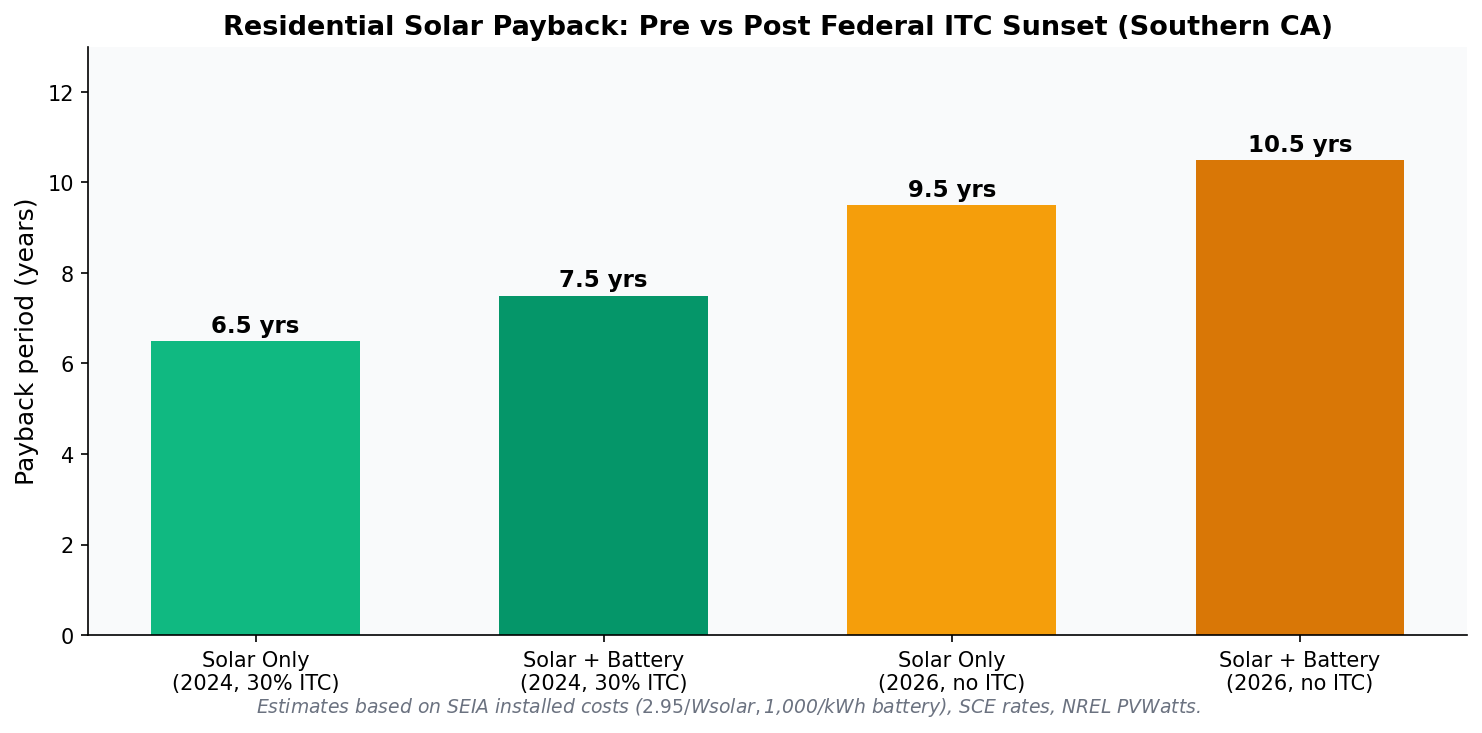
For a cash-purchased system in 2026, payback now lands in the 9–11 year range for most Southern California homeowners, depending on utility, shading, and battery sizing. That's longer than the 6–8 years common in 2024, but still well inside the 25-year warranty horizon — and panel production keeps offsetting bills long after payback.
Where this leaves SoCalGas customers
The CPUC ruling doesn't lower your gas bill on its own. What it does is reinforce that the gas system is no longer the default low-cost utility it was a decade ago. Homeowners weighing a heat-pump water heater, induction range, or HVAC replacement now have a regulatory environment that favors electrification — and a solar + battery system that turns those electrified loads into self-generated kilowatt-hours.

The honest framing: rooftop solar in 2026 is a 9–11 year financial decision, not the 4–6 year slam-dunk it was when the ITC was at 30% and panel prices were lower. But it is still a clearly positive ROI for most California homeowners, and it's the only utility decision you fully control once installed.
How to run your own numbers
Before you trust any installer's quote, build your own baseline. Three steps that take about 15 minutes:
- Pull 12 months of bills from your SoCalGas and SCE/LADWP accounts. You want annual kWh and annual therms.
- Run a free production estimate using NREL data through EnergyScout's /assessment tool. It uses your address, roof orientation, and local solar irradiance to estimate annual kWh production.
- Check incentives by ZIP at /solar-battery-incentives-zipcode-search — SGIP, local utility rebates, and any active state programs.

Then — and only then — get quotes. EnergyScout's /providers directory lists vetted local installers you can compare against your own numbers. If a quote's projected savings are wildly higher than what NREL says your roof can produce, that's your signal to ask harder questions.
The takeaway
The CPUC told SoCalGas it can't pre-bill customers for a hydrogen pipeline that may never serve them. That's $11 saved per meter in the near term — and a useful reminder that the cost of staying on the gas system isn't fixed. Whether that nudges you toward solar, a battery, or a heat pump, the right move starts with running the math on your own home.
Run the numbers for your home at energyscout.org — free, no signup required, NREL-backed estimates.
More Articles
Do Solar Panels Work During a Power Outage?
Most homeowners assume solar panels keep the lights on when the grid goes down. The actual answer surprises people — and the fix is simpler than you think.
Read article Battery StorageChile Hit 75% Solar in March. Here's What U.S. Homeowners Should Take From It
Chile's grid produced 29% of its electricity from solar in March, with peaks at 75%. The bottleneck wasn't generation — it was storage and transmission. Here's the homeowner takeaway.
Read article