What Germany's Battery Toll Market Means for U.S. Homes
Lenders backing utility-scale batteries in Germany now demand 60-80% contracted revenue before they release debt. That financing signal tells homeowners something important about when batteries pay back at the residential level.
BlackRock-backed developer Akaysha Energy disclosed this week that European lenders now require 60% to 80% of project revenue to be locked in under contract before they will commit debt to a utility-scale battery energy storage system (BESS) in Germany. PV Magazine reported that Akaysha is using structured "toll" agreements - borrowed from the Australian market - to clear that bar.
That sounds like wonky project-finance news. It isn't. The same forces shaping how grid-scale batteries get built in Frankfurt are quietly redefining what a battery is worth on the side of your house in Phoenix or Newark. Here's the translation.
What a "toll" actually is - and why it matters
In a battery toll, an offtaker (usually a utility or trader) pays the battery owner a fixed fee for the right to charge and discharge the system on demand. The battery owner gets a predictable revenue floor; the offtaker captures the upside from arbitrage and ancillary services. It's the same logic as a gas-fired peaker plant's tolling agreement, just applied to lithium-ion.
The fact that lenders are insisting on 60-80% contracted revenue tells us two things at once:
- Pure merchant battery economics are getting harder. Spreads between cheap midday power and expensive evening power are compressing as more batteries come online - the so-called "cannibalization" effect.
- Long-duration storage is becoming bankable. Akaysha is specifically building 2-4 hour systems with toll structures, signaling that lenders now believe the duration will be needed.
The International Energy Agency projects global battery storage capacity will grow more than sixfold by 2030, with grid-scale projects making up the bulk of that growth (IEA, Batteries and Secure Energy Transitions). That growth is what's pulling forward the financing-discipline conversation.
Why a German project-finance memo matters at your kitchen table
U.S. homeowners are not negotiating tolling agreements. But the same fundamentals - duration value, time-of-use spreads, and contract certainty - drive whether a 10 kWh home battery is a smart purchase or an expensive insurance policy.
Three things you should be watching:
1. Time-of-use spreads are widening in the U.S.
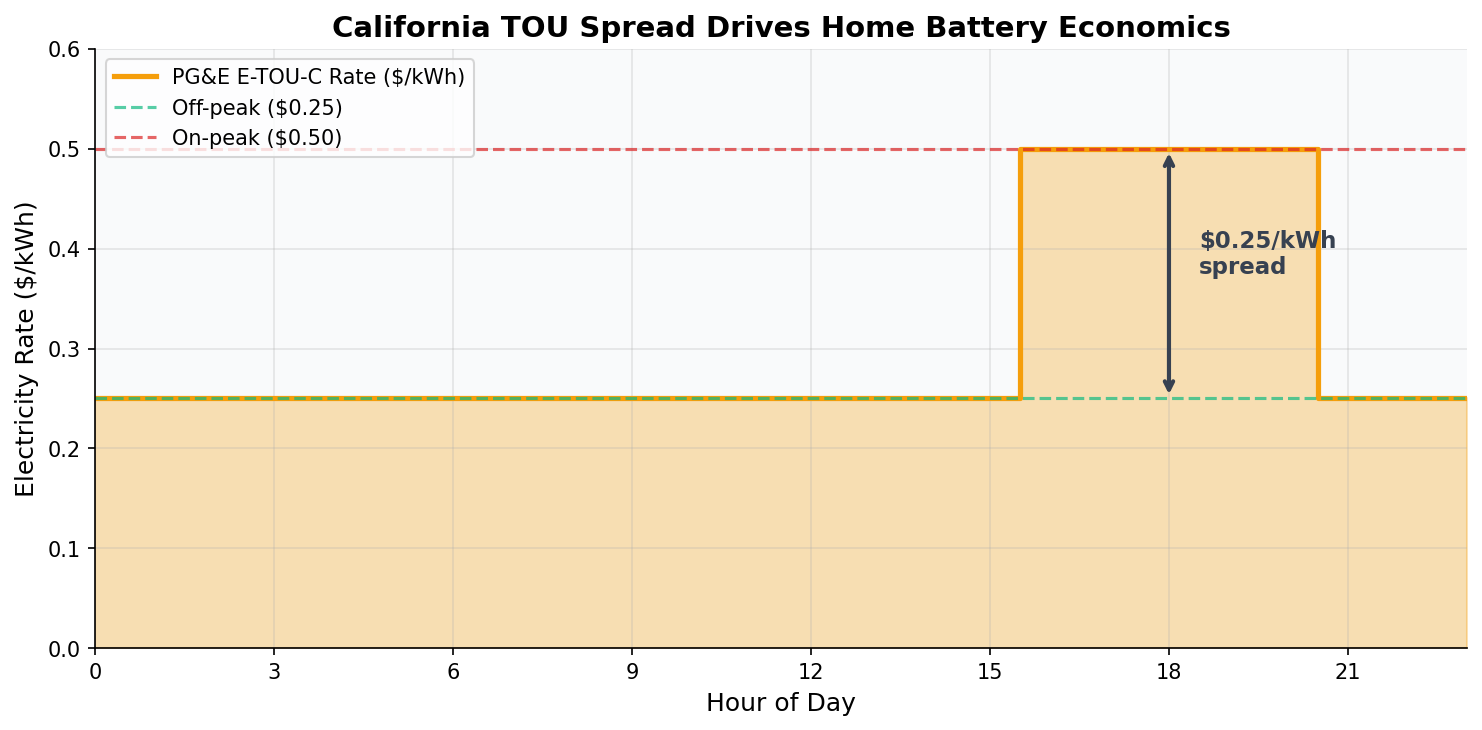
According to EIA data, average residential electricity prices climbed about 6% year-over-year in 2025. But the average hides the real story: in California, evening on-peak rates under PG&E's E-TOU-C now reach roughly $0.50/kWh, while overnight off-peak is closer to $0.25/kWh. That ~$0.25/kWh spread is exactly the arbitrage signal that makes a home battery economically interesting - the same signal driving Germany's toll structures.
2. Net metering is being replaced - not killed
California's NEM 3.0 (technically the Net Billing Tariff) cut export credits by roughly 75% versus NEM 2.0, according to filings reviewed by the CPUC. That changed home solar math: a battery is now nearly required to capture the value of self-consumption rather than exporting cheap and buying expensive. Lawrence Berkeley Lab's Tracking the Sun report shows the share of new residential solar installations paired with batteries climbed from under 10% in 2020 to over 25% in California by 2024 (LBNL Tracking the Sun).
3. The federal 30% ITC for purchased systems expired in 2026
This is the change most homeowners haven't fully absorbed. The Inflation Reduction Act's 30% Investment Tax Credit for residential solar and standalone storage purchased outright sunset at the end of 2025 under current law. Leases and power purchase agreements (PPAs) - where a third party owns the system - can still claim the commercial ITC and pass savings through. That's a real economic delta. SEIA tracks the ongoing legislative landscape, but as of today, ownership economics shifted meaningfully against cash purchases.
The math: when does a home battery pay back today?
Let's run a representative case for a California home on PG&E E-TOU-C with a 7 kW solar array and a 10 kWh battery (roughly the size of a Tesla Powerwall 3 or one Enphase IQ 10).
Assumptions:
- Battery capacity: 10 kWh usable
- Daily cycle: 1 full cycle, 365/year (high-utilization assumption)
- TOU spread captured: ~$0.20/kWh (peak avoidance net of round-trip losses ~10%)
- Annual savings: 10 kWh x 365 x $0.20 = $730/year
- Installed cost (post-ITC, lease/PPA flow-through): ~$9,000-$11,000
That's a simple payback of roughly 12-15 years on the battery alone, before factoring in resilience value (avoided generator costs, food preservation during outages, medical equipment continuity). For a homeowner in a Public Safety Power Shutoff zone, that resilience number can easily be worth $500-$1,000/year on its own.
Compare that to the merchant arbitrage logic the German lenders are walking away from: when spreads are thin and uncertain, batteries don't pencil. When spreads are wide and somewhat predictable - exactly the situation under California TOU rates - they do.
State incentives are where the real money still lives
With the federal ITC expired for cash purchases, state-level programs are doing the heavy lifting:
- California SGIP (Self-Generation Incentive Program): Up to ~$1,000/kWh for equity-resilience customers, with general-market incentives in the $150-$250/kWh range, per CPUC filings.
- Massachusetts ConnectedSolutions: Pays roughly $200-$275 per kW of summer dispatch capacity per year for batteries that participate.
- New York NY-Sun + utility programs: Stacked rebates that can knock several thousand dollars off a battery install.
The catch: these programs change quarterly, have queues, and have very specific eligibility rules. A homeowner shopping today should check current status before assuming any number.
You can pull a current list for your ZIP using EnergyScout's incentive search tool, which is updated against state agency filings.
What the Germany news actually predicts for U.S. homeowners
Three forecasts, anchored to public data:
1. Battery durations will get longer. Akaysha is building 2-4 hour systems and lenders are funding them. Expect U.S. residential batteries to follow: 10 kWh is becoming the baseline, with 15-20 kWh stacks (two-Powerwall or larger Enphase configurations) increasingly common as homeowners size for whole-home backup rather than partial.
2. Contracted revenue is the new normal. For homeowners, the analog is utility programs that pay you a fixed amount per kWh dispatched (ConnectedSolutions in the Northeast, Bring Your Own Battery in California). Expect more of these. The free-market "export and arbitrage" model is fading; structured programs are replacing it.
3. Installer quality matters more than ever. When batteries were a luxury add-on, installer mistakes were expensive but recoverable. Now that batteries are core to the economic case, a misconfigured TOU schedule or oversized inverter can erase the entire payback. The National Renewable Energy Laboratory has documented installer-quality variance as one of the largest drivers of soft-cost differences in U.S. solar.

How to actually run the numbers for your house
Three steps, in order:
- Get a real production estimate. NREL's PVWatts calculator (which we use under the hood) gives location-specific kWh output for any roof orientation. Run a free assessment to see your home's annual production estimate alongside likely incentive eligibility.
- Pull your current incentives. Search by ZIP at energyscout.org/solar-battery-incentives-zipcode-search to see federal, state, and utility programs you currently qualify for.
- Talk to multiple installers. Quote variance for the same system can run 30-50%, per EnergySage marketplace data. Get at least three bids from vetted local providers.
The bottom line
Germany's lenders are sending a message: in a maturing storage market, the projects that get built are the ones with predictable, contracted economics. The same is becoming true at the residential level. Batteries paired with solar - sized correctly, installed by a competent contractor, paired with state incentives and time-of-use rates - have a defensible payback. Batteries bought as standalone insurance against outages are still expensive.
The honest answer to "should I get a battery?" is the same one those lenders are giving Akaysha: it depends on your contract. For a homeowner, your "contract" is your TOU rate structure plus your state's incentive stack. Run those numbers before anyone tries to sell you hardware.
If you want to start with the math, our free assessment at energyscout.org will pull your local production estimate, current incentives, and utility rate context in about two minutes - no contact info required to see the numbers.
More Articles
Do Solar Panels Work During a Power Outage?
Most homeowners assume solar panels keep the lights on when the grid goes down. The actual answer surprises people — and the fix is simpler than you think.
Read article Battery StorageChile Hit 75% Solar in March. Here's What U.S. Homeowners Should Take From It
Chile's grid produced 29% of its electricity from solar in March, with peaks at 75%. The bottleneck wasn't generation — it was storage and transmission. Here's the homeowner takeaway.
Read article