Hyundai's IONIQ V & The EV-Solar Connection at Home
Hyundai just unveiled the IONIQ V at Auto China 2026, doubling down on its EV future. For U.S. homeowners, the story underneath is bigger: pairing rooftop solar with battery storage is the smartest way to power the EV in your driveway.
At Auto China 2026, Hyundai Motor reaffirmed its long-term commitment to the world's largest EV market with the debut of the IONIQ V, the first IONIQ model purpose-built for Chinese consumers. The launch is part of Hyundai's renewed "In China, For China, To Global" strategy — a signal that the global EV race is accelerating, not slowing.
For U.S. homeowners, the headline isn't really about a single car. It's about what comes next: a wave of more affordable, longer-range EVs hitting driveways across America. And the smartest way to fuel them isn't the public fast charger down the street — it's the rooftop above your head.
Why Hyundai's China Push Matters for U.S. Drivers
Hyundai's announcement positions China as a strategic innovation hub for its global EV lineup. According to the International Energy Agency (IEA), China accounted for roughly 60% of global EV sales in 2024, and competition there is forcing automakers to slash costs and improve range fast [IEA, 2024]. Those innovations don't stay in China — they ripple outward into the models Americans buy.
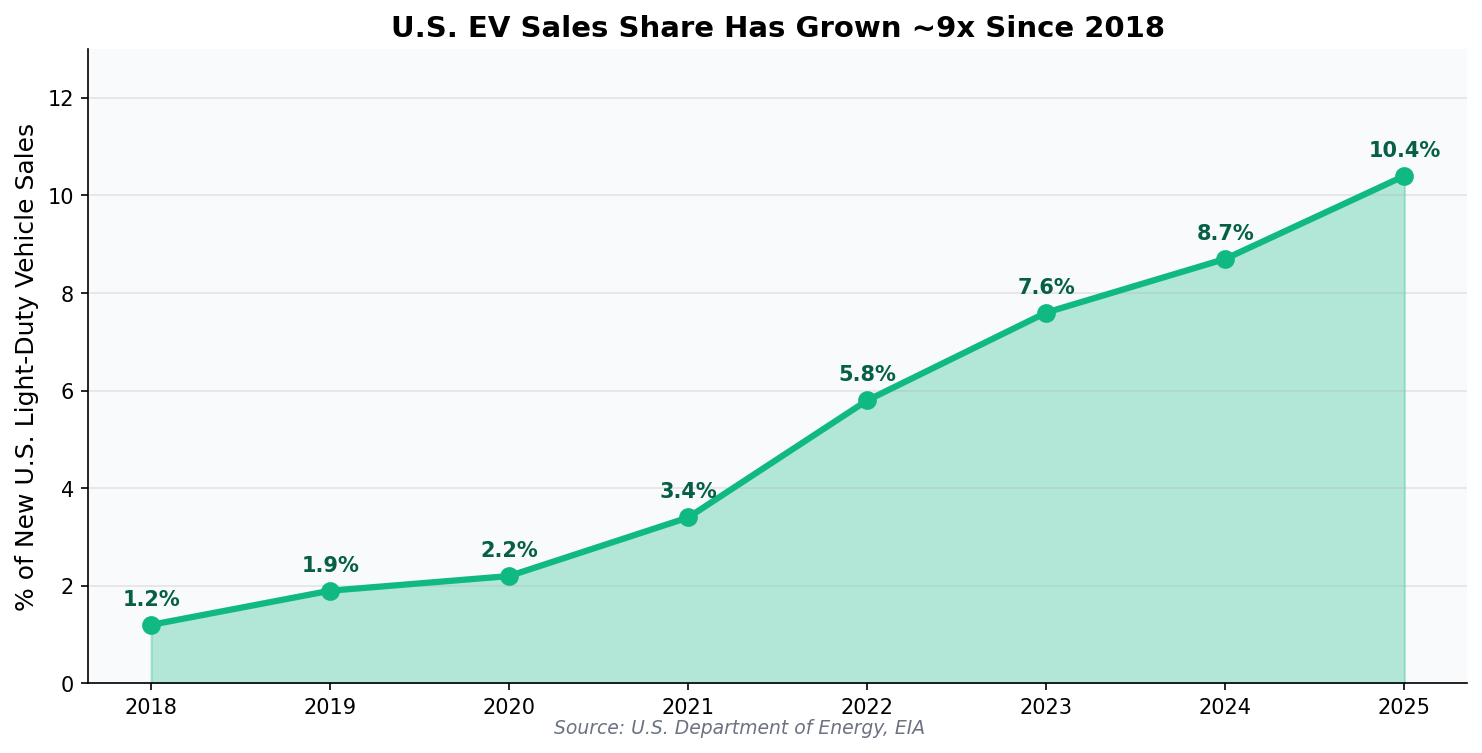
The U.S. Department of Energy reports that EVs already make up more than 10% of new light-duty vehicle sales in 2025, and that share is climbing [DOE]. As more households go electric, the question shifts from "Should I get an EV?" to "How do I charge it affordably?"
The Hidden Math of EV Charging
Most new EV owners assume that charging at home on the grid is automatically cheap. It can be — but it depends entirely on your utility's rates and time-of-use structure. The U.S. Energy Information Administration (EIA) reports the average residential electricity price hit roughly 16.5¢/kWh in 2024, with California, Massachusetts, and Hawaii pushing well above 30¢/kWh during peak hours [EIA Electric Power Monthly].
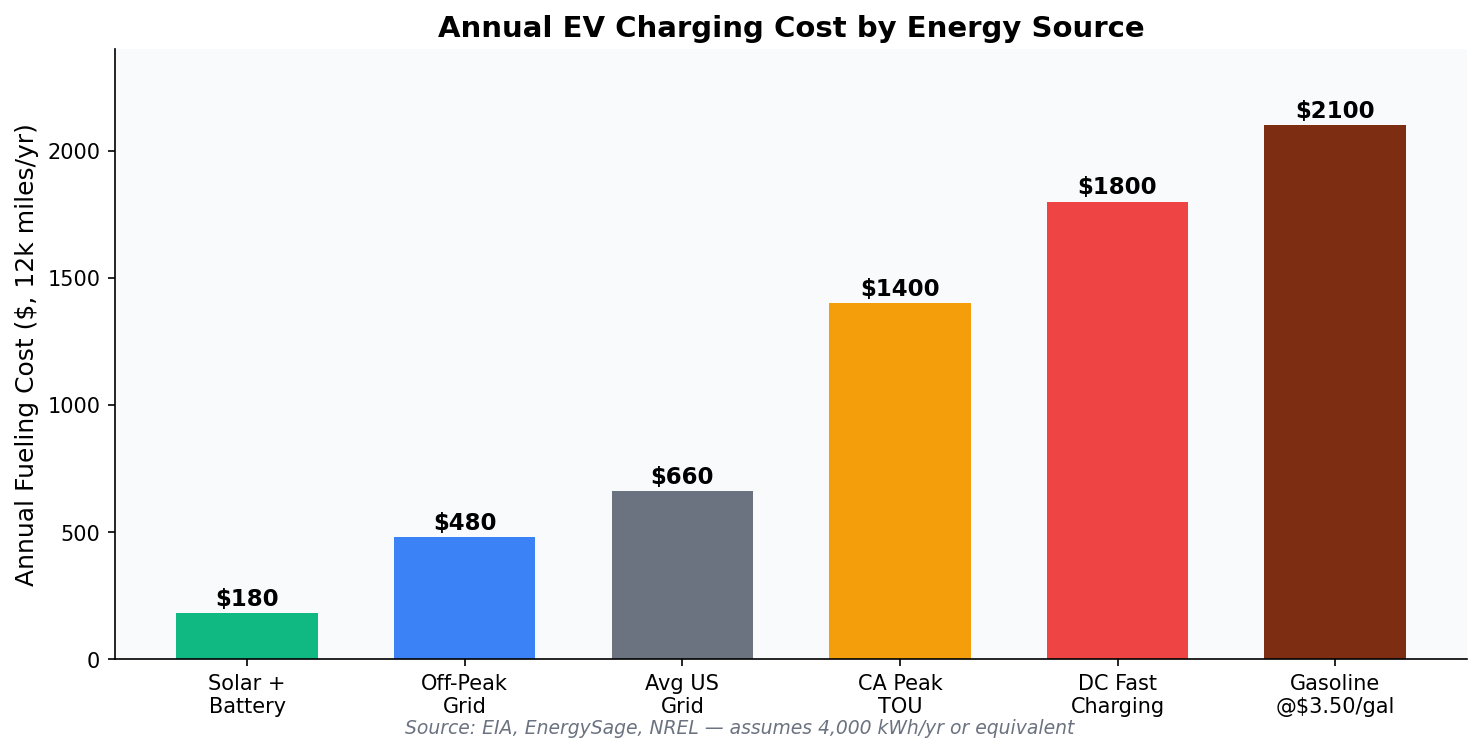
For a typical EV consuming 4,000 kWh per year (about 12,000 miles of driving), that's:
- National average: ~$660/year in charging costs
- California peak rates: ~$1,400/year or more
- Powered by your own solar: Often less than $200/year in marginal cost
The gap is what makes home solar the best partner an EV will ever have.
Solar + EV: A Compounding Advantage
The National Renewable Energy Laboratory (NREL) has documented the synergy clearly: a properly sized rooftop solar array can offset 80–100% of household electricity use, including EV charging, especially when paired with smart-charging schedules [NREL Technical Report]. Add a battery, and you can shift solar generated at noon into evening EV charging — bypassing peak utility rates entirely.
Why Battery Storage Just Got More Important
In 2026, the rules of the U.S. solar incentive game changed significantly. The federal 30% Investment Tax Credit (ITC) for purchased residential solar and battery systems expired at the end of 2025. Leases and Power Purchase Agreements (PPAs) still qualify for the credit, which has shifted homeowner decision-making considerably [SEIA].
That doesn't mean solar stopped making sense — far from it. According to Lawrence Berkeley National Laboratory's Tracking the Sun report, residential solar prices have fallen more than 70% since 2010, and battery storage costs are following a similar curve [LBNL]. With state-level incentives, net metering reforms, and time-of-use rate arbitrage, the economics still pencil out — especially for EV-owning households.
In states like California, the CPUC's NEM 3.0 rules make battery storage essentially mandatory to maximize solar value, because exported energy is now compensated at far lower rates than it once was [CPUC]. For an EV household, this is actually a feature, not a bug: you want to consume your own solar, not export it.
Sizing a Solar+Battery System for an EV Household
A traditional non-EV home in the U.S. uses about 10,500 kWh per year (EIA). Add an EV, and that jumps by roughly 30–40%. Here's a practical sizing framework:
Step 1: Estimate your driving load
Multiply your annual miles by 0.3 to estimate kWh needed. 12,000 miles × 0.3 ≈ 3,600 kWh/year for charging.
Step 2: Add it to your baseline
If your home currently uses 10,500 kWh/year, your EV-inclusive load is roughly 14,100 kWh/year.
Step 3: Size the array
In a region averaging 1,400 kWh per kW of installed solar per year (most of the continental U.S.), you'd need roughly a 10 kW system to cover the full load — a common residential size.
Step 4: Add storage
A 10–15 kWh battery typically covers overnight EV charging plus essential household loads. Sonnen, Tesla Powerwall, Enphase IQ, and FranklinWH all offer systems in this range.
The Real Savings Picture
EnergySage's 2024 marketplace data shows that homeowners who pair solar with EV charging report payback periods 2–4 years shorter than solar-only homes, because they're displacing a much higher-cost energy source (gasoline) on top of grid electricity [EnergySage].
Consider a homeowner in Phoenix:
- Drives 14,000 miles/year in an EV
- Saves ~$1,500/year vs. gasoline at $3.50/gallon
- Saves ~$700/year by charging on solar instead of grid
- Total annual energy savings: ~$2,200/year
Over a 25-year solar system lifespan, that's $55,000+ in cumulative savings — even before accounting for utility rate inflation, which has averaged 4.3% annually over the past decade per EIA data.
How to Get Started
The Hyundai IONIQ V launch is one more reminder that the EV transition is global, accelerating, and irreversible. Whether your next car is a Hyundai, Ford, Chevy, or Tesla, the cheapest electrons it will ever drink come from your own roof.
If you're considering solar — especially with an EV in the picture — start by understanding what's possible at your specific address:
- Run a free assessment at energyscout.org/assessment to estimate your solar potential, system size, and savings.
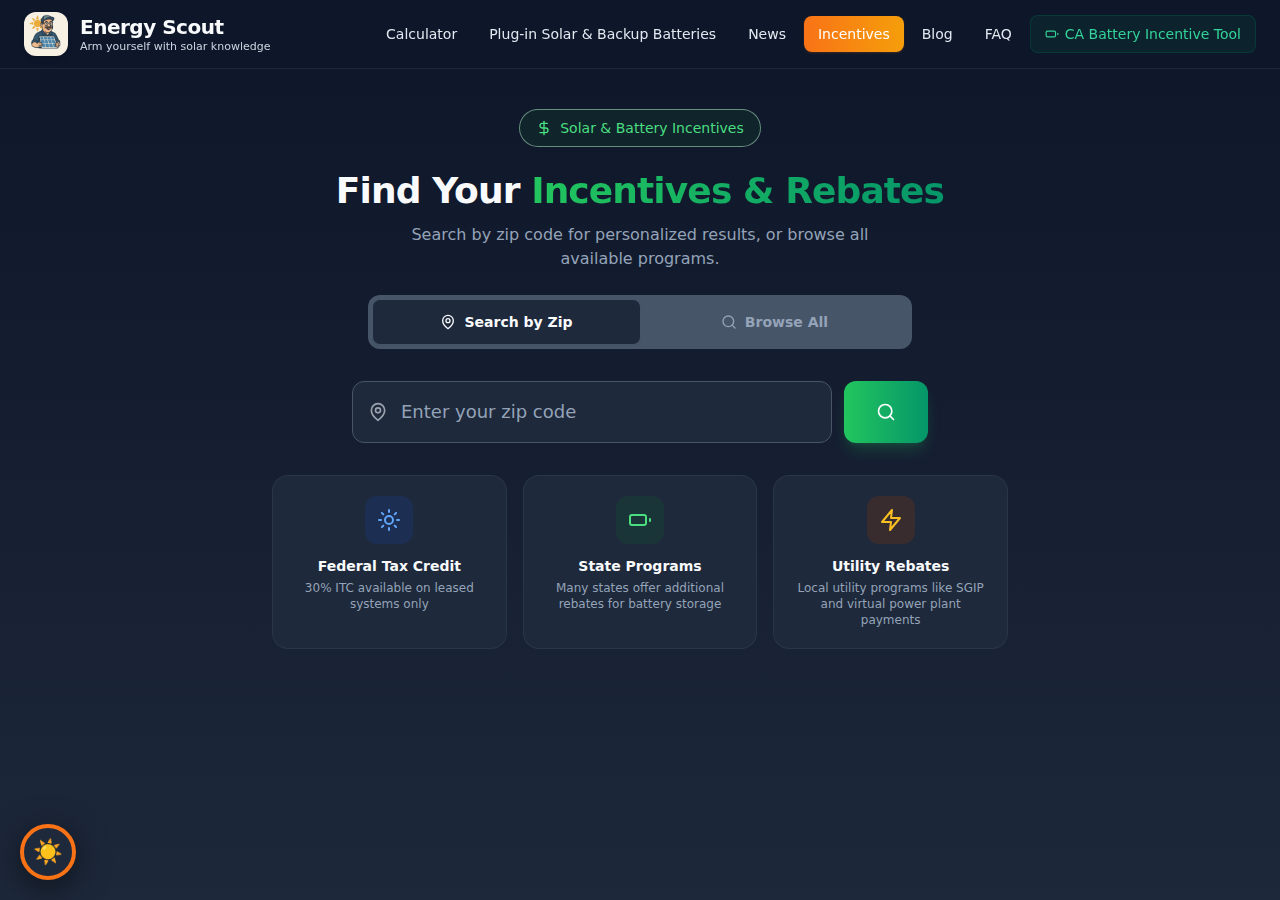
- Check available incentives by ZIP code at energyscout.org/solar-battery-incentives-zipcode-search — especially state and utility programs that have grown more important since the federal ITC change.
- Compare local installers at energyscout.org/providers who specialize in solar+battery systems and can quote EV charger integrations.
The Bottom Line
Hyundai's strategic doubling-down in China tells us something simple: EVs are winning. The smart move for homeowners isn't to wait — it's to make sure the energy fueling your driveway is the cleanest, cheapest energy you can produce. Rooftop solar paired with battery storage turns your home into your own personal gas station, with prices that don't change when OPEC sneezes.
Ready to see what's possible at your home? Get your free EnergyScout assessment today — no salespeople, no spam, just data.
More Articles
Do Solar Panels Work During a Power Outage?
Most homeowners assume solar panels keep the lights on when the grid goes down. The actual answer surprises people — and the fix is simpler than you think.
Read article Battery StorageChile Hit 75% Solar in March. Here's What U.S. Homeowners Should Take From It
Chile's grid produced 29% of its electricity from solar in March, with peaks at 75%. The bottleneck wasn't generation — it was storage and transmission. Here's the homeowner takeaway.
Read article