Indonesia's EV Push and What It Teaches U.S. Homeowners
A new study says Indonesia's EV push is really about energy independence — not climate. The same import-vs-domestic-energy math applies to U.S. homeowners weighing rooftop solar.
Indonesia is rethinking the math on its transportation system. A new study highlighted by CleanTechnica argues the country's push toward electric vehicles isn't just about cutting emissions — it's increasingly about cutting oil import dependence, which has become a structural drag on the national budget.1
That story matters far beyond Jakarta. The same logic — replacing imported fossil fuel with domestic electrons — is exactly what a U.S. homeowner does when they install rooftop solar paired with a battery. The scale is different. The economics rhyme.
The Indonesia signal: fuel subsidies are a balance-sheet problem
For decades, Indonesia kept gasoline and diesel artificially cheap through subsidies. According to the IEA, Indonesia's fossil fuel subsidies hit roughly $26 billion in 2022, one of the largest in the world.2 When global oil prices spike, the subsidy bill balloons — and the country has to import more crude to keep filling the tank.
The new study reframes EV adoption as energy security, not just climate policy. Every kWh that powers a motorbike or car off the grid is a kWh that didn't have to be imported as refined fuel. That's a recurring savings, not a one-time win.
Now zoom in to a single American driveway. The same arithmetic applies — and the numbers are surprisingly clean.
What this looks like for a U.S. homeowner
The average U.S. residential electricity rate hit 16.4 cents per kWh in 2024, according to EIA data, with California averaging closer to 32 cents and Hawaii north of 40 cents.3 Gasoline, meanwhile, averaged around $3.30/gallon nationally last year.4
Here's the clean comparison most homeowners never run:
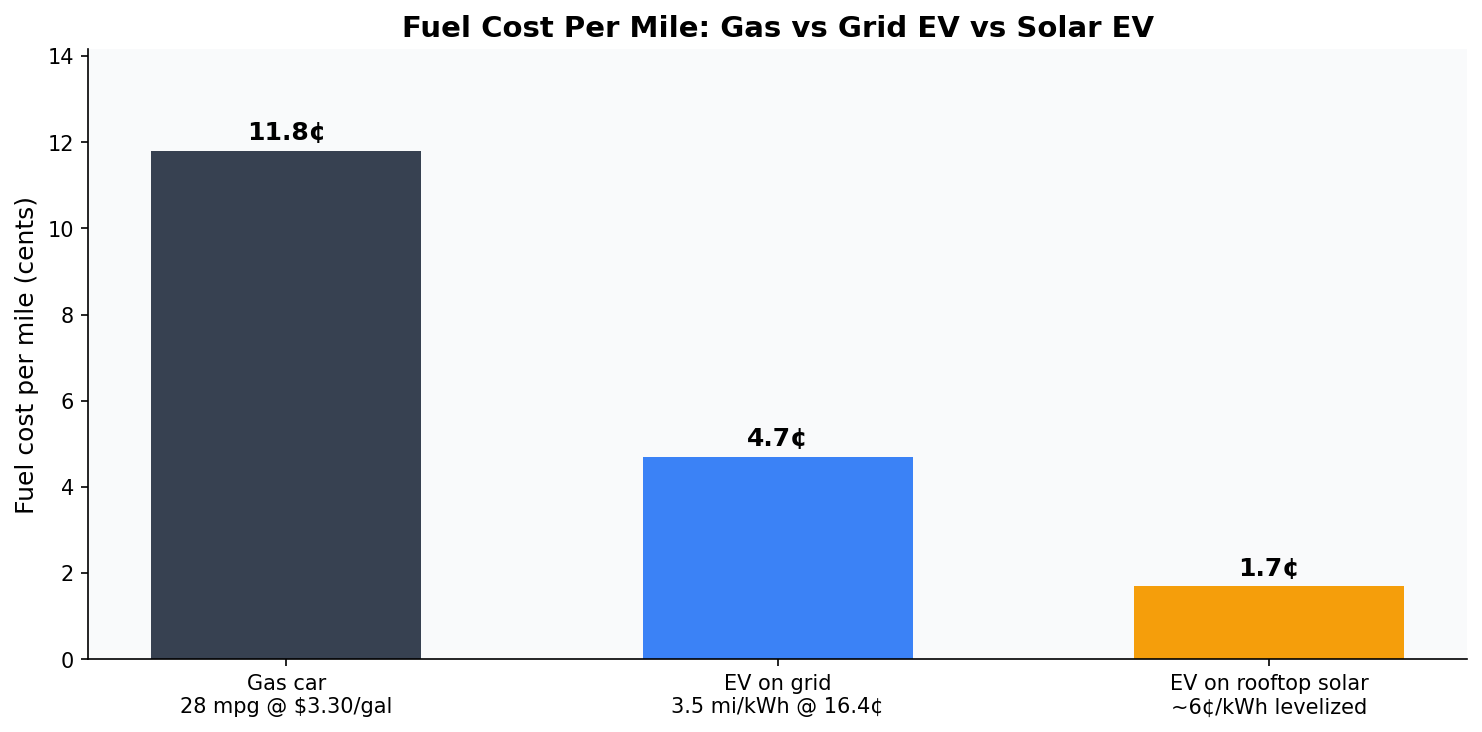
- A gas car at 28 mpg burning $3.30/gallon costs about 11.8 cents per mile in fuel.
- An EV at 3.5 miles/kWh on 16.4¢ utility power costs about 4.7 cents per mile.
- That same EV charged off rooftop solar (levelized cost ~6¢/kWh after install)5 costs about 1.7 cents per mile.
That's an order of magnitude difference between imported fuel and homegrown sunlight. Indonesia is doing the same calculation at a national level.
The homeowner's "oil dependence" — your utility bill
Most U.S. homeowners don't import oil personally, but they do import electricity. About 60% of U.S. electricity in 2024 still came from fossil fuels — 43% natural gas and roughly 16% coal, per EIA's Electric Power Monthly.3 When natural gas prices jumped in 2022, residential electric bills jumped with them. That's the same exposure Indonesia is trying to escape.
Rooftop solar plus a battery is the household-scale version of building energy independence. You're swapping a variable, imported fuel cost for a fixed, depreciating capital cost. Lawrence Berkeley Lab's Tracking the Sun report puts median installed residential solar at about $4.10/watt before incentives in 2023.6 A 7 kW system at that price is roughly $28,700 gross.
Run the math on a typical 7 kW system
Take a homeowner in a state with 1,400 kWh/kW/year of solar production — about average for the U.S. according to NREL's PVWatts model.7
- Annual production: 7 kW × 1,400 = 9,800 kWh/year
- Bill offset at 16.4¢/kWh: ~$1,607/year
- Bill offset at California rates (32¢): ~$3,136/year
- System cost (post-2026, no federal ITC for purchased systems): ~$28,700
- Simple payback at national average: ~17.8 years
- Simple payback at California rates: ~9.1 years
The federal 30% Investment Tax Credit for purchased residential solar expired at the end of 2025. As of 2026, only third-party-owned systems — leases and Power Purchase Agreements (PPAs) — still capture the ITC, which the lessor passes through as a lower monthly rate.8 That changes the homeowner decision significantly.
State and utility incentives still do the heavy lifting
With the federal credit gone for buyers, state and utility programs are now the difference-maker. Examples worth checking:
- California SGIP for battery storage — equity tiers can cover most of a battery's cost for qualifying households.9
- New York NY-Sun incentives plus a 25% state tax credit (capped at $5,000).
- Massachusetts SMART production-based incentive program.
- Illinois Shines SREC payments through the state Adjustable Block Program.
These vary block by block. EnergyScout's incentive search lets you plug in a ZIP code and see what's currently funded in your jurisdiction without sales-pitch overhead.
Battery storage: the "fuel reserve" parallel
Indonesia is also investing in nickel processing and battery manufacturing precisely because batteries are the strategic reserve of an electrified economy. For a homeowner, the same logic applies on a smaller scale.
A 10 kWh home battery stores roughly enough to run a refrigerator, lights, internet, and a few outlets for 24–30 hours. EnergySage's 2024 marketplace data puts installed battery costs around $1,000–$1,300 per kWh of capacity before incentives.10 California's SGIP equity tier can drop net cost dramatically for income-qualified households.
Batteries don't usually pay back on price arbitrage alone in flat-rate states. They earn their keep through:
- Outage backup (especially in PSPS-prone California or hurricane-prone Gulf Coast)
- Time-of-use rate shifting (charge cheap, discharge during peak)
- Self-consumption under net billing rules like California's NEM 3.0
The takeaway: it's not about saving the planet, it's about controlling your input costs
The Indonesian study reframes EVs from a green-consumer purchase to a national balance-sheet decision. The same reframe works at the household level. You don't have to care about emissions to care about predictable bills, lower lifetime transportation costs, and not being exposed to whatever natural gas or oil does next.
Solar plus battery, where the math works, is a hedge. It locks in part of your energy cost for 25+ years at known prices. That's a different value proposition than "go green" — and it's the one Indonesia is now making at the national level.

How to check your own numbers
If you want to see whether the math works for your specific home, ZIP code, and utility, EnergyScout pulls live NREL solar production data and current incentive databases:
- Free solar + battery assessment — production estimates and savings projections for your address
- Incentives lookup — state, utility, and local programs by ZIP
- Local installer matches — vetted installers in your area
The goal isn't to convince you solar is right for every home — it isn't. The goal is to give you the same kind of imported-fuel-vs-domestic-energy comparison that countries are running, but at the scale of your roof.
Run the numbers for your home at energyscout.org.
More Articles
Do Solar Panels Work During a Power Outage?
Most homeowners assume solar panels keep the lights on when the grid goes down. The actual answer surprises people — and the fix is simpler than you think.
Read article Battery StorageChile Hit 75% Solar in March. Here's What U.S. Homeowners Should Take From It
Chile's grid produced 29% of its electricity from solar in March, with peaks at 75%. The bottleneck wasn't generation — it was storage and transmission. Here's the homeowner takeaway.
Read article