Turkey's New 1 GW TOPCon Factory: What It Means for US Homeowners
Kalyon PV just doubled its solar cell production with a new 1 GW TOPCon factory in Ankara. Here's what TOPCon technology actually delivers for homeowners — and how to read the numbers on your next solar quote.
On May 8, 2026, Kalyon PV started production at a new 1 GW TOPCon solar cell factory in Ankara, Turkey, lifting the company's total cell capacity to 2.1 GW (PV Magazine, May 8, 2026). That's a single overseas factory announcement — easy to skim past. But TOPCon is now the dominant residential panel technology in 2026, and what happens to global cell supply directly affects what shows up on your solar quote.
Let's walk through what TOPCon actually is, how the math compares to older PERC panels, and what a homeowner should look for on a 2026 bid.
What TOPCon means in plain English
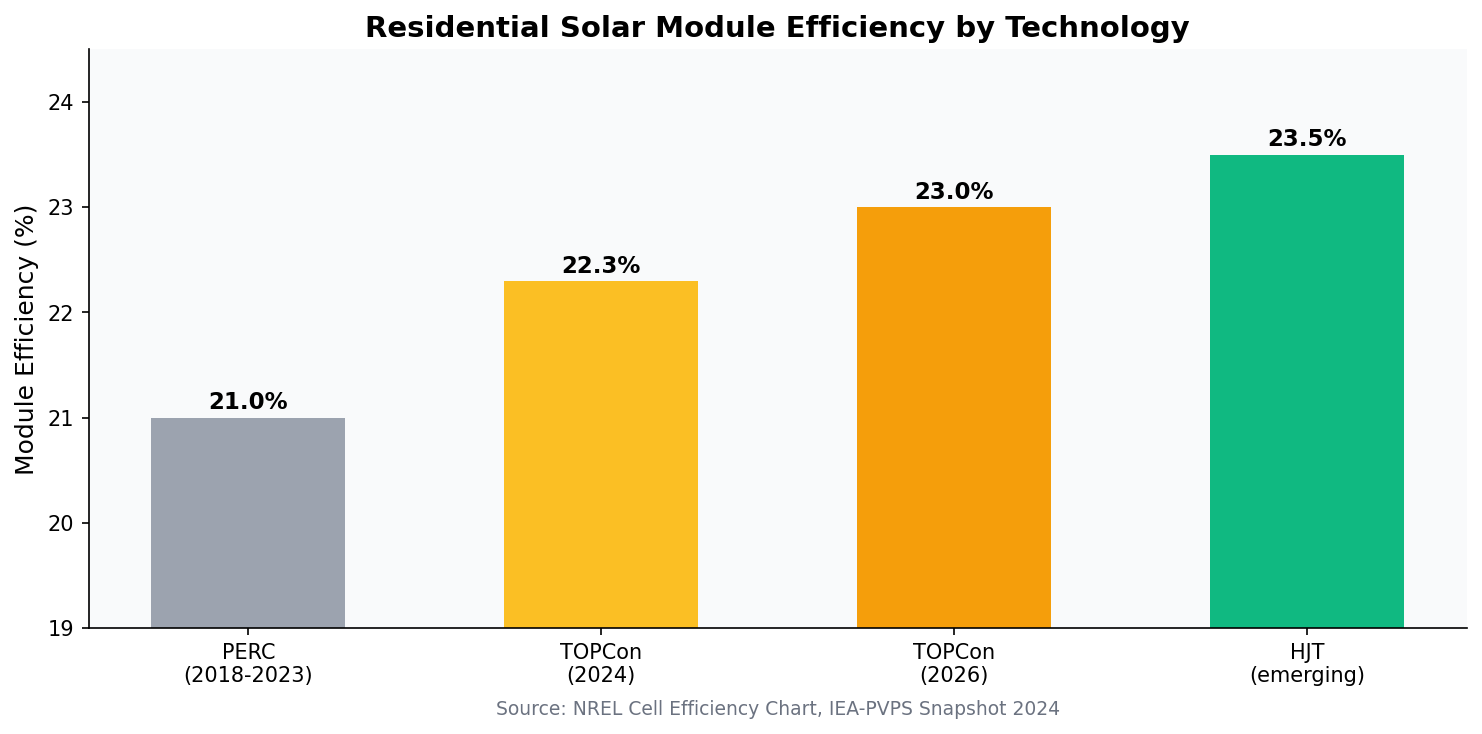
TOPCon stands for Tunnel Oxide Passivated Contact. It's a cell architecture that adds an ultra-thin oxide layer behind the silicon to reduce energy loss at the rear contact. The result is a higher conversion efficiency than the PERC (Passivated Emitter and Rear Cell) panels that dominated rooftops from 2018 through 2023.
The numbers, in round terms:
- PERC residential modules: ~20–21% efficiency, 0.40–0.45%/°C temperature coefficient
- TOPCon residential modules: ~22–23% efficiency, ~0.30%/°C temperature coefficient (NREL Cell Efficiency Chart)
Two practical differences fall out of those specs. First, you fit more wattage on the same roof. A typical 1.7m × 1.1m residential TOPCon module hits 430–450 W, versus 380–410 W for PERC at the same footprint. Second, TOPCon loses less production on hot summer afternoons, exactly when grid rates peak under time-of-use billing.
The International Energy Agency's 2024 PV market review reported that TOPCon's share of new module shipments crossed 60% globally in 2024 and was projected to exceed 75% by 2026 (IEA-PVPS Snapshot 2024). Kalyon's new line is one piece of that supply ramp.
Why a Turkish factory matters to a homeowner in Ohio
Solar cell manufacturing is a global pipeline. Cells made in one country get laminated into modules in another, then shipped to distributors who supply your local installer. The US Department of Energy's 2024 Solar Industry Snapshot tracked roughly 50 GW of US module assembly capacity by end of 2024, but most of those US-assembled modules still rely on imported cells (DOE Solar Energy Technologies Office).
More global cell capacity — including Kalyon's added 1 GW — generally pulls cell prices down. Cell prices feed into module prices, which feed into installer wholesale costs. Wood Mackenzie and SEIA's US Solar Market Insight reports tracked residential module prices falling from roughly $0.45/W in 2022 to $0.27/W in late 2024 as TOPCon supply ramped (SEIA / Wood Mackenzie).
That said, modules are only ~12–15% of an installed residential system cost. Lawrence Berkeley Lab's Tracking the Sun 2024 report put the median installed price of a residential PV system at $4.10/W before incentives, with the equipment (modules + inverters + racking) representing roughly $1.20/W of that total (LBNL Tracking the Sun 2024). Soft costs — labor, permitting, sales, overhead — make up the rest.
So a 5–10% drop in cell prices usually translates to a 1–2% drop in your final bid. Real, but modest. The bigger value of TOPCon for a homeowner isn't sticker price — it's lifetime production.
The math: TOPCon vs PERC on a real roof
Take a 7 kW system on a south-facing roof in Columbus, Ohio. Using NREL PVWatts default assumptions for that location (NREL PVWatts Calculator):
- PERC system (20.5% modules, 0.42%/°C): ~9,100 kWh/year
- TOPCon system (22.5% modules, 0.30%/°C): ~9,450 kWh/year
That's roughly a 4% production lift. At AEP Ohio's 2025 average residential rate of about $0.16/kWh (EIA State Electricity Profiles), the TOPCon system produces about $56/year more in offset value. Over a 25-year warranty period, that's roughly $1,400 of additional savings — not life-changing, but a meaningful tilt when two bids are otherwise close.
TOPCon panels also degrade more slowly. Most TOPCon manufacturers warrant ~87.4% production at year 30, versus ~82–84% for PERC. NREL's long-term degradation studies put modern TOPCon median annual degradation at roughly 0.4%/year, compared to 0.5–0.6%/year for PERC (NREL Module Reliability).
What to look for on a 2026 quote
If you're collecting solar bids in 2026, here's how to read the equipment line item:
- Cell technology: Look for "N-type TOPCon" or "HJT" in the panel datasheet. Avoid lingering PERC inventory unless the bid is significantly cheaper.
- Module wattage: 415–450 W is the 2026 residential sweet spot. Below 400 W usually signals older stock.
- Temperature coefficient: A figure between -0.26%/°C and -0.32%/°C is normal for TOPCon. -0.40%/°C or worse is PERC-era.
- Degradation warranty: 87%+ at year 25 is the new floor. Some Tier 1 brands offer 89–90%.
- Manufacturer Tier 1 status: BloombergNEF maintains the Tier 1 list quarterly. Tier 1 isn't a quality stamp, but it does indicate financial stability for warranty support.
The federal incentive picture in 2026
One thing to flag clearly: the federal 30% Investment Tax Credit for purchased residential solar systems expired at the end of 2025. That changes the math for cash and loan-financed systems. Leases and Power Purchase Agreements (PPAs) still qualify because the third-party owner — not you — claims the credit, and they typically pass a portion of that benefit through in lower monthly payments.
State and utility incentives are still very much alive. California's SGIP for batteries, New York's NY-Sun rebate, Massachusetts SMART, and dozens of state rebates and net metering programs continue to move the payback math. The DSIRE database (DSIRE) is the most comprehensive public list, but it's a lot of fine print.
If you want a faster read on what your specific ZIP qualifies for, our ZIP-code incentive search pulls state, utility, and local programs into one view.
The takeaway
Kalyon's new 1 GW factory is one data point in a much larger trend: the world is making far more TOPCon cells, residential module prices keep drifting down, and panel efficiencies keep creeping up. None of that creates urgency to sign tomorrow. It does mean that any 2026 quote you accept should specify TOPCon (or HJT) modules, 415 W or higher, with a 25-year 87%+ degradation warranty.
The most useful next step for any homeowner is the same as always: run the numbers for your specific roof, ZIP code, and utility before you talk to a salesperson. Our free assessment tool uses NREL production data and your local rates to estimate first-year savings and payback period. From there, you can see vetted local installers who quote in plain English.
Cheaper cells from Turkey are good news. Knowing what to do with them on your own roof is better.
More Articles
Do Solar Panels Work During a Power Outage?
Most homeowners assume solar panels keep the lights on when the grid goes down. The actual answer surprises people — and the fix is simpler than you think.
Read article Battery StorageChile Hit 75% Solar in March. Here's What U.S. Homeowners Should Take From It
Chile's grid produced 29% of its electricity from solar in March, with peaks at 75%. The bottleneck wasn't generation — it was storage and transmission. Here's the homeowner takeaway.
Read article