What the Lexus TZ Means for Your Home Energy Math
A three-row electric SUV like the new Lexus TZ adds about 4,000 kWh of annual load to a home. Here's the solar, battery, and incentive math for making that work in 2026.
Lexus just pulled the wraps off the TZ, its first three-row all-electric SUV, built around what the brand calls a “Driving Lounge” concept. It’s a luxury family hauler with a battery big enough to power a small house. And that last part is what most homeowners miss when a vehicle like this gets announced.
A modern three-row BEV typically carries a 100–120 kWh battery pack. For context, the average U.S. home uses about 29 kWh per day (EIA, 2024). That means the battery sitting in your driveway has roughly three to four days of whole-home electricity in it — if your house is set up to use it.
This article isn’t a Lexus review. It’s a look at the math behind owning a long-range EV, putting solar on the roof, and using a home battery to glue them together. We’ll show the numbers, cite the sources, and point you to the tools you can use to run the same calculation for your address.

What the Lexus TZ tells us about where home energy is heading
Three-row electric SUVs are the segment automakers care about most right now. The Rivian R1S, Kia EV9, Volvo EX90, and now the Lexus TZ are all aimed at the same buyer: a household that already has a garage, a driveway, and likely a roof that gets sun.
According to the IEA Global EV Outlook 2024, EVs accounted for 18% of global car sales in 2023, up from 14% in 2022. In the U.S., DOE data shows EVs hit roughly 10% of new light-duty vehicle sales in 2024.
Here’s the part that matters for this conversation: the average residential electricity rate in the U.S. is $0.166/kWh (EIA, January 2025), and rates have climbed faster than overall inflation for four straight years. Charging a 100 kWh BEV at home runs about $16.60 from empty to full. Doing it on solar you already own runs about $0.
The charging math, drawn out
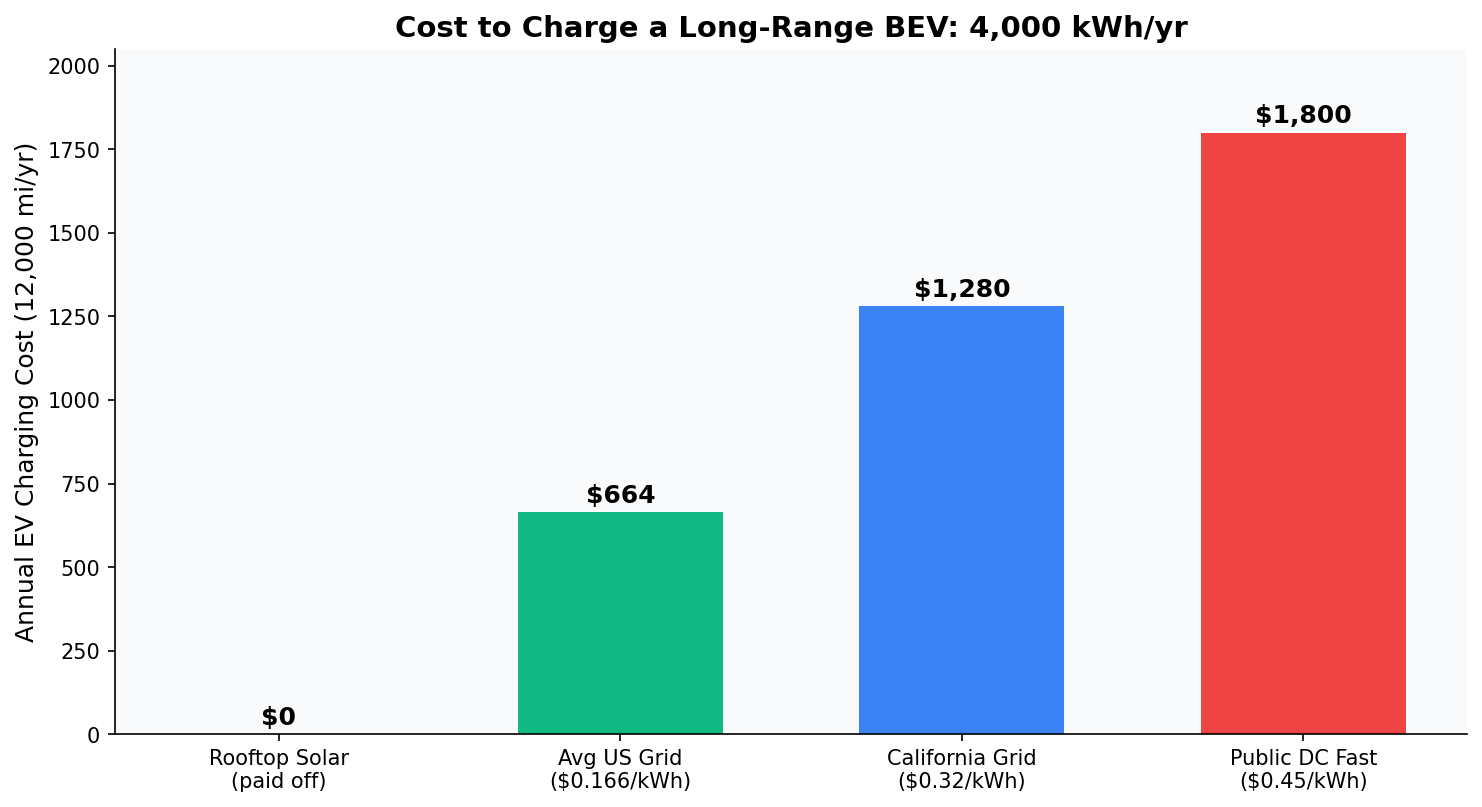
A typical American household drives about 12,000 miles a year. At a BEV efficiency of 3 miles per kWh, that’s 4,000 kWh of charging needed annually. Some quick scenarios:
- Grid charging at $0.166/kWh: 4,000 kWh × $0.166 = $664/yr
- Grid charging in California at $0.32/kWh: 4,000 kWh × $0.32 = $1,280/yr
- Solar-direct charging at home: ~$0/yr after the system is paid off
- Public DC fast charging at $0.45/kWh: 4,000 kWh × $0.45 = $1,800/yr
Over a 10-year ownership window, the difference between charging on rooftop solar versus public DC fast charging is roughly $18,000 in California — before you factor in any rate hikes.
Sizing solar to actually cover an EV
Most homeowners size their solar system to offset their existing electric bill. When you add a long-range BEV like the Lexus TZ, you’re effectively adding a second house worth of load.
The NREL PVWatts model is the gold standard for estimating production. For a south-facing roof in a typical U.S. climate, you can expect about 1,400–1,600 kWh per year per kW of installed solar.
So to cover 4,000 kWh of EV charging on top of an average home’s 10,500 kWh/year usage, you’re looking at roughly:
- Total annual load with EV: ~14,500 kWh
- Solar needed at 1,500 kWh/kW/yr: ~9.7 kW system
- Approximate cost at $2.75/W (EnergySage 2024 average): ~$26,700 before incentives
That’s a real number, not a marketing one. EnergyScout’s free assessment tool uses your actual roof, address, and utility rate to refine this estimate — not a national average.
Where the federal tax credit stands in 2026
This is the part homeowners get wrong most often, so we’ll be direct about it. The federal 30% Investment Tax Credit (ITC) for purchased residential solar systems expired at the end of 2025. If you’re buying a system outright in 2026, you can no longer claim the 30% federal credit.
What still qualifies:
- Third-party owned systems (leases and Power Purchase Agreements) — the installer or finance company claims the credit and passes savings through in your monthly payment
- State and utility rebates — many remain in place independent of the federal ITC
- Net metering credits — rules vary by state and utility
Per SEIA, leases and PPAs continue to access the 30% credit through their commercial structure. That’s why financing structure matters more in 2026 than it did in 2024.

Adding a battery: from EV to whole-home backup
This is where the Lexus TZ story gets interesting for homeowners. A bidirectional-capable EV can theoretically discharge to your house. But most current vehicles either don’t support it or require a specific (and expensive) bidirectional charger.
A dedicated home battery sidesteps the complexity. Common residential batteries deliver 10–15 kWh of usable capacity (DOE). At the U.S. average daily home draw of 29 kWh, a single 13.5 kWh battery covers roughly 11 hours of typical load — or 30+ hours if you’re running essentials only (fridge, lights, internet, a few outlets).
Pairing solar + battery + EV in the same household gets you three layers of resilience:
- Solar produces during the day — charges the home battery first, then the car
- Home battery covers evening load — including any overnight EV charging
- EV becomes the backup-of-last-resort for multi-day outages, if it supports V2H
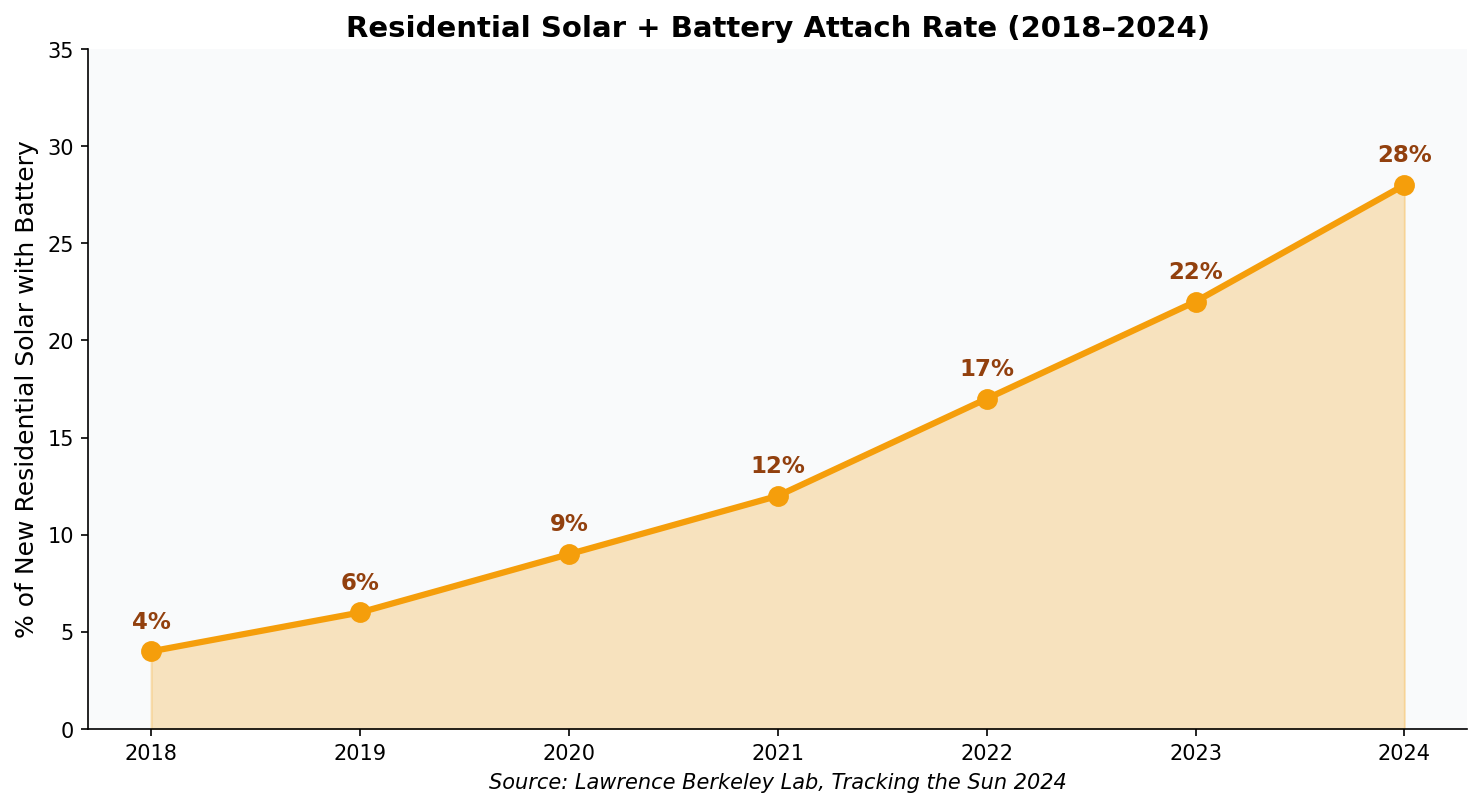
Lawrence Berkeley Lab’s Tracking the Sun 2024 report found that 28% of new residential solar installations now include a battery, up from less than 5% in 2018. The reason isn’t fear — it’s economics. Time-of-use rates make stored solar more valuable than exported solar in most utility territories.
Putting the numbers together for an EV-owning household
Let’s build a representative case. A California household with a Lexus TZ-class EV, average home usage, and a 9.7 kW solar + 13.5 kWh battery system:
- Annual electricity load: 14,500 kWh (home + EV)
- Annual solar production: ~14,550 kWh (NREL PVWatts, CA average)
- Pre-solar utility bill at $0.32/kWh: $4,640/yr
- Post-solar utility bill (with NEM 3.0 export rate): ~$600–$900/yr
- Annual savings: ~$3,800/yr
- Approximate system cost (lease/PPA, after 30% ITC pass-through): $1,800–$2,400/yr in payments
The math isn’t magic — it’s leverage. The same roof produces the energy that runs the house and the car, and the battery shifts the value of that energy into the most expensive billing windows.
How to run your own numbers
Every claim above came from a public source. The math behind your specific home depends on your roof orientation, your utility rate, and your driving patterns. None of that requires a sales call.
Three free EnergyScout tools that get you to a real estimate:
- /assessment — site-specific solar production and savings based on NREL data
- /solar-battery-incentives-zipcode-search — current state, utility, and federal incentives by ZIP code
- /providers — vetted local installers, no contact info required to browse

The takeaway
The Lexus TZ headline is about a luxury SUV. The actual story for most homeowners is that the average household’s biggest energy decision is no longer just “solar or no solar.” It’s how the roof, the battery, and the vehicle work together.
Run the numbers for your specific home and ZIP at energyscout.org. The tools are free, no email required to see your estimate.
More Articles
Do Solar Panels Work During a Power Outage?
Most homeowners assume solar panels keep the lights on when the grid goes down. The actual answer surprises people — and the fix is simpler than you think.
Read article Battery StorageChile Hit 75% Solar in March. Here's What U.S. Homeowners Should Take From It
Chile's grid produced 29% of its electricity from solar in March, with peaks at 75%. The bottleneck wasn't generation — it was storage and transmission. Here's the homeowner takeaway.
Read article