Robotaxi Chargers Are Coming. Your Power Bill Knows.
A startup's robotic robotaxi charger is clever engineering — but the real homeowner story is the megawatts of new EV load hitting the same grid that powers your house. Here's the math on hedging with rooftop solar.
A startup unveiled a multi-bay robotic charger this week designed to autonomously plug in robotaxi fleets — the kind of unglamorous infrastructure problem nobody talks about until it breaks. InsideEVs reported the system targets the one human-operated chore left in the driverless-car stack: someone has to physically connect the cable.
It's a clever bit of engineering. But the deeper story for homeowners isn't the robot arm — it's the load. Every robotaxi depot, every fast-charging hub, every new EV on the road is pulling from the same grid your house is connected to. And that grid is changing faster than most utilities can keep up with.
Here's what that means for your electric bill, and what you can actually do about it.
The robotaxi load problem, in real numbers
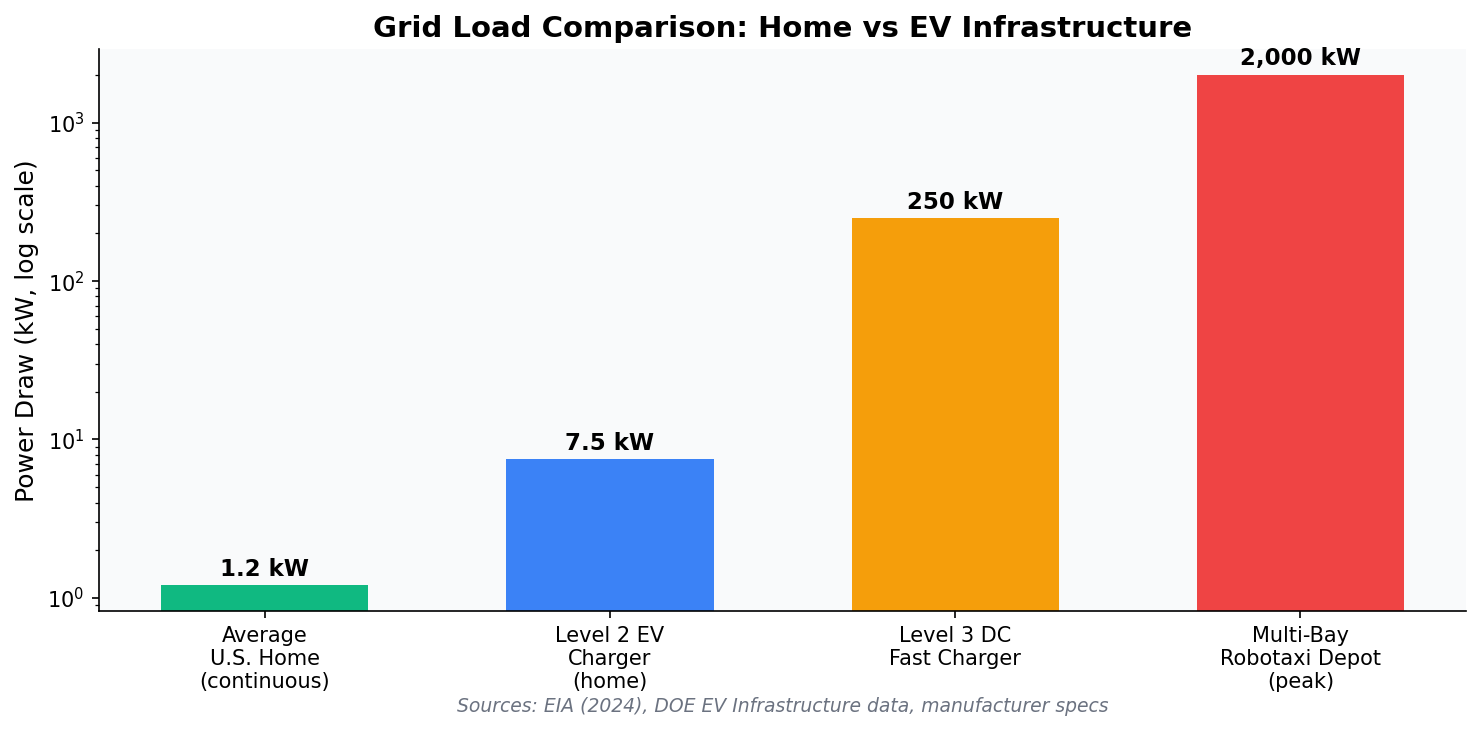
A typical Level 3 DC fast charger draws 150–350 kW. A multi-bay robotic depot serving a robotaxi fleet can pull 1–3 megawatts during peak charging windows. For comparison, the average U.S. home uses about 10,500 kWh per year, or roughly 1.2 kW continuous (EIA, 2024).
One robotaxi depot can equal the steady-state demand of 1,000+ homes.
The U.S. Department of Energy estimates EV charging will add roughly 9% to total U.S. electricity demand by 2030 (DOE, 2024). Most of that load lands in the same urban and suburban substations that serve residential customers.
Why this shows up on your power bill
Utilities pay for new substations, transformers, and feeder upgrades through rate cases — and those costs get spread across all ratepayers. The Lawrence Berkeley National Laboratory tracked residential rates climbing an average of 4.3% annually from 2020 to 2024 (LBNL, 2024), with EV-driven distribution upgrades cited as a growing share of capital spending.
In California, PG&E's residential Tier 1 rate sits around $0.41/kWh as of early 2026. ConEd customers in New York are paying north of $0.30/kWh delivered. Even in moderate markets like Texas and Arizona, residential rates have outpaced inflation for four straight years (EIA, 2024).
You don't drive a robotaxi. But you're helping pay for the wires that charge them.
The math: distributed solar as a hedge
The argument for rooftop solar isn't ideological — it's arithmetic. If your utility rate is rising 4–6% per year, every kWh you generate at home is a kWh you don't buy at tomorrow's price.
Run the numbers on a typical 7 kW residential system:
- Annual production: ~10,000 kWh in most U.S. climates (per NREL PVWatts modeling)
- Installed cost: ~$22,000 before incentives (national median, EnergySage 2025 marketplace data)
- Annual offset at $0.30/kWh: $3,000/year
- Simple payback: ~7.3 years
- 25-year production value at flat rates: $75,000
- 25-year production value at 4% rate inflation: ~$125,000
The rate-inflation column is where this gets interesting. The faster utility rates climb — driven by EV infrastructure, grid hardening, and capacity buildout — the more valuable each kWh of self-generation becomes.

One important caveat: the federal ITC has changed
The 30% federal Investment Tax Credit for purchased residential solar systems expired at the end of 2025. As of 2026, only leases and Power Purchase Agreements (PPAs) still qualify for the federal credit, which is claimed by the third-party owner and typically passed through to homeowners as a lower monthly rate.
This is a real change, and any installer telling you otherwise is reading from an old script. The Solar Energy Industries Association and DOE both confirm the purchased-system sunset.
State and utility incentives, however, are still very much alive — and in some markets they're more generous than the old federal credit ever was.
Where the real money still lives: state and utility programs
Battery storage incentives have actually expanded in several states over the past two years:
- California SGIP: Up to $1,000/kWh for qualifying battery installations in high-fire-risk zones (CPUC, 2025)
- New York NY-Sun + Energy Storage: Combined incentives can cover 25–40% of system cost (NYSERDA)
- Massachusetts SMART + ConnectedSolutions: Production-based payments plus battery dispatch revenue
- Maryland Energy Storage Tax Credit: 30% credit up to $5,000 per residential battery
These programs change quarterly. Funding gets allocated, exhausted, and refilled on cycles that don't sync with anybody's news feed.

EnergyScout's incentive search tool pulls from current state databases by ZIP code, so you're seeing what's actually available this month — not what was published in a 2024 blog post.
Battery storage: the robotaxi-era hedge
The robotaxi load story makes a quieter case for residential battery storage. Here's why:
Utilities increasingly use Time-of-Use (TOU) rates to manage demand. In California, peak rates between 4 PM and 9 PM run as high as $0.55/kWh, while off-peak rates can drop below $0.20/kWh. As fleet charging grows, that peak/off-peak spread is forecast to widen.
A 10 kWh home battery — charged from your panels during midday and discharged during evening peak — captures that arbitrage automatically. Real-world payback math from EnergySage marketplace data shows TOU-arbitrage payback in 7–10 years for households on tiered rates, even before counting backup-power value during outages.
For homes in PG&E, SCE, SDG&E, and ConEd territory, the TOU spread alone often justifies the battery before any incentive math.
Sizing your system for a higher-load future
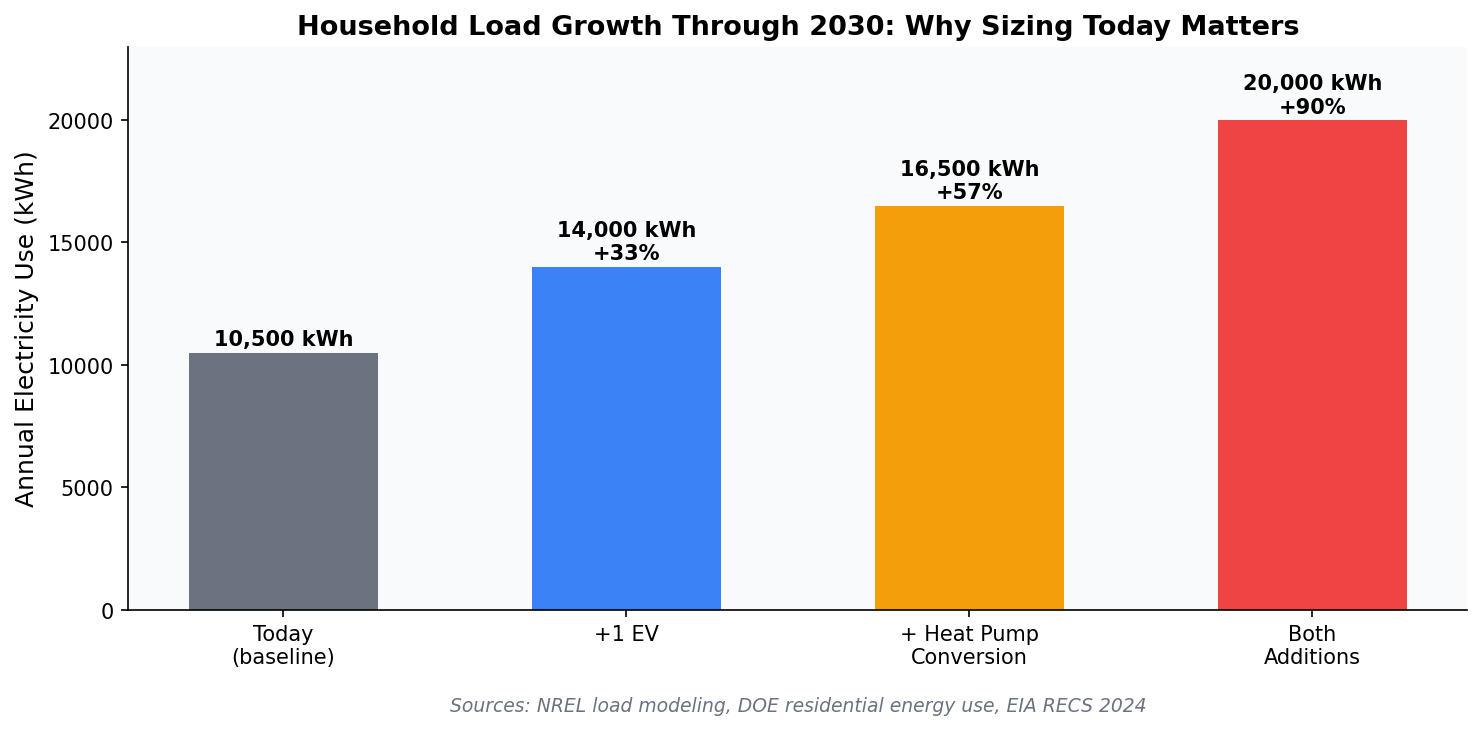
If you're sizing solar today, it's worth thinking about your 2030 household — not your 2024 household.
The average new EV adds 3,000–4,000 kWh/year to a home's electricity demand (NREL). A heat-pump conversion from natural gas can add another 4,000–6,000 kWh/year depending on climate. Households that add both can see their electric load nearly double over a five-year window.
That changes the optimal system size. A 7 kW array sized for today's bill may be undersized in 2028 if you add an EV and a heat pump. Most net-metering programs allow you to oversize modestly for anticipated load — but the rules vary by state and utility.
Choosing an installer who understands the math
The single biggest variable in residential solar economics isn't panel brand or inverter type — it's installer quote variance. EnergySage's 2025 marketplace data shows quotes for the same home routinely vary by 30–50% between installers.
A few practical filters:
- Get at least three written quotes — never sign with the first door-knocker
- Ask for the production estimate methodology (PVWatts, Aurora, HelioScope are reputable)
- Confirm the equipment warranty and the workmanship warranty separately
- Verify the installer is a NABCEP-certified contractor or employs one
- Read the contract financing terms carefully — dealer fees on financed systems can add 15–25% to the cost
EnergyScout's installer directory filters by state licensing, NABCEP certification, and verified customer reviews.
The bigger picture
A robotic arm plugging in a robotaxi is a small technical milestone. The grid load behind it is not.
The honest read: residential electricity rates are going to keep climbing for at least the next decade as utilities absorb EV charging demand, fleet electrification, data center growth, and overdue grid hardening. You can't opt out of the grid. But you can shrink the share of your bill that's exposed to those rate hikes.
Solar isn't a magic bullet. It's a hedge — priced in 2026 dollars against an electric bill priced in future-decade dollars.
Run your own numbers
The right system for your home depends on your roof, your utility, your usage, and your local incentives. A generic payback estimate is worth roughly what you paid for it.
If you want a starting point grounded in your actual ZIP code, EnergyScout's free assessment uses NREL solar production data and your local utility rate to estimate production, savings, and payback for your address. Check the incentive database while you're there — there's a decent chance your state or utility has a program you didn't know about.
The goal isn't to sell you solar. The goal is to give you enough numbers to make an honest decision, either way.
More Articles
Do Solar Panels Work During a Power Outage?
Most homeowners assume solar panels keep the lights on when the grid goes down. The actual answer surprises people — and the fix is simpler than you think.
Read article Battery StorageChile Hit 75% Solar in March. Here's What U.S. Homeowners Should Take From It
Chile's grid produced 29% of its electricity from solar in March, with peaks at 75%. The bottleneck wasn't generation — it was storage and transmission. Here's the homeowner takeaway.
Read article