Arizona's 4 GW Solar+Storage Deal: What It Means for Homeowners
Salt River Project and NextEra just inked one of the largest solar + storage PPAs in U.S. history — 3 GW of solar and 1 GW of batteries. Here's what the math behind this deal tells homeowners about where rooftop solar is heading.
On May 1, 2026, Salt River Project (SRP) — Arizona's third-largest utility serving roughly 1.1 million customers — signed a power purchase agreement with NextEra Energy Resources for 3,000 megawatts of solar and 1,000 megawatts of battery storage, with the full buildout scheduled through 2027 (PV Magazine).
That's a 4 GW project — enough nameplate solar capacity to power roughly 500,000 average U.S. homes at peak output, paired with battery storage that can dispatch electricity for hours after the sun goes down. It is one of the largest single solar-plus-storage procurements ever signed by a U.S. utility.
Big number. But what does a deal between a utility and a developer actually tell you — a homeowner sizing up rooftop solar for your own roof? More than you'd think. Let's run the math.
Why utilities are buying solar + storage at this scale
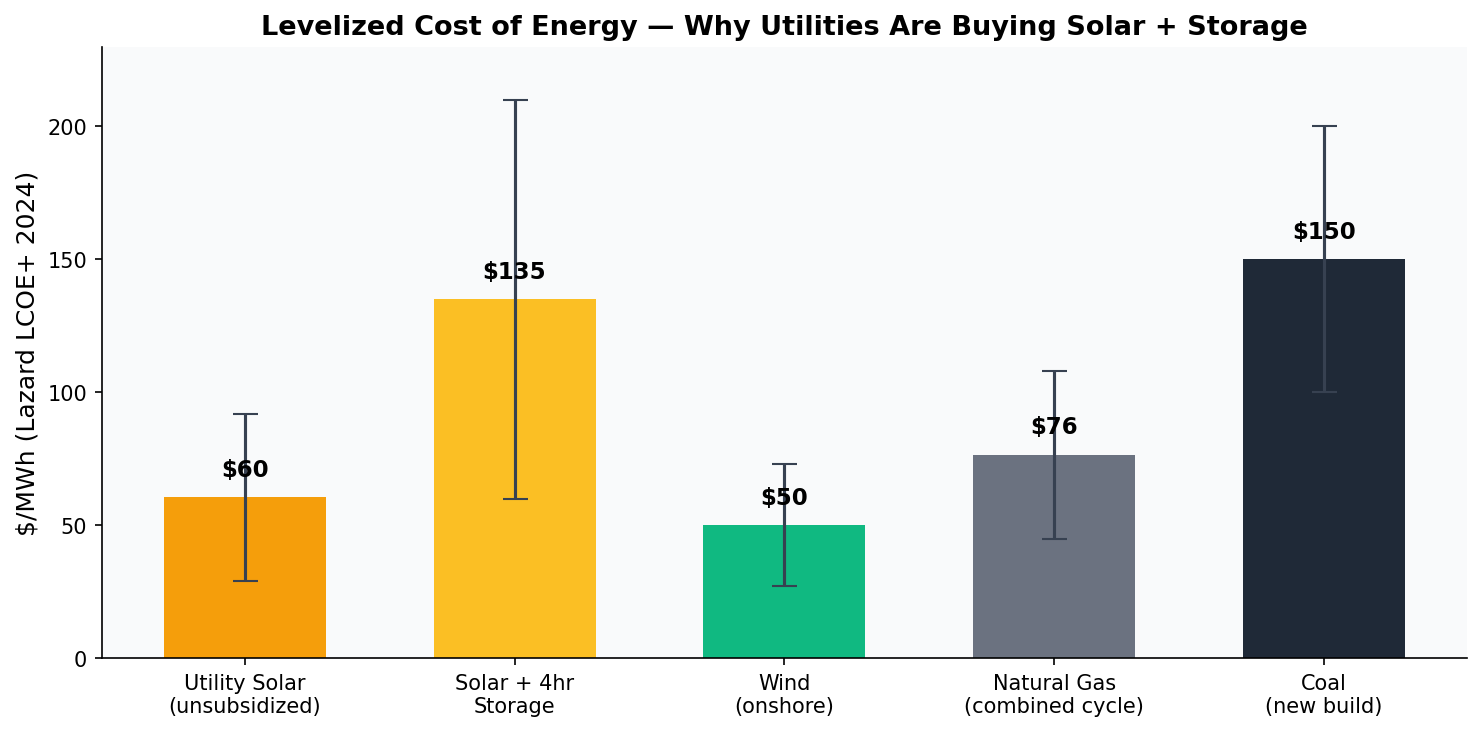
Utilities don't sign 25-year PPAs out of charity. They sign them because the levelized cost of energy (LCOE) from new solar plus storage now beats almost everything else on the grid.
According to Lazard's 2024 LCOE analysis, unsubsidized utility-scale solar lands between $29 and $92 per MWh. Solar paired with 4-hour storage runs roughly $60–$210/MWh. New combined-cycle natural gas costs $45–$108/MWh, and new coal is well over $100/MWh (Lazard LCOE+ 2024).
SRP's service territory hits 115°F summer afternoons. Air conditioning peaks line up almost perfectly with solar production — and storage covers the early-evening shoulder when the sun drops but air conditioners are still grinding. From a utility's perspective, this is the cheapest way to keep the lights on.
The grid is changing — and your bill will follow
The U.S. Energy Information Administration projects solar will make up 58% of new utility-scale capacity additions in 2026, with battery storage at 23% (EIA Today in Energy). Coal retirements continue. Gas additions slow. The generation mix is shifting under our feet.
For homeowners, two things follow from that:
- Retail rates keep climbing. The EIA reports U.S. residential electricity prices rose roughly 28% from 2020 to 2025, with Arizona, California, and Texas seeing some of the steepest hikes (EIA Electric Power Monthly).
- Net metering is being rewritten. California's NEM 3.0 cut export compensation by roughly 75% in April 2023 (CPUC). Arizona, Florida, and several other states are revisiting their own rules.
The combined effect: power from the grid costs more, and selling solar back to the grid is worth less. That math points homeowners toward the same conclusion utilities just reached — pair solar with storage, and use as much of your own electricity onsite as possible.
Run the math on your own roof
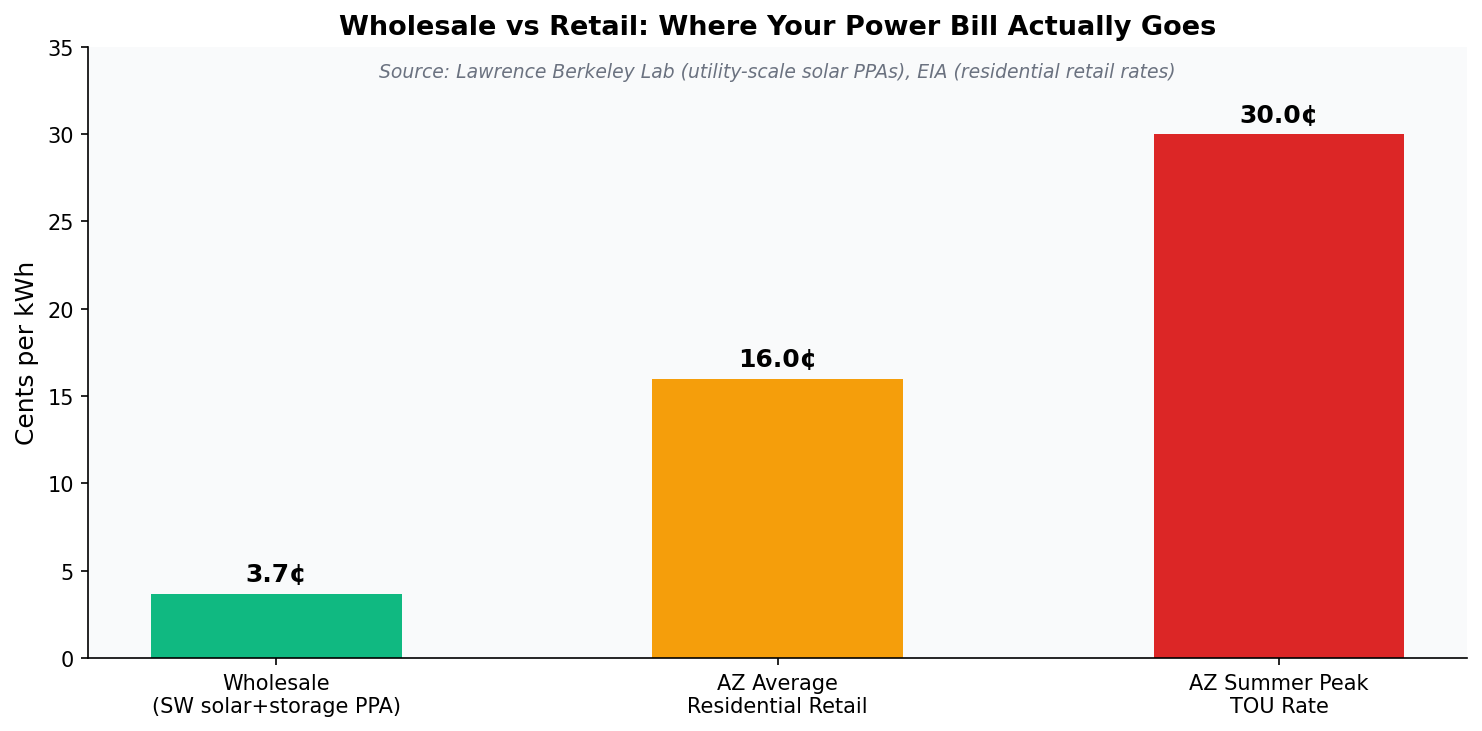
Here's a worked example for a typical SRP customer in Phoenix. Average residential rate in Arizona was about $0.16/kWh in 2025, with peak summer time-of-use pricing pushing past $0.30/kWh on hot afternoons (EIA).
- System size: 8 kW rooftop solar
- Annual production (Phoenix, NREL PVWatts): ~13,500 kWh/year
- Self-consumption value at $0.16/kWh: $2,160/year
- Installed cost (national avg, EnergySage Q1 2026): ~$2.85/W = $22,800 before incentives
- Simple payback (no storage): ~10–11 years
Add a 13.5 kWh battery (Tesla Powerwall 3 or equivalent) at roughly $13,000 installed, and the storage shifts solar production from midday to evening peak. Under time-of-use rates, that battery arbitrage adds another $300–$600/year in avoided peak charges, depending on the utility's TOU windows.

Want this same math for your address? Our free solar assessment tool uses NREL's PVWatts production model and your local utility rates to spit out a personalized estimate in about 60 seconds. No phone number required.
The 30% federal tax credit just changed
This is the single most misunderstood piece of solar economics in 2026. The federal Residential Clean Energy Credit (Section 25D) — the 30% ITC for purchased systems — expired at the end of 2025. Systems installed in 2026 and beyond no longer qualify for the homeowner-facing 30% credit (IRS).
What's still on the table:
- Third-party-owned systems (leases and PPAs) still qualify for the commercial Section 48 credit, which the installer typically passes through as a lower monthly payment.
- State and utility incentives remain active in many markets — Arizona has a 25% state tax credit (capped at $1,000), and SRP offers battery rebates.
- Net billing and TOU arbitrage still drive economics in time-of-use markets.
Translation: if you were planning to write a check for a system in 2026, the math changed. A lease or PPA may now beat ownership on monthly cash flow, even though long-term lifetime savings are usually higher with ownership. Run the comparison before you sign anything.

Our incentive search tool pulls every active state, utility, and local rebate for your ZIP code in one place — including SRP's specific battery storage rebate program for Arizona customers.
What 4 GW of new generation tells us about price direction
When a utility commits to a 4 GW PPA, it's locking in a price for 20–25 years. SRP and NextEra didn't disclose the strike price publicly, but the Lawrence Berkeley National Laboratory's 2024 utility-scale solar report shows the median PPA price for new solar+storage projects in the Southwest at $28–$45/MWh (LBL).
That's roughly $0.03–$0.045/kWh wholesale. Retail residential rates in Arizona are 4–6× higher. The gap between wholesale generation cost and retail delivery cost — the part of your bill paying for transmission, distribution, billing, and utility margins — is now the dominant cost component for most American households.
Rooftop solar bypasses the wholesale-to-retail markup entirely. That's structurally why behind-the-meter solar continues to pencil out even as utility-scale prices fall.
Storage is the part most homeowners get wrong
A common mistake: sizing storage like it's a generator. It isn't. A 13.5 kWh home battery isn't designed to power your house for three days during an outage — it's designed to shift 1–2 hours of peak-rate consumption per day, every day, for 10+ years.
The Department of Energy's residential storage guidance recommends sizing batteries to cover 4–8 hours of essential loads (refrigerator, lights, internet, a few outlets) — not whole-home backup (DOE Energy Saver). Whole-home backup typically requires 30+ kWh of storage and a much larger interconnection — the cost runs $30,000–$50,000.
For most homeowners, a single 10–15 kWh battery paired with solar gets you:
- Time-of-use bill savings every day
- 4–8 hours of essential-load backup during outages
- Future-proofing against further net metering cuts
What to do this week
The SRP–NextEra deal isn't going to change your power bill next month. But it's a strong directional signal: utilities are betting that solar + storage is the cheapest grid resource for the next 25 years. The same physics work on your roof.
Three concrete steps:
- Run your numbers. Use our free assessment to see kWh production, dollar savings, and payback period for your specific address.
- Check your incentives. The federal 30% ITC for purchased systems is gone, but state and utility programs are still active. Search your ZIP code.
- Compare installers. Ownership vs lease vs PPA each have different break-even points in 2026. Get quotes from at least three local installers before signing.
Solar economics are still real — they just shifted underneath us when the federal credit expired. Run the math for your house before someone else runs it for you.
More Articles
Do Solar Panels Work During a Power Outage?
Most homeowners assume solar panels keep the lights on when the grid goes down. The actual answer surprises people — and the fix is simpler than you think.
Read article Battery StorageChile Hit 75% Solar in March. Here's What U.S. Homeowners Should Take From It
Chile's grid produced 29% of its electricity from solar in March, with peaks at 75%. The bottleneck wasn't generation — it was storage and transmission. Here's the homeowner takeaway.
Read article