SEC Pulls Back on Climate Rules: What It Means for Solar
The SEC just submitted a proposal to rescind its climate disclosure rule. The decision shifts risk back to households — and makes running your own solar math more important than ever.
On May 7, 2026, the Securities and Exchange Commission submitted a proposed rule titled Rescission of Climate-Related Disclosure Rules to the White House Office of Management and Budget for review. The original rule, finalized in March 2024, required publicly traded companies to disclose climate-related financial risks and, in some cases, greenhouse gas emissions. Pulling it back changes how investors price utility risk — and that has real downstream effects on what homeowners pay for electricity.
This isn't a story about Washington politics. It's a story about who absorbs the cost of weather, fuel volatility, and aging grid infrastructure. When disclosure shrinks, those costs don't disappear. They show up on your utility bill.
What the SEC actually proposed
The 2024 rule (Release No. 33-11275) required Scope 1 and Scope 2 emissions disclosures for large filers and material climate risk reporting for all registrants. According to the SEC's own filing, compliance was projected to cost roughly $530,000 per year for accelerated filers and $370,000 for smaller reporters. The agency now argues those costs outweigh the benefits to investors.
Critics, including the Sustainable Investment Forum and a coalition of state treasurers managing more than $1 trillion in pension assets, argue the opposite: without standardized climate disclosures, investors can't price risk in utilities, insurers, or fossil-fuel-heavy portfolios. The SEC's own economic analysis estimated the rule would unlock roughly $4.3 billion in better-informed capital allocation annually.
Why this matters for your electricity bill
Investor-owned utilities serve about 72% of U.S. electricity customers, according to the U.S. Energy Information Administration. Their cost of capital — the rate they pay to borrow money for grid upgrades, generation, and storm hardening — flows directly into customer rates through state regulatory commissions.
Here's the chain: when climate risk is disclosed transparently, lenders and bondholders can price it. Utilities with cleaner, lower-risk portfolios get cheaper debt. When disclosure thins out, all utilities tend to pay a slightly higher risk premium because investors hedge against the unknown. According to a 2023 Lawrence Berkeley National Laboratory review, even a 25-basis-point increase in utility cost of capital can add roughly $0.003–$0.005/kWh to retail rates over time. On a typical 10,800 kWh annual household consumption (EIA average), that's $32–$54 per year per household — not catastrophic, but a real number that compounds.
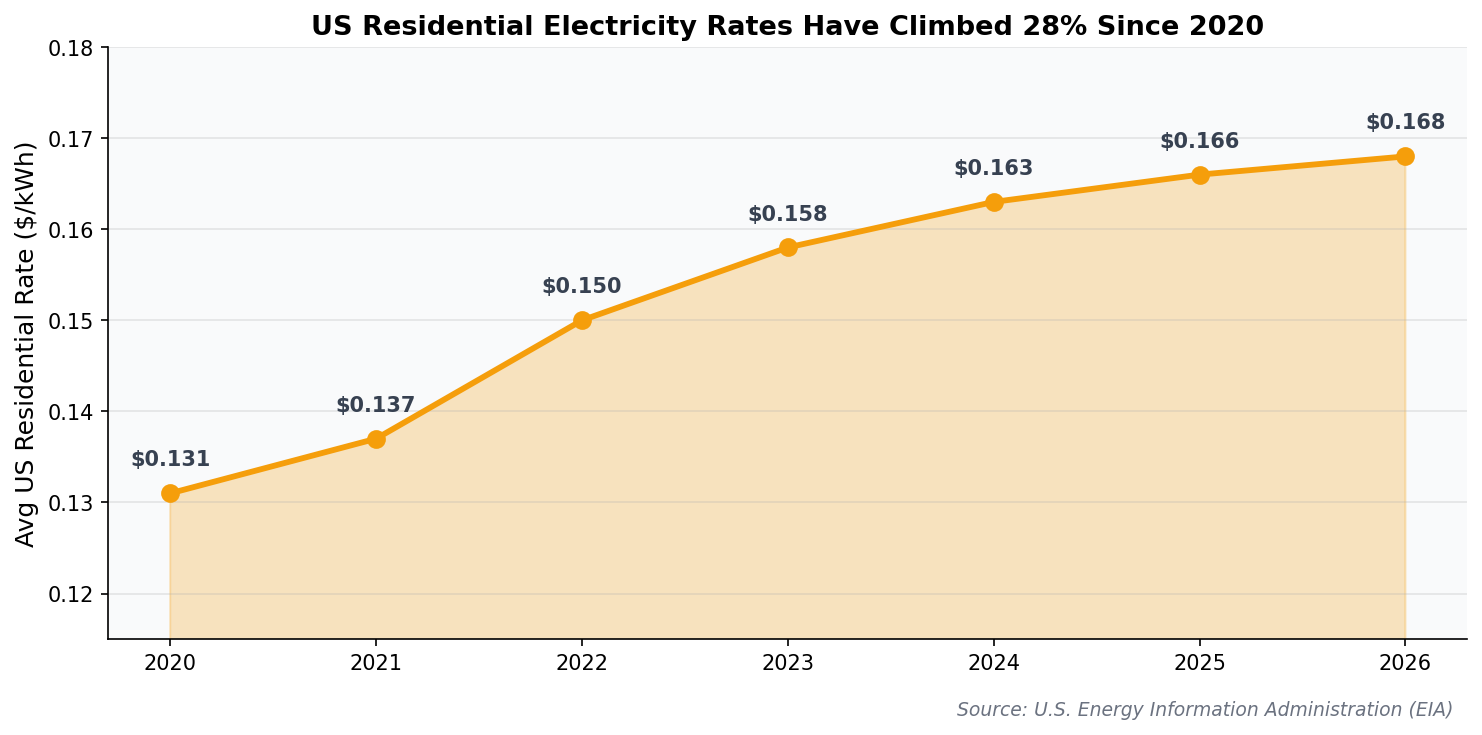
Meanwhile, residential electricity prices are already climbing. The EIA's Short-Term Energy Outlook reports the U.S. residential average rose from $0.137/kWh in 2022 to $0.168/kWh in early 2026 — a 22.6% increase in three years.
The math for homeowners
Run a simple comparison. A 7 kW rooftop solar system in a typical mid-Atlantic location produces about 9,200 kWh per year, according to NREL's PVWatts calculator. At today's $0.168/kWh average:
- Annual offset value: 9,200 kWh × $0.168 = $1,545.60
- Installed cost (post-ITC for purchased systems, 2026): ~$22,400 at $3.20/W (EnergySage 2025 marketplace data)
- Simple payback (no rate inflation): 14.5 years
- Simple payback (with 3%/yr utility rate inflation): ~11.8 years
If utility rates accelerate even slightly because of weaker disclosure and higher capital costs, that payback shortens further. Solar is, in effect, a hedge against rate volatility you can install on your roof.
The 2026 incentive landscape — what's still on the table
This is where careful reading matters. The federal 30% Residential Clean Energy Credit (Section 25D) expired at the end of 2025 for purchased systems. Homeowners who buy solar outright in 2026 cannot claim the 30% credit. However, the Section 48E commercial credit still applies to third-party-owned systems — meaning solar leases and Power Purchase Agreements (PPAs) can still capture the credit, with the savings often passed through to homeowners as lower lease payments.
State and utility incentives are unaffected by SEC rulemaking. Some still-active programs as of 2026:
- California SGIP — battery rebates ranging from $150–$1,000/kWh depending on equity tier (CPUC)
- New York NY-Sun — block grants ranging $0.20–$0.80/W
- Massachusetts SMART — fixed declining-block compensation
- Illinois Shines — REC payments worth $4,000–$10,000 over 15 years for typical systems
- Net metering — varies by state; check before you buy
What weakening climate disclosure does NOT change
It's worth being honest about what this rollback doesn't do. It doesn't repeal the Inflation Reduction Act. It doesn't eliminate state RPS targets. It doesn't change the underlying physics of solar economics. According to SEIA's Solar Market Insight, residential solar installed capacity grew 14% year-over-year in 2025, even as the federal credit wound down for purchased systems, because state programs and utility rate increases kept the math working.
What it does do is reduce transparency. Investors will have less visibility into which utilities are exposed to wildfire, flood, hurricane, and stranded-asset risk. That uncertainty tends to be priced in as a small premium on debt — and that premium is recovered through rate cases.
How to think about your decision
Three quick checks before signing anything:
- Get an honest production estimate. Use NREL's PVWatts or our free assessment tool with your actual address and roof orientation. Don't trust round numbers from a sales rep.
- Compare lease vs purchase carefully. Without the federal 30% credit on purchased systems, leases and PPAs (which still capture the commercial credit) are competitive again for many households. Do the 25-year cash flow on both.
- Check your specific state and utility incentives. A $4,000 state rebate or a strong net metering policy can shift payback by 2–4 years. Use our ZIP-code incentive search to see what applies to you.

The bottom line
Federal climate policy is going to keep shifting. Disclosure rules tighten, then loosen. Tax credits expand, then contract. The one thing that doesn't change much is the kilowatt-hour: the sun produces predictable energy, and your utility's rates trend up over time. According to the EIA, U.S. residential rates have risen at an average of 2.8% per year over the last decade, slightly above general inflation.
Whether or not the SEC finalizes this rescission, the question for homeowners stays the same: does generating your own electricity beat buying it from the grid over the next 20 years? In most U.S. ZIP codes, the answer is still yes — but it depends on your roof, your utility, and the program mix in your state.
If you want to run the numbers for your specific home, our free solar assessment tool uses NREL production data, your local utility rates, and current state incentives to give you a real estimate — no sales call required. Check your numbers at energyscout.org.
Sources: SEC Release No. 33-11275; U.S. Energy Information Administration (EIA); NREL PVWatts; SEIA Solar Market Insight 2025; Lawrence Berkeley National Laboratory; CPUC SGIP program data; EnergySage 2025 marketplace report.
More Articles
Do Solar Panels Work During a Power Outage?
Most homeowners assume solar panels keep the lights on when the grid goes down. The actual answer surprises people — and the fix is simpler than you think.
Read article Battery StorageChile Hit 75% Solar in March. Here's What U.S. Homeowners Should Take From It
Chile's grid produced 29% of its electricity from solar in March, with peaks at 75%. The bottleneck wasn't generation — it was storage and transmission. Here's the homeowner takeaway.
Read article