Sierra Club Backs Steyer: What It Means for CA Solar
The Sierra Club's endorsement of Tom Steyer for California governor signals a continued climate-policy push. We break down what it could mean for rooftop solar economics, NEM 3.0, and battery incentives — without the political spin.
On May 6, 2026, the Sierra Club endorsed Tom Steyer in California's gubernatorial race, citing his record of investing in climate solutions and challenging fossil-fuel interests (CleanTechnica, May 7, 2026). For California's 1.7 million rooftop-solar households — the largest residential solar fleet in the country (SEIA) — endorsements like this are worth paying attention to. Not because of the politics, but because the next governor will inherit decisions on net metering, battery rebates, and utility rate design that directly affect the math on a home solar system.
Let's look at the numbers a Steyer-led administration would be working with, and what's actually at stake for homeowners.
The current state of California rooftop solar economics
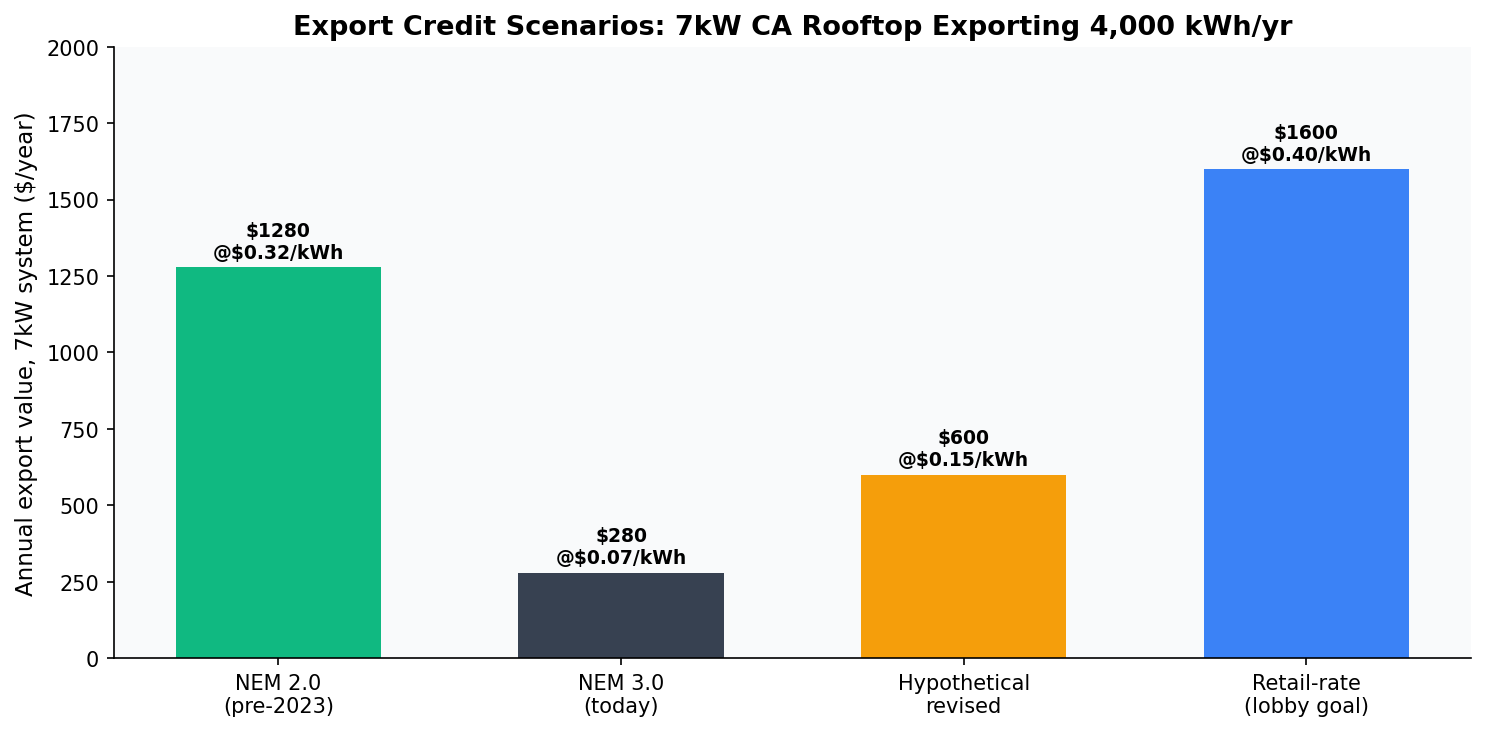
California's NEM 3.0 (Net Billing Tariff) took effect in April 2023 and fundamentally changed solar payback math. Under the prior NEM 2.0, exported solar earned roughly the retail rate — about $0.30–$0.45/kWh on most investor-owned utility tariffs. Under NEM 3.0, exports are valued at the utility's avoided cost, which Lawrence Berkeley National Lab pegs at roughly $0.05–$0.08/kWh on average, with brief peaks in late summer evenings (LBNL).
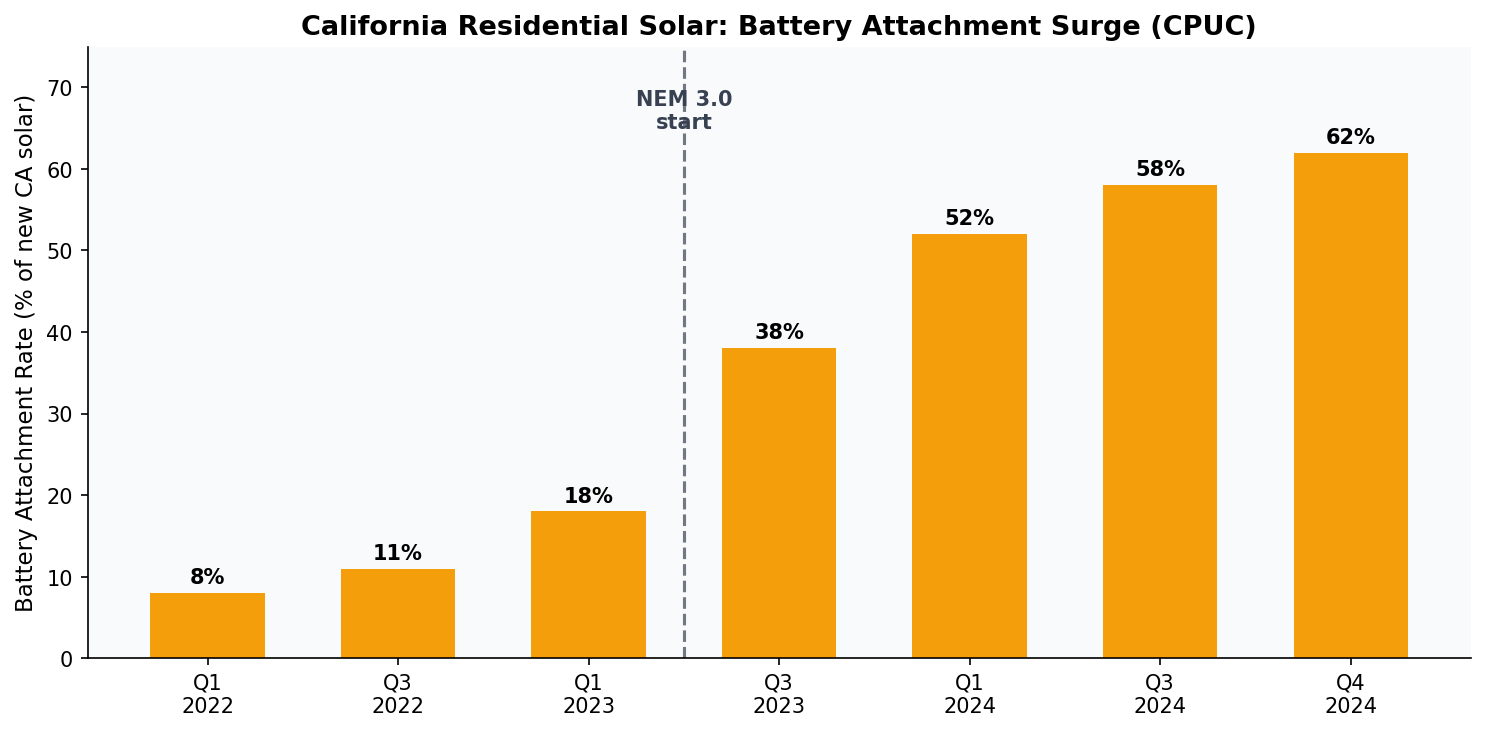
The result: payback periods on solar-only systems in California stretched from roughly 6 years to 9–12 years for typical PG&E and SCE customers (EnergySage). Adding a battery — to self-consume rather than export — has become the dominant economic strategy. According to the California Public Utilities Commission, attachment rates for batteries on new residential solar applications jumped from under 10% in 2022 to over 60% by Q4 2024 (CPUC).
Why the policy direction matters
California still offers two of the most valuable home-energy incentives in the country, but they're under constant review:
- Self-Generation Incentive Program (SGIP): Up to $1,000/kWh of battery capacity for equity-tier customers, $200/kWh for general-market residential. A 13.5 kWh Powerwall 3 in an equity zip code can pull more than $13,000 off the install cost (CPUC SGIP Handbook).
- Property tax exclusion: Active solar systems remain excluded from property reassessment through January 1, 2027, under Revenue and Taxation Code §73 (CA Board of Equalization).
- Disadvantaged Communities — Single-family Solar Homes (DAC-SASH): No-cost solar for income-qualified households in priority census tracts.
Whoever runs Sacramento next has direct or indirect influence over all three. SGIP is funded by ratepayer surcharges authorized through the legislature and CPUC. The property tax exclusion sunset is a legislative call. DAC-SASH funding is administered by Grid Alternatives under CPUC oversight.
What a Steyer governorship could change — by the numbers
Steyer's published platform (per his campaign site and prior NextGen America positions) prioritizes a 100% clean electricity goal earlier than California's current 2045 SB 100 mandate, and explicitly calls for restoring stronger compensation for distributed solar exports. Without endorsing or opposing the candidate, here's what those positions would mean mathematically:
Scenario 1: NEM 3.0 export rates revised upward
If the average export credit moved from today's ~$0.07/kWh to $0.15/kWh (a midpoint between NEM 2.0 and NEM 3.0), a typical 7 kW PG&E rooftop system exporting 4,000 kWh/year would gain about $320/year in additional value. Over a 25-year system life, that's roughly $8,000 in extra lifetime savings, shrinking payback by 2–3 years (NREL valuation methodology).
Scenario 2: SGIP general-market budget expansion
The SGIP residential general-market step is currently at $0.15/Wh ($150/kWh) after multiple step-downs. If a new administration restored it to the original $0.25/Wh, a 13.5 kWh battery would qualify for ~$3,375 instead of ~$2,025 — a $1,350 swing per home (SelfGenCA program metrics).
Scenario 3: Status quo
Even if nothing changes, the underlying economics still favor solar+battery in most California zip codes — just with a longer payback. PG&E's tier-1 residential rate hit $0.42/kWh in 2025 (PG&E tariff sheet E-1), and the EIA forecasts California retail residential rates rising another 4–6% annually through 2027 (EIA State Profile).
How to think about this as a homeowner
Election cycles create noise. The substance for homeowners is much simpler: what does your roof, your utility, and your zip code's incentive stack actually look like today? Policy changes can improve or erode the math, but they rarely make a system that pencils today not pencil tomorrow — and they almost never make a system that doesn't pencil today suddenly pencil tomorrow.
That's why we built EnergyScout's free tools around your actual numbers, not policy speculation.
The free assessment tool uses NREL's PVWatts model with your roof's solar resource data to estimate annual production, then layers in your utility's current tariff to project bill savings. It accounts for NEM 3.0 export pricing automatically for California addresses.
The incentive search tool pulls current SGIP step rates, federal rules, and any local utility rebates by ZIP. (Federal note: the 30% Investment Tax Credit on purchased systems expired at the end of 2025. Only third-party-owned systems — leases and PPAs — can still claim it as of 2026, and the value is captured by the lessor.)
Important federal-level context for 2026
Regardless of state-level outcomes, the federal incentive picture changed materially this year:
- Section 25D (residential ITC) for purchased systems: expired December 31, 2025. Cash and loan-financed systems installed in 2026 cannot claim the 30% credit (IRS Residential Clean Energy Credit guidance).
- Section 48 (commercial ITC) still applies to leases and PPAs, where a third party owns the system and may pass through some of the savings via lower monthly payments (DOE).
- State and utility incentives — SGIP, DAC-SASH, property tax exclusion — are unaffected by the federal ITC expiration.
This means California's state incentives now carry more weight than ever for purchased systems. A SGIP rebate that was a nice-to-have in 2024 is the difference between a 9-year and a 12-year payback in 2026.
What we'll be watching
Three concrete metrics will tell us how much the political winds matter for homeowner economics over the next 18 months:
- Average NEM 3.0 export credit ($/kWh): Tracked by CPUC quarterly. Today: ~$0.07/kWh. A meaningful policy shift would push this above $0.10/kWh.
- SGIP general-market step level ($/Wh): Currently $0.15/Wh and stepping down. A reversal would move it back toward $0.20–$0.25/Wh.
- PG&E/SCE/SDG&E residential tier-1 rates ($/kWh): Rising regardless of who's in office. EIA projects 4–6% annual increases through 2027.
If you're a California homeowner trying to figure out whether solar+battery makes sense for your roof — not a hypothetical median home — start with the actual numbers. Run a free EnergyScout assessment with your address, then compare quotes from vetted local installers. The political news will keep coming. Your math doesn't change with it.
More Articles
Do Solar Panels Work During a Power Outage?
Most homeowners assume solar panels keep the lights on when the grid goes down. The actual answer surprises people — and the fix is simpler than you think.
Read article Battery StorageChile Hit 75% Solar in March. Here's What U.S. Homeowners Should Take From It
Chile's grid produced 29% of its electricity from solar in March, with peaks at 75%. The bottleneck wasn't generation — it was storage and transmission. Here's the homeowner takeaway.
Read article