Sodium-Ion Batteries: What ESS + Alsym Means for Homeowners
Flow battery maker ESS just inked a deal to manufacture Alsym Energy's sodium-ion cells. Here's what this shift away from lithium could mean for residential solar storage costs and safety.
On May 1, 2026, flow-battery maker ESS announced it will manufacture a new sodium-ion battery developed by Massachusetts-based startup Alsym Energy (CleanTechnica, May 2026). On its surface, this is a B2B manufacturing partnership. But for homeowners weighing solar-plus-storage in 2026 — the year the federal 30% Investment Tax Credit expired for purchased systems — the underlying chemistry shift matters.
Let's walk through what sodium-ion actually changes, where the cost math sits today, and what to watch for as this technology moves from gigafactory press releases into real residential price lists.
The news in one paragraph
ESS, best known for its long-duration iron-flow batteries, will use its existing manufacturing footprint to produce Alsym's non-lithium, water-based battery cells. Alsym's chemistry is built around sodium and manganese rather than lithium, cobalt, or nickel. The pitch: comparable energy density to lithium iron phosphate (LFP), no thermal runaway risk, and a supply chain that doesn't run through a handful of countries that dominate lithium refining.
Why sodium-ion is suddenly everywhere
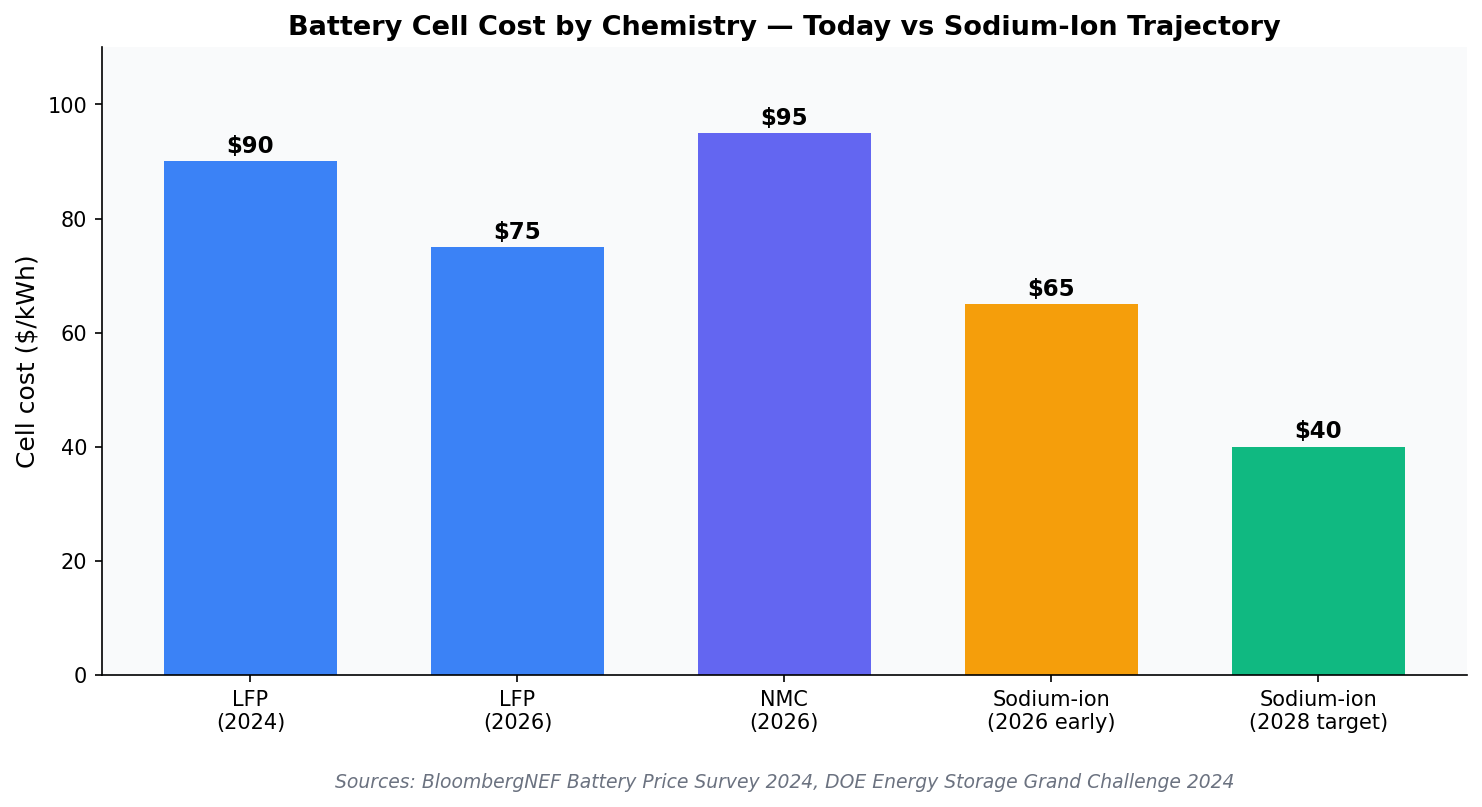
Sodium-ion isn't new — Faradion in the UK and CATL in China have shipped cells for years. What's changed in 2025–2026 is cost. The U.S. Department of Energy's 2024 Energy Storage Grand Challenge update pegged sodium-ion cell costs at roughly $40–80/kWh in early commercial production, with a credible path to $40/kWh at scale (DOE, 2024). LFP cells, the dominant chemistry in residential storage, sat near $90/kWh in late 2024 according to BloombergNEF's annual battery price survey.
For homeowners, cell cost is only part of the picture. A typical 13.5 kWh residential battery installed today runs $13,000–$18,000 before incentives — and most of that is enclosure, inverter, BMS, labor, and permitting, not cells (Lawrence Berkeley National Lab, Tracking the Sun). So even a 30% drop in cell pricing translates to maybe $1,500–$2,500 off the installed price. Real, but not transformational on its own.
The math: what storage costs today
Here's the current landscape for a homeowner sizing a battery to a typical 7 kW solar array:
- Tesla Powerwall 3 (13.5 kWh, LFP): ~$15,000 installed
- Enphase IQ Battery 5P (5 kWh modular, LFP): ~$7,000 installed for one unit
- FranklinWH aPower 2 (15 kWh, LFP): ~$16,000 installed
Divide installed cost by usable capacity and you get $1,000–$1,150/kWh installed for residential LFP today. Sodium-ion at the cell level could push that toward $850–$950/kWh installed within 24–36 months — assuming inverter and balance-of-system pricing holds steady.
What sodium-ion actually changes for a home
1. Fire safety and insurance
The most concrete near-term benefit isn't price — it's safety. Lithium-ion thermal runaway has driven local code changes restricting where batteries can sit (NFPA 855 setbacks, garage-only installs in some jurisdictions). Alsym's water-based chemistry can't enter thermal runaway. If that holds up in UL 9540A testing at scale, it could mean fewer permitting headaches and lower homeowners-insurance markups for installed storage.
2. Cold-weather performance
Sodium-ion holds capacity better than lithium at low temperatures. Faradion's published data shows roughly 90% rated capacity at -20°C, versus 60–70% for typical LFP (Faradion technical data). For homeowners in Minnesota, Maine, or Montana, that's the difference between a battery that delivers full backup on the coldest night and one that gives you 60% of nameplate.
3. Cycle life and warranties
This is where sodium-ion still has work to do. The best LFP residential batteries warranty 10 years and 6,000+ cycles. Early sodium-ion cells have demonstrated 4,000–5,000 cycles in lab conditions. Until field data accumulates, expect 8-year warranties on first-generation residential sodium-ion products versus 10-year LFP.
The 2026 incentive picture
The most important thing for homeowners to understand right now: the federal 30% Investment Tax Credit for purchased residential solar and battery systems expired at the end of 2025. Section 25D was sunsetted under the One Big Beautiful Bill Act. Today, only systems financed through a third-party lease or power-purchase agreement (PPA) — where the installer or financing company owns the system — still capture the federal credit through Section 48 (SEIA, 2026).
State and utility programs are now doing the heavy lifting:
- California SGIP: $150–$1,000/kWh for storage, with higher tiers for medical baseline and high-fire-threat zones (CPUC)
- Massachusetts ConnectedSolutions: $200–$275/kW-summer for enrolled batteries that participate in grid events
- New York NY-Sun + battery adders: stacked rebates depending on utility territory
- Maryland Energy Storage Tax Credit: 30% of installed cost up to $5,000
You can pull the live list for your ZIP code on EnergyScout's incentive search tool.
Should you wait for sodium-ion?
The honest answer: probably not, unless you're sitting on a system that already works fine.
Sodium-ion batteries from this ESS-Alsym partnership are unlikely to appear in residential UL-listed products before late 2027. Meanwhile, every month you delay solar plus storage is a month of paying full retail electricity. The U.S. Energy Information Administration reports residential rates rose 22% nationally between 2020 and 2024, with California, Hawaii, and the Northeast posting double-digit single-year jumps in 2023 (EIA Electric Power Monthly).
Here's a useful framing: if your payback period on solar alone is under 10 years at current rates, install solar now. Add a battery if (a) your utility has time-of-use rates with a peak/off-peak spread above $0.20/kWh, (b) you're in a wildfire PSPS zone, or (c) your state has a stackable storage rebate worth $4,000+. Wait on adding a second battery if cost is the only consideration — that's where sodium-ion economics could matter in 2027–2028.
What to watch over the next 12 months
- UL 9540A test results for Alsym cells — this is the gating factor for residential listings
- First gigawatt-hour shipments from ESS's Oregon facility — the manufacturing partnership only matters if it scales
- BloombergNEF's 2026 battery price survey (typically published December) — will show whether sodium-ion is hitting promised cost curves
- State storage rebate refills — California's SGIP equity budget tends to exhaust mid-year
Run your own numbers
Battery chemistry headlines are interesting, but the only number that matters is your specific payback. EnergyScout's free assessment tool uses NREL's PVWatts production model, your local utility rate, and current state incentives to estimate solar and battery economics for your address. It takes about three minutes and doesn't require a phone number.
If you want to compare what local installers are actually quoting, the providers directory lists vetted companies in your ZIP with real customer-reported pricing. The market is shifting fast — the more you can compare quotes against published benchmarks, the better.
Whether your next battery is LFP, sodium-ion, or something we haven't seen yet, the homeowner math hasn't changed: avoided utility cost minus installed cost minus financing, divided by years of useful life. Run it before you sign anything.
More Articles
Do Solar Panels Work During a Power Outage?
Most homeowners assume solar panels keep the lights on when the grid goes down. The actual answer surprises people — and the fix is simpler than you think.
Read article Battery StorageChile Hit 75% Solar in March. Here's What U.S. Homeowners Should Take From It
Chile's grid produced 29% of its electricity from solar in March, with peaks at 75%. The bottleneck wasn't generation — it was storage and transmission. Here's the homeowner takeaway.
Read article