Solar Inverters Can Spot Cyberattacks — Why Yours Doesn't
Researchers can flag inverter cyberattacks with near-perfect accuracy using firmware-level signals — but today's communication standards never transmit those flags. Here's what it means for homeowners with rooftop solar.
On May 1, 2026, pv magazine reported on work from a King Abdullah University of Science and Technology (KAUST) lab that hit up to 100% accuracy detecting cyberattacks on solar inverters using a single hardware performance counter — the kind of low-level signal already available inside most modern inverter chips. The catch: the communication standards inverters speak today (SunSpec Modbus, IEEE 1547, IEC 61850) don't carry those signals anywhere. The inverter knows. Nobody else does.1
That's an interesting research result on its own. For homeowners with — or considering — rooftop solar and battery backup, it's also a useful prompt to think about a system most people never look at: the inverter, and what it's doing on your network.
What an inverter actually does (and why attackers care)
Your solar panels produce DC power. Your house, the grid, and most batteries run on AC. The inverter is the box that converts between them, and in modern systems it does a lot more than that:
- Decides when to send power to the grid vs. your home vs. the battery
- Reports production data to your monitoring app
- Responds to utility commands (curtailment, voltage support, frequency response)
- Receives firmware updates from the manufacturer
That last point is where the cybersecurity conversation lives. An inverter is, functionally, a small networked computer with the ability to inject or withhold electricity from the grid. The U.S. Department of Energy's 2022 Cybersecurity Considerations for Distributed Energy Resources report flagged inverter firmware and communications as a growing attack surface as solar penetration scales.2
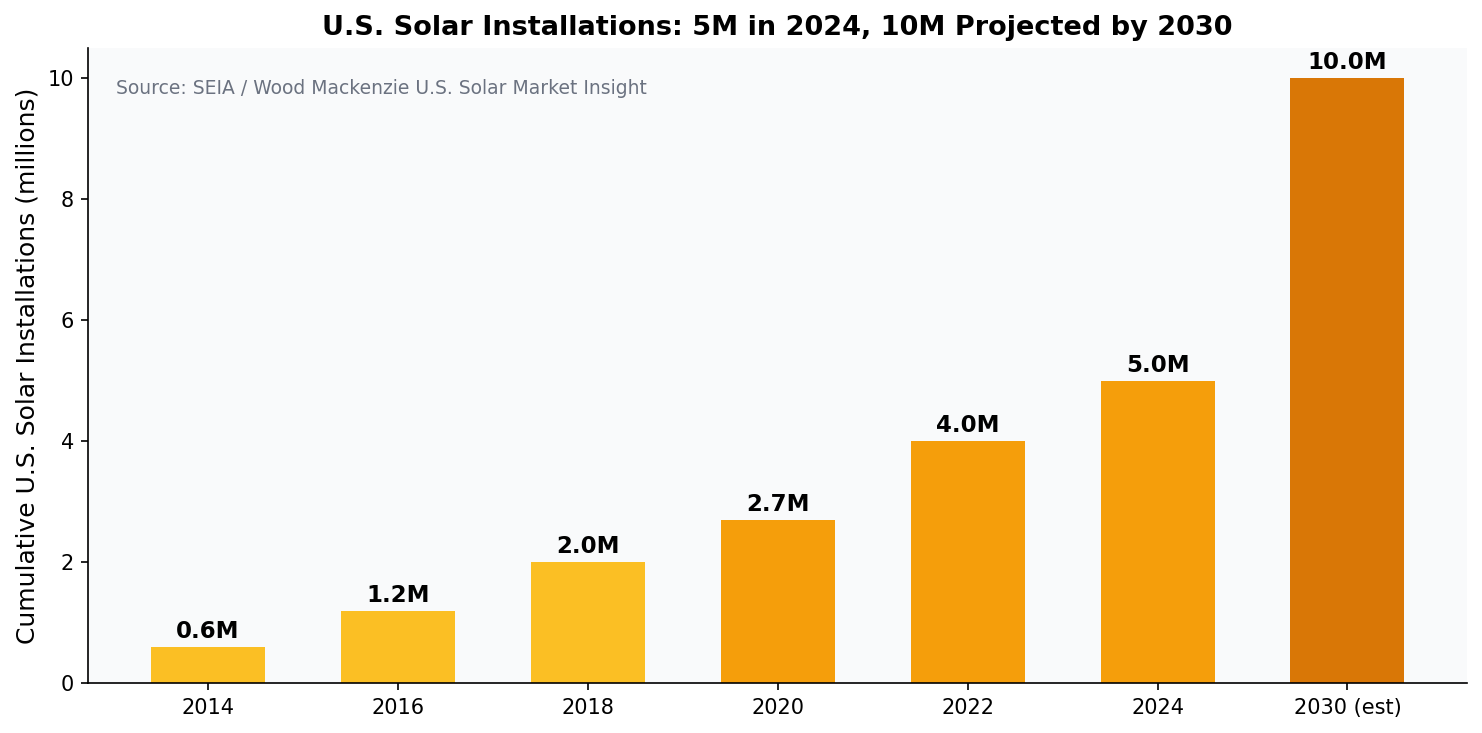
According to the SEIA / Wood Mackenzie U.S. Solar Market Insight, the U.S. crossed 5 million solar installations in 2024 and is on track to exceed 10 million by 2030.3 Each one has at least one inverter. That's a lot of small networked computers.
What the KAUST research actually showed
The KAUST team trained a lightweight model on data from a single hardware performance counter — essentially a CPU register inside the inverter that ticks up when the chip does certain low-level operations. Patterns in those tick counts changed measurably during simulated attacks (firmware tampering, malicious control signals, denial-of-service against the controller).
Reported detection accuracy: up to 100% on the test set, with negligible compute overhead. The researcher's point to pv magazine wasn't "we solved it." It was: the signal exists, the inverter sees it, and the standards we use to talk to inverters don't have a field for it.1
SunSpec Modbus, the dominant North American protocol, defines registers for AC power, DC voltage, temperature, fault codes, grid-support commands. There's no "I think I'm being attacked" register. Adding one is a standards process, not a research problem.
Should homeowners worry?
Honestly: not in the way the headline suggests. A few useful things to keep in mind:
1. The threat model is mostly utility-scale and aggregated, not individual
Lawrence Berkeley National Lab's 2023 Distributed Energy Resources Cybersecurity Framework work makes the same point: the concerning scenario isn't an attacker turning off one home's inverter. It's coordinated control of thousands of inverters at once, used to destabilize grid frequency.4 Your individual roof is not a target. The aggregated fleet is.
2. Most modern inverters already auto-update firmware
Tesla, Enphase, SolarEdge, and Generac all push security patches over-the-air. The same software-update model that makes attacks possible is also what closes them. Ask any installer when your inverter last got a firmware update — if the answer is "never" or "I don't know," that's worth a follow-up.
3. Battery backup is what actually protects you during a grid event
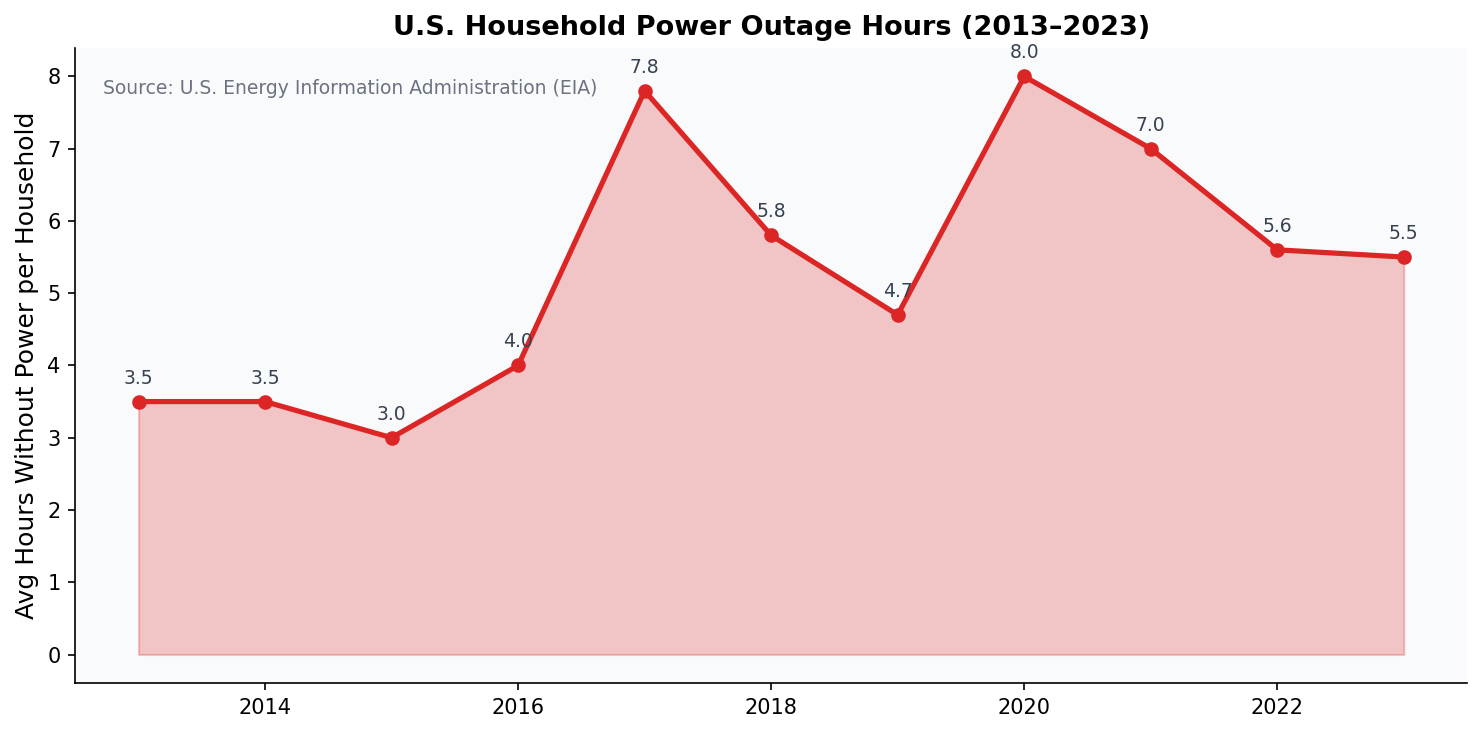
This is the homeowner takeaway. Whether the grid goes down because of a cyberattack, a wildfire shutoff, a hurricane, or a transformer failure, the answer for your house is the same: a battery sized for your essential loads. Per EIA data from 2024, the average U.S. household experienced 5.5 hours of power outages in 2023, more than double the 2013 number — and that's before any grid-attack scenario.5
Run the math: what "resilience" actually costs
Here's a concrete example using real 2026 pricing. A typical 13.5 kWh battery (Tesla Powerwall 3, Enphase IQ Battery 10T, Franklin aPower) installed alongside a 7 kW solar array:
- System cost (solar + battery): ~$32,000–$38,000 installed (per EnergySage 2026 marketplace data)6
- Federal ITC (purchased systems): Expired end of 2025 for residential ownership. Leases and PPAs still qualify under the commercial 48E credit through their own timeline.
- Backup capacity: 13.5 kWh runs a refrigerator (~1.5 kWh/day), Wi-Fi router, lights, and a few outlets for roughly 24–36 hours in a typical outage
- State incentives: California SGIP (up to $1,000/kWh in equity tiers), Massachusetts ConnectedSolutions, New York NY-Sun, Maryland Energy Storage Tax Credit — varies wildly by ZIP
The cybersecurity angle doesn't change this math. It just adds another reason that islanded backup — power that works when the grid doesn't — is worth pricing out.
What to ask your installer
If you're shopping for solar in 2026, the cyber question is a fair one to raise. Useful, specific things to ask:
- "Does the inverter receive automatic firmware updates? How often?" — You want yes, and you want "as released by the manufacturer."
- "Is the inverter on its own network segment, or on my home Wi-Fi?" — Many inverters can sit on a separate VLAN. Worth asking.
- "Does my battery system support grid-forming operation in island mode?" — This is what lets your house run independently if the grid is unstable for any reason.
- "Which monitoring app? What data does it send to the cloud?" — Production data is fine. Some apps also send detailed home consumption profiles.
Good installers answer these directly. Installers who deflect — "don't worry about that" — tell you something useful too.
The standards problem won't be solved this year
The KAUST researcher's broader point is correct: even if every inverter on the grid could detect attacks tomorrow, the protocols that connect them to utilities and aggregators don't carry that information. Updating SunSpec, IEEE 1547, and IEC 61850 to include cyber-event telemetry is a multi-year standards process involving manufacturers, utilities, regulators, and grid operators.
According to the NREL 2023 inverter cybersecurity baseline assessment, fewer than 15% of deployed residential inverters in North America implement the optional IEEE 1547-2018 cybersecurity profile.7 The rest run on the older, less hardened spec. Closing that gap is the actual work.
What this means if you're shopping for solar right now
Three things, in order:
- Don't let cyber risk talk you out of solar. The grid you're already connected to has the same risks, minus the personal generation that makes you partially independent.
- Add battery backup if outages matter to you. Whatever the cause, a sized battery means your fridge, your modem, and your medical devices keep running.
- Buy from installers who can answer firmware and network questions. They exist. Use a real comparison process — not the first door-knocker.
Run your own numbers
Whether the inverter cybersecurity question is interesting or irrelevant to you, the underlying decision is the same one solar shoppers have been making for a decade: does a system pay for itself given your roof, your rates, and your local incentives? You can get a baseline answer in a few minutes with our free solar + battery assessment, and check what your specific ZIP qualifies for at our incentives search tool. When you're ready to talk to installers, our vetted provider directory filters for installers who actually answer the firmware questions.
The inverter on your wall is a small computer that decides when your house gets power. That's been true since the day it was installed. The KAUST research is a reminder to take it seriously — and a reason to make sure your system has a battery behind it, so the lights stay on regardless of why the grid blinks.
Sources: pv magazine (May 2026), U.S. Department of Energy CESER, SEIA / Wood Mackenzie U.S. Solar Market Insight 2024, Lawrence Berkeley National Laboratory, U.S. Energy Information Administration, EnergySage 2026 marketplace data, NREL inverter cybersecurity assessment 2023.
More Articles
Do Solar Panels Work During a Power Outage?
Most homeowners assume solar panels keep the lights on when the grid goes down. The actual answer surprises people — and the fix is simpler than you think.
Read article Battery StorageChile Hit 75% Solar in March. Here's What U.S. Homeowners Should Take From It
Chile's grid produced 29% of its electricity from solar in March, with peaks at 75%. The bottleneck wasn't generation — it was storage and transmission. Here's the homeowner takeaway.
Read article