Solar Module Reliability: A Homeowner's Diligence Checklist
Sinovoltaics launched a free PV testing tool for utility projects this week. The same reliability questions apply to your rooftop system — here's the homeowner version of that diligence checklist, with real degradation math.
On May 6, 2026, Dutch-German quality assurance firm Sinovoltaics released a free browser-based tool that builds project-specific reliability testing scopes for utility-scale solar projects. The tool sorts recommended lab tests by priority and exports a downloadable scope report — work that previously required a paid consultant to scope out a multi-thousand-dollar test plan.
That's interesting news for utility developers. But it also matters to homeowners considering rooftop solar — because the same module reliability questions that drive utility-scale lab testing show up in your 25-year warranty, your degradation rate, and your real payback math.
Here's what the news means, and how to apply the same "show me the data" mindset to your own home solar decision.
What Sinovoltaics actually launched
Sinovoltaics' new tool — announced in PV Magazine — generates a custom test plan for a given solar project. You input the climate, mounting type, project size, and risk tolerance, and the tool returns a prioritized list of IEC, UL, and extended-stress lab tests with a downloadable scope.
The point is that not every solar project needs every test. A floating PV plant in a tropical climate has different failure modes than a rooftop array in Arizona. Targeted testing catches the failure modes that actually matter for your conditions and skips the ones that don't.
The same logic — match the diligence to the conditions — applies to a homeowner buying a $25,000 rooftop system.
Why module reliability is a homeowner question, not just a utility one
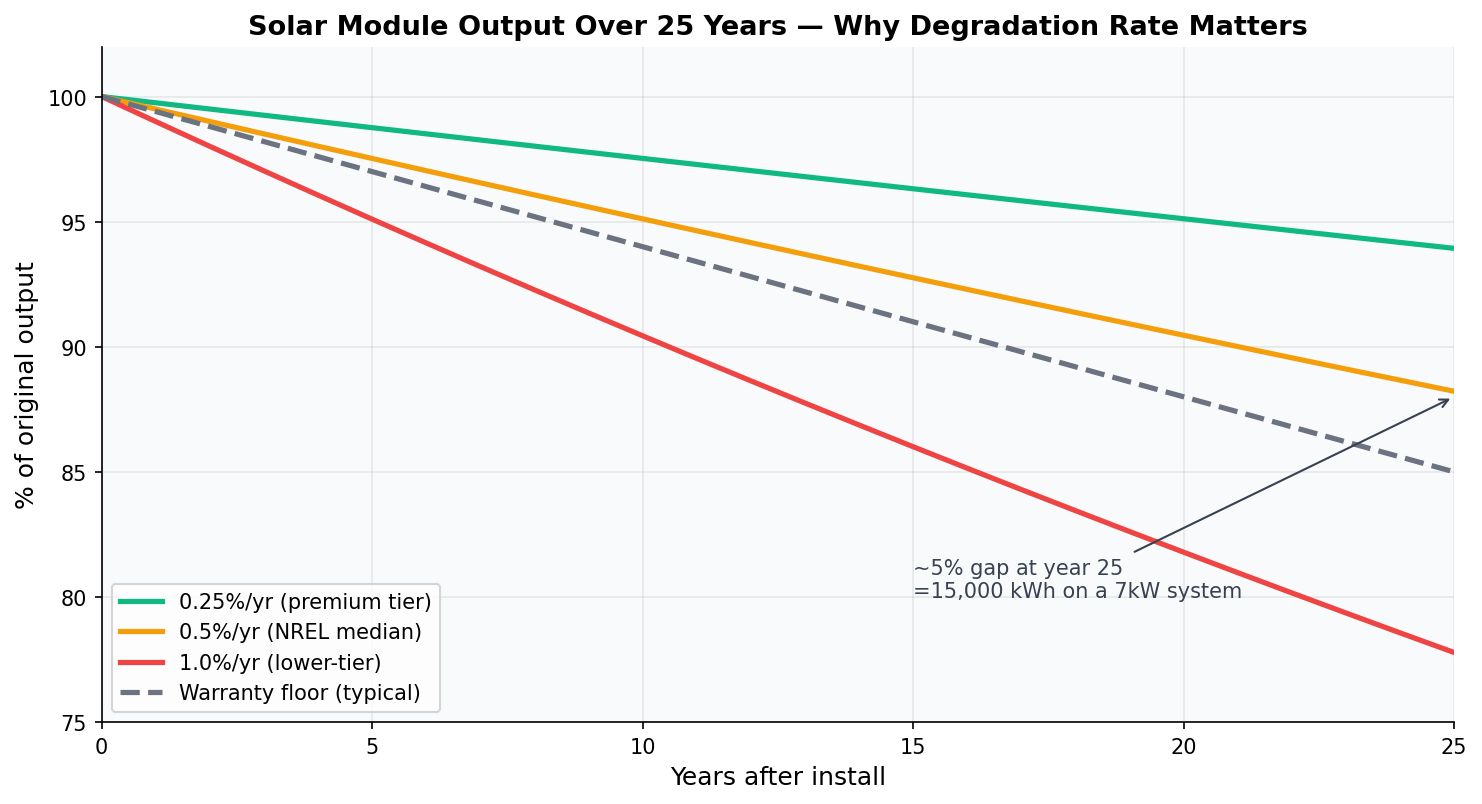
Solar panels are warrantied for 25 years. Most manufacturers guarantee 80–87% of original output at year 25, which implies an average degradation rate of 0.5–0.8% per year. According to NREL's long-running degradation study, the median real-world degradation rate is about 0.5%/year — but the spread is wide. Some modules degrade at 0.2%/year. Some degrade at 1.5%/year.
That spread is the whole game. Here's the math on a 7 kW system in a market with $0.18/kWh retail electricity:
- Year 1 production: ~10,500 kWh (roughly 1,500 kWh per kW in a sunny climate, per NREL's PVWatts)
- Year 1 value: 10,500 × $0.18 = $1,890
- 25-year output at 0.5%/yr degradation: ~247,000 kWh
- 25-year output at 1.0%/yr degradation: ~232,000 kWh
- Difference: 15,000 kWh, or about $2,700 at today's rates — and far more if utility rates keep climbing
Pick the wrong module and you're not getting ripped off in year one. You're getting ripped off in years 15–25, when you've already forgotten which brand you bought.
What the lab tests actually catch
The IEC 61215 and IEC 61730 standards every legitimate residential panel passes are type-approval tests — they confirm the design works under standard conditions. Extended-stress testing, which is what Sinovoltaics' tool helps utility buyers scope, catches things like:
- Potential-induced degradation (PID): Voltage stress can cause some modules to lose 20–30% of output in humid climates. The U.S. Department of Energy identifies PID as one of the most common module failure modes.
- Light-and-elevated-temperature-induced degradation (LeTID): A newer failure mode in PERC cells, with field losses of 5–10% reported by Lawrence Berkeley Lab researchers.
- Backsheet cracking: Some polyamide backsheets fail at 10–15 years instead of 25.
- Cell microcracks: Caused by hail, install handling, or thermal cycling — invisible until output drops.
You probably won't commission a private test lab for a 7 kW residential array. But you can apply the same screening logic when picking equipment.
Three questions a homeowner should ask before signing
1. What's the panel's measured degradation rate — not the warranty floor?
Warranties guarantee a worst-case. Tier-1 manufacturers (Q CELLS, REC, LG legacy, Panasonic, SunPower/Maxeon, Jinko, Trina, Longi, Canadian Solar) typically publish field-tested degradation rates of 0.25–0.40%/year. If the panel a contractor is quoting doesn't have a published, third-party-validated degradation curve, that's a red flag.
2. Is the manufacturer financially solvent enough to honor a 25-year warranty?
A 25-year warranty is worthless if the company is bankrupt in year 8. Per SEIA tracking, the residential solar market has consolidated significantly through 2025–2026. Stick with manufacturers that have been profitable for at least a decade and have a U.S. service entity.
3. Does the panel have a documented PID, LeTID, and salt-mist test rating if you live near the coast?
If your home is within 5 miles of the ocean, ask for IEC 61701 salt-mist corrosion certification. If you're in a humid climate, ask for the manufacturer's PID-resistance test results.
How this maps to your real payback math
Module reliability is one variable. The other big ones are install cost, incentive stack, and electricity rate trajectory. The numbers we see most often in 2026:
- Average installed cost: $2.80–$3.40/W before incentives for owned systems, per EnergySage 2026 marketplace data
- Federal 30% ITC for purchased systems: Expired in 2026. Only third-party-owned systems (leases and PPAs) still qualify, because the credit goes to the owner, which is the leasing company in those structures
- State and utility rebates: Still active in many states (NY-Sun, Mass SMART, Illinois Shines, NJ SuSI). California's NEM 3.0 export rates remain low, which is why batteries are now standard in CA quotes
- Average payback for owned systems (post-ITC): 9–13 years in high-rate states, 12–18 years in low-rate states
The expiration of the federal ITC for purchased systems in 2026 is the single biggest economic shift in residential solar this decade. Run your own numbers carefully — quotes built on 2025 ITC assumptions overstate savings. Our free assessment tool uses current 2026 incentive data.
Where to verify what's actually available in your ZIP
State and utility incentives change quarterly. The DSIRE database (maintained by NC Clean Energy Technology Center) is the most comprehensive public source. EnergyScout's ZIP-code incentive search pulls from DSIRE plus utility-specific filings to show what's currently active in your area, including any battery-only rebates that survived the ITC sunset.
The bottom line
Sinovoltaics' new tool is a small piece of news, but it points at a bigger principle: solar is a 25-year purchase, and the math only works if the equipment performs as advertised. Utility developers have always paid for independent lab testing. Homeowners can't, but they can ask the right questions, pick proven equipment, and run their own payback math with realistic degradation assumptions.
If you want to see what the math looks like for your roof — your roof's actual production potential, your utility's current rate, and the incentives still active in your ZIP — start with our free solar assessment. No phone calls, no pushy follow-ups. Just the numbers.
More Articles
Do Solar Panels Work During a Power Outage?
Most homeowners assume solar panels keep the lights on when the grid goes down. The actual answer surprises people — and the fix is simpler than you think.
Read article Battery StorageChile Hit 75% Solar in March. Here's What U.S. Homeowners Should Take From It
Chile's grid produced 29% of its electricity from solar in March, with peaks at 75%. The bottleneck wasn't generation — it was storage and transmission. Here's the homeowner takeaway.
Read article