380,000 Miles Later: What a Tesla's Battery Tells Solar Homeowners
A 380,000-mile Model 3 just made headlines for keeping its original battery — at the cost of roughly 33% range loss. The same chemistry that powers EVs powers home batteries, so the story is worth a careful look for any homeowner shopping solar storage.
A 2019 Tesla Model 3 Standard Range Plus has crossed 380,000 miles on its original battery pack. According to InsideEVs, the car still drives normally — but the usable range is down roughly a third from new. That is a remarkable durability story and a sober reminder at the same time. Lithium-ion cells age. They age in cars, and they age in the wall-mounted battery sitting in your garage.
If you are considering a home battery to pair with solar, this is the data point worth understanding before you sign anything. The chemistry is similar. The duty cycle is different. The economics depend on knowing both.
The headline number: 33% capacity loss after 380,000 miles
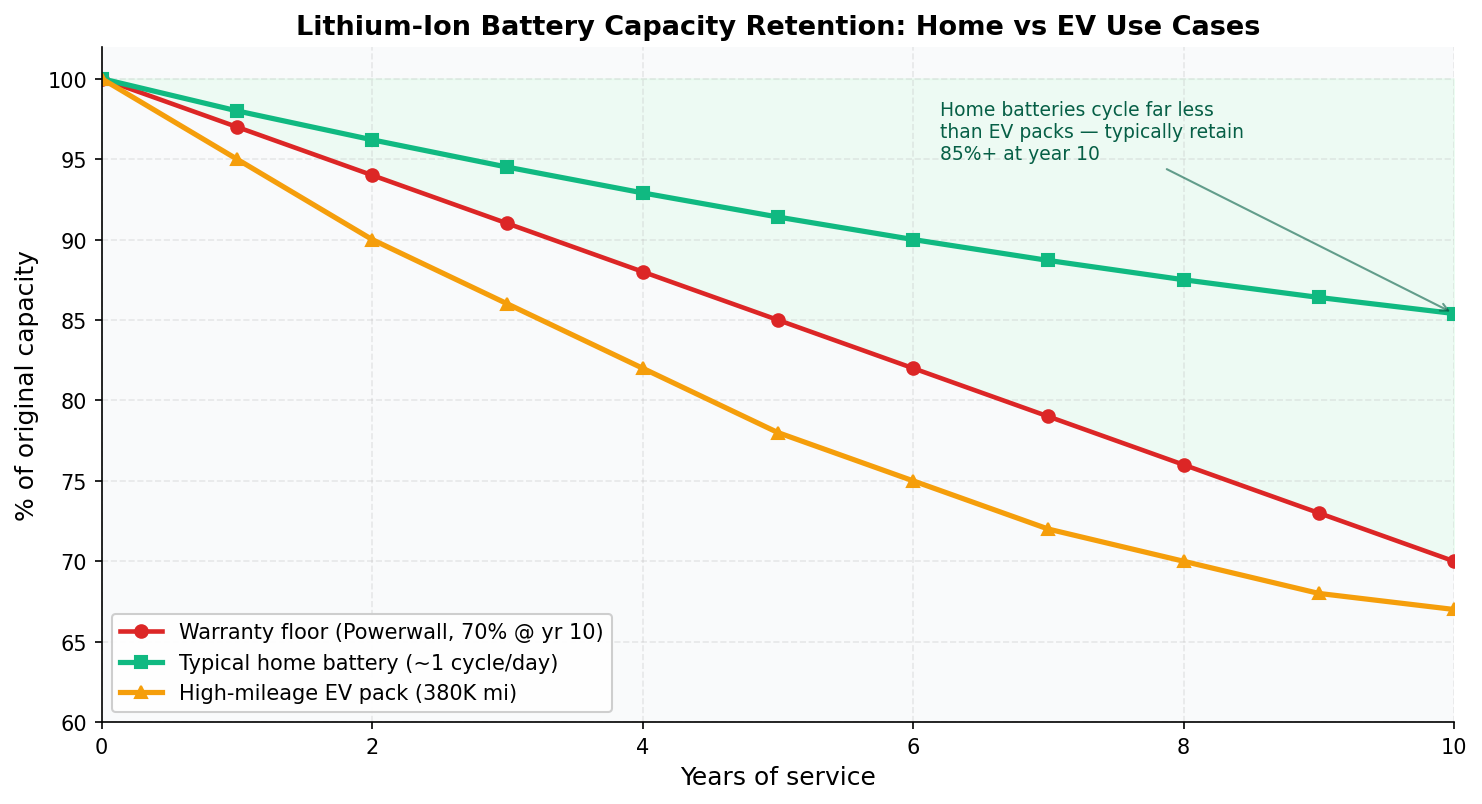
The owner of the high-mileage Model 3 reports usable range has dropped from about 240 miles to roughly 160 miles. That is a 33% reduction in usable energy after roughly 1,200 to 1,500 full cycle equivalents — far more than most home batteries will ever see in their warrantied life.
For context, the U.S. Department of Energy's recent battery durability research shows fleet-average EV degradation of roughly 1.8% per year for modern lithium-ion packs. A 7-year-old Model 3 with 380K miles is well above the average mileage but right in line on percentage loss — the chemistry is doing what chemistry does.
Why this matters for home solar+battery shoppers
The cells inside a Tesla Powerwall, an Enphase IQ Battery, a Franklin aPower, or a SolarEdge Home Battery are the same general family — lithium iron phosphate (LFP) or nickel-manganese-cobalt (NMC) — as those in EVs. The packaging is different and the duty cycle is far gentler, but the aging mechanisms are identical:
- Calendar aging — capacity drops over time even when the battery is sitting idle.
- Cycle aging — each charge/discharge wears the electrodes a little.
- Temperature stress — heat above ~95°F accelerates both forms of aging substantially.
A typical home battery cycles once per day at most, often less. Over 10 years, that is roughly 3,650 cycles — close to what the 380K-mile Tesla has experienced, but spread over a much longer calendar period. The good news: warranties reflect that. Most major home battery warranties guarantee 70% capacity retention at year 10.
What the major warranties actually promise
Reading the warranty before you buy is the single most useful thing a homeowner can do. Here is what the leading residential batteries promise:
- Tesla Powerwall 3 — 10 years, unlimited cycles, 70% capacity retention guaranteed (Tesla warranty PDF).
- Enphase IQ Battery 5P — 15 years or 6,000 cycles, whichever comes first, 60% capacity retention.
- Franklin aPower 2 — 12 years, 70% retention, throughput-based.
- FranklinWH / SolarEdge / LG — typically 10–12 years at 70%.
Translation: even at the warranty's end-of-life threshold, you still have most of your storage. A 13.5 kWh Powerwall guaranteed to 70% means at least 9.45 kWh of usable capacity at year 10 — enough to run a refrigerator, lights, and Wi-Fi for well over 24 hours during an outage.

The math: what a third of capacity loss would actually cost
Let us run the numbers the way you should run them on your own home. A typical solar+battery setup:
- 10 kWh battery (similar to Powerwall 3 at 13.5 kWh, or two stacked Enphase 5P units)
- Average residential electricity rate: $0.17/kWh nationally per EIA (over $0.30 in California, Hawaii, parts of New England)
- Daily cycling for self-consumption arbitrage: 3,650 cycles over 10 years
At 100% capacity, that battery shifts about 3,650 × 10 kWh = 36,500 kWh over its warrantied life. At a $0.17/kWh retail-vs-export spread, that is roughly $6,200 of value over a decade.
Now apply the Tesla-style 33% degradation. If average usable capacity over the life of the battery is closer to 85% (starting at 100%, ending around 70%), lifetime throughput drops to about 31,000 kWh, or $5,270 of arbitrage value. The degradation costs you roughly $930 over 10 years, or $93/year. Worth knowing — but not a deal-breaker if the system is sized correctly up front.
You can run these numbers for your own home with our free solar + battery assessment tool. It pulls NREL solar production data for your address, your local utility rate, and the actual incentive stack for your ZIP.

Three things the Tesla story actually proves
1. Modern lithium-ion is durable. 380,000 miles on the original pack would have been laughable in 2010. Battery management systems, thermal control, and chemistry refinements have pushed cycle life dramatically higher. Lawrence Berkeley National Laboratory's Tracking the Sun reports that residential storage systems installed since 2020 are showing meaningfully better real-world degradation curves than older fleets.
2. Degradation is gradual, not catastrophic. A battery does not fail at year 10 like a lightbulb. It slowly does less. A homeowner who sized their battery to cover a 6 kWh evening load with a 10 kWh battery on day one will still cover that 6 kWh load on year 9 — just with less reserve.
3. Warranty math beats marketing math. The retention percentage in the warranty is what you should plan around. Anything beyond that is upside.
How to size a battery so degradation doesn't bite
The simplest rule: size for end-of-warranty capacity, not nameplate. If you need 7 kWh of evening backup and the battery's warranty is 70% at year 10, divide: 7 ÷ 0.70 = 10 kWh nameplate. That gives you headroom for the entire warrantied life without scrambling later.
Other practical moves:
- Avoid hot garages where possible. Most home batteries are rated for –4°F to 122°F operation, but cell life drops fast above ~95°F. A shaded north wall or conditioned utility room is ideal.
- Keep state-of-charge between 20% and 90% in daily use. Most home battery management systems do this automatically; do not override unless you have a specific outage to prep for.
- Stack two smaller units instead of one giant one. Modular systems (Enphase, Franklin, Tesla Powerwall 3 with expansion) let you add capacity later as load grows or as one unit ages.
What about incentives in 2026?
Worth saying clearly: the federal residential 30% Investment Tax Credit for purchased solar and battery systems expired at the end of 2025. Leases and PPAs still qualify under the commercial ITC structure, which is why several national installers have shifted heavily into third-party-owned models.
State and utility incentives, however, are alive and growing — California's SGIP, Massachusetts' SMART program, New York's NY-Sun, and dozens of utility-specific battery rebates can stack to thousands of dollars. We track the live incentive map at our incentives ZIP search tool.

The bottom line
A 380,000-mile Tesla losing a third of its range is not a horror story — it is a usefully concrete data point. It tells home battery shoppers that lithium-ion holds up far longer than people expect, that degradation is gradual and predictable, and that the warranty number is the one you should plan against. Size for end-of-warranty capacity, read the warranty PDF before you sign, and let the math drive the decision.
If you want to see what a properly sized solar+battery system would actually cost and save at your address — including warranty-adjusted economics, your local incentive stack, and quotes from vetted installers — you can start a free EnergyScout assessment. No sales calls, no pressure, just the numbers.
Sources: InsideEVs, U.S. Department of Energy, Energy Information Administration, Lawrence Berkeley National Laboratory, Tesla, Enphase, California SGIP.
More Articles
Do Solar Panels Work During a Power Outage?
Most homeowners assume solar panels keep the lights on when the grid goes down. The actual answer surprises people — and the fix is simpler than you think.
Read article Battery StorageChile Hit 75% Solar in March. Here's What U.S. Homeowners Should Take From It
Chile's grid produced 29% of its electricity from solar in March, with peaks at 75%. The bottleneck wasn't generation — it was storage and transmission. Here's the homeowner takeaway.
Read article